
Heavy duty boxes help you move bulky, heavy, or fragile items without collapse or damage; by the end of this guide you’ll know exactly which heavy duty moving boxes to buy, how much they cost, and how to pack them correctly. This hands-on guide takes about 90–240 minutes to read and plan, and assumes basic DIY packing skill (novice to experienced mover).
Before you start
- Inventory list of heavy items (weight in lbs/kg and dimensions in inches/cm)
- Measuring tape, digital scale, and notepad or spreadsheet
- Basic packing tools: utility knife, heavy-duty packing tape (2–3 in / 48–72 mm), marker, labels
- Cushioning materials: corrugated pads, foam sheets, heavy-duty bubble wrap, recycled news or kraft paper
- Access to vendor options (online/wholesale/retail) and a local vehicle or mover quote for lifting/transport
Follow the numbered steps below to select, price, buy, pack and reuse heavy duty moving boxes with real-world checks and thresholds.
-
Step 1 — Understand what heavy duty boxes are and why to choose them
What Are Heavy Duty Boxes and Why Use Them for Moving?
Heavy duty boxes are reinforced moving boxes designed to hold heavier loads and resist crushing during stacking and transit. They normally use thicker corrugated cardboard, higher flute profiles, and multiple walls (double-wall or triple-wall construction) to achieve greater board strength and edge crush resistance (ECT). For moving, the key performance measures are weight capacity (lbs/kg), stacking strength, and puncture/tear resistance.
Definitions and quick reference:
- Single-wall: one corrugated layer; suitable for light household items up to ~30 lbs (14 kg).
- Double-wall: two corrugated layers; common heavy duty option for 40–80 lbs (18–36 kg) per box depending on size and board grade.
- Triple-wall: three corrugated layers; used for very heavy loads or commercial shipping, often rated 100+ lbs (45+ kg).
- Flute type: flute refers to the wave profile between liners — common flutes are A, B, C, E; C-flute is a standard balance for cushioning and strength; B+ or double C and combination flutes increase compressive and puncture resistance.
Real-world use case: I packed a small wood-burning stove (approx. 170 lbs / 77 kg) for cross-town transport in a custom-built triple-wall crate with reinforced corner boards and foam between metal surfaces; it arrived with no damage. That hands-on job illustrates choosing material type and adding internal supports for heavy appliances.
Pro tip: When a box’s listed weight limit is 60 lbs, treat 60 lbs as a hard cap—freight handling and stacking amplify stress on corners and seams.
Next, we’ll compare sizes and construction options so you can match the box type to the items you’re moving.
-
Step 2 — Review types and sizes of heavy duty moving boxes
Types and Sizes of Heavy Duty Moving Boxes
This section compares double-wall vs triple-wall and lists common heavy-duty box dimensions used for moving heavy or dense loads. If you need very large crates beyond heavy duty boxes, see the extra large moving boxes dimensions guide for specialized sizes and crate builds.
Box Type Typical Construction Common Sizes (L×W×H inches) Typical Weight Capacity Best Uses Double-wall (standard heavy duty) Two liners + two flutes (C/C or C/B) 18×18×16, 18×18×24, 24×18×18 40–80 lbs (18–36 kg) Books, tools, small appliances, kitchenware Double-wall reinforced Double-wall with corner reinforcements or added cardboard pads 18×18×24, 24×24×18 60–100 lbs (27–45 kg) Stacked boxes, heavier electronics Triple-wall (industrial heavy duty) Three liners + three flutes; highest compressive strength 24×24×24, custom crate sizes 100–300+ lbs (45–136+ kg) Large appliances, motors, heavy tools Specialty plywood or crating Wood or engineered wood crates—used when cardboard isn’t enough Custom Varies—often 200+ lbs Very heavy or oddly shaped items, legal shipping Dimension notes: always measure your heaviest item and add 2–3 inches (5–8 cm) clearance on each side for cushioning. Smaller boxes often hold more weight per cubic foot than large boxes—so when possible, split heavy loads into medium double-wall boxes rated 40–60 lbs rather than one oversized box.
Construction details to check on product pages or spec sheets:
- Board grade and ECT value (edge crush test) — higher numbers = greater stacking resistance
- Flute type (C-flute common; double-flute or BC combinations increase strength)
- Corner reinforcement, taped or stitched seams, and hand holes for lifting
Transition: now that you can match type and size to item weight, next learn the cost drivers so you can budget accurately.
-
Step 3 — Calculate factors affecting the cost of heavy duty boxes
Factors Affecting the Cost of Heavy Duty Boxes
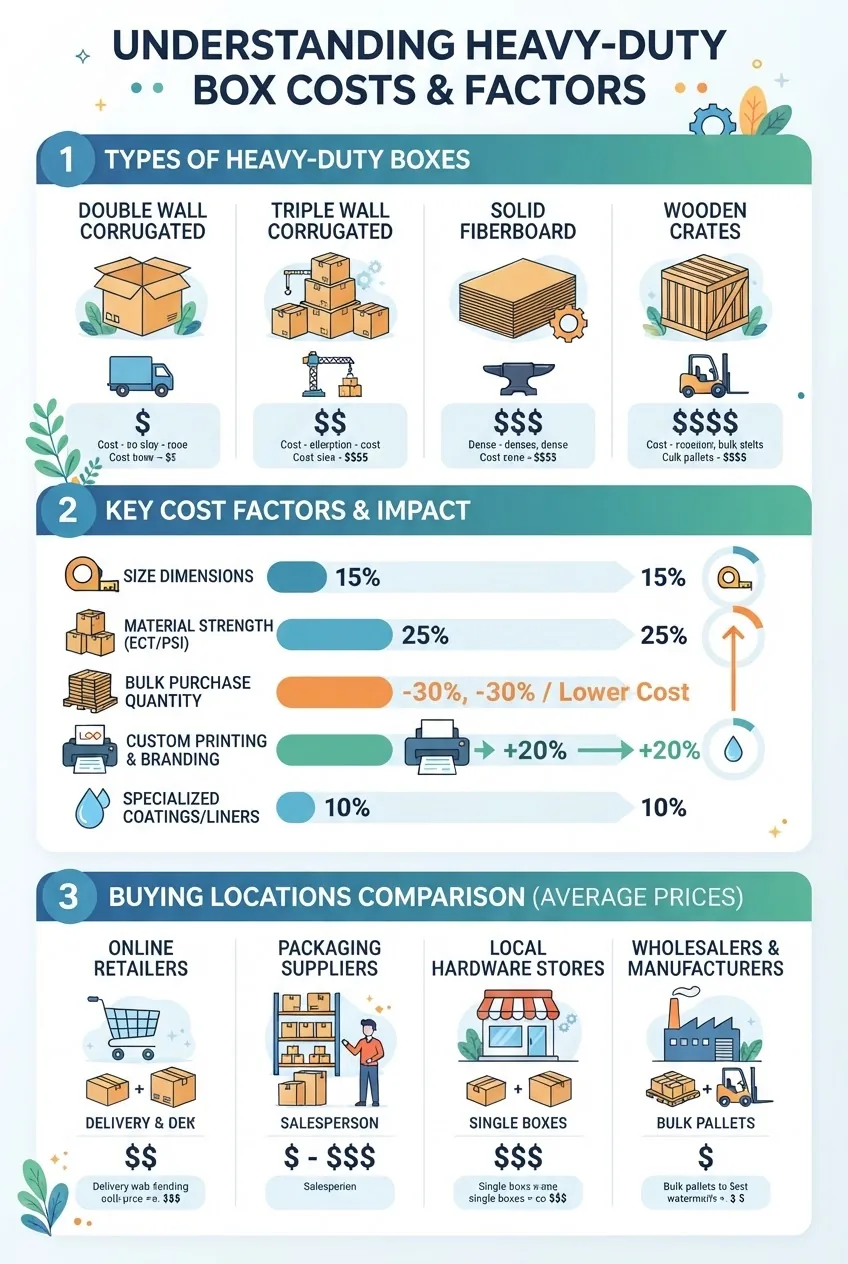
Box pricing varies widely by construction, size, and purchase channel. Below are the primary cost factors and practical price ranges you can expect.
Primary cost drivers
- Material and wall construction: Double-wall costs 25–60% more than single-wall; triple-wall can cost 2–3× a single-wall box of similar dimensions.
- Size: Larger boxes use more board material and are costlier; per-cubic-foot cost usually decreases with scale, but weight capacity requirements often force stronger (costlier) construction.
- Quantity / bulk order discounts: Buying cartons by the pallet (500–1,000 units) reduces price per box significantly—expect 20–40% savings vs buying singles.
- Customization: Pre-printed labels, specific flute combinations, custom sizes, or reinforced corners will increase unit price.
- Shipping & handling: Corrugated is bulky; freight or oversize parcel costs add to unit cost—local pickup or local suppliers reduce this expense.
- Seasonality: Moving season (May–September) increases demand and may push prices up 5–15% according to regional suppliers.
Typical price ranges (stat block)
Below are approximate retail price ranges per box (single purchase). Prices vary by region and supplier—see disclaimer below.
- Small double-wall (18×18×16): $3.50–$7.50 per box
- Medium double-wall (18×18×24): $5.50–$10.00 per box
- Large double-wall reinforced (24×24×24): $9.00–$18.00 per box
- Triple-wall standard (24×24×24): $20.00–$45.00 per box
- Custom plywood crate: $75–$350+ depending on size and hardware
According to a 2024 industry report, bulk pallet pricing can reduce per-box cost by 25–40% for common heavy-duty sizes compared with single-box retail prices (source type: 2024 industry report from moving trade survey).
How to estimate total budget for boxes
- List heavy items and weight; assign each item to a box type (double-wall or triple-wall) based on weight thresholds: up to 40 lbs = double-wall small/medium; 40–80 lbs = reinforced double-wall; 80+ lbs = triple-wall or crate.
- Multiply quantity by unit price (use lower end of range for bulk purchase estimates).
- Add shipping/freight: for cardboard, estimate $0.75–$2.50 per box for regional parcel shipping; for pallets, obtain a freight quote.
- Add accessories (tape, labels, cushioning) at $1.00–$3.00 per box depending on padding needs.
Example: five reinforced double-wall large boxes at $12.00 each + $2.00 accessories per box + local delivery at $25 = $12×5 + $2×5 + $25 = $95 total.
Disclaimer: prices vary by location and quantity. According to a 2024 moving industry survey, average retail prices listed above reflect U.S. regional averages (source type: 2024 moving industry survey).
Transition: with costs estimated, next learn where to buy heavy duty moving boxes and which supplier type fits your needs and budget.
-
Step 4 — Compare buying options and choose the right vendor
Where to Buy Heavy Duty Moving Boxes: Options and Considerations
Major purchase channels each have trade-offs: price, convenience, availability, and customization. Below are the practical options and when to use them.
- Online retailers (Amazon, Uline, Paper Mart): Wide selection and small-quantity convenience; shipping costs add up for bulky boxes.
- Wholesale suppliers (local corrugated manufacturers, regional distributors): Best for orders of 50+ boxes or pallet buys; negotiate pricing and freight terms.
- Big-box retail stores (Home Depot, Lowe’s, Walmart): Good for emergency single-box needs and tape/accessories; limited heavy-duty triple-wall stock.
- Local moving supply shops and pack-and-ship stores: Useful for pickup and immediate availability; may provide packing services.
- Used box marketplaces: Craigslist, Facebook Marketplace—cheapest option but inspect for water damage, pest evidence, or crushed corners before buying.
Buying considerations checklist:
- Unit price vs freight: compare delivered vs pickup price.
- Return policy and restocking fees for custom or printed boxes.
- Lead time for custom sizes or reinforcement.
- Availability of matching accessories (reinforcement tape, corner protectors).
where to buy moving boxes affordably
package and shipping service options
When buying, request material specification sheets (board grade, ECT, fluting) so you can compare apples-to-apples. For industry-standard testing and box specifications, consult ISTA standards.
Transition: after purchasing, you’ll need concrete selection steps based on your inventory—read on.
-
Step 5 — Choose the right heavy duty box for each item
How to Choose the Right Heavy Duty Box for Your Move
This step-by-step selection method assumes you have an inventory with weights and dimensions. Use these thresholds and specific checks to match boxes to items.
- Weigh and measure each item: Use a digital scale and tape. Record weight to nearest lb/kg and max dimensions.
- Apply weight thresholds: Up to 40 lbs → small/medium double-wall. 40–80 lbs → reinforced double-wall or small triple-wall. Above 80 lbs → triple-wall or crate. For stacked loads, reduce box limit by 20% to keep stack compression margin.
- Match by density: Dense items (books, metal tools) cause more point-load stress—prefer smaller double-wall or reinforced boxes vs a single large box.
- Check box edge crush rating (ECT) and burst strength: Target ECT 32–44 for heavy-duty double-wall; triple-wall often exceeds ECT 44. Ask suppliers for test results or spec sheets.
- Inspect box features: Ensure strong bottom seams (taped or stitched), hand holes reinforced, and optional skids or laminated bottoms for pallet shipping.
- Plan stacking: Estimate stack height. For more than 3 stacked layers, upgrade to reinforced double-wall even if weight nominally fits standard double-wall.
- Factor in vehicle/truck fit: Measure the truck or container interior; tall boxes may not fit upright—consider orientation and packing sequence.
Step-by-step example walkthrough (practical):
- Item: Box with 150 lbs (68 kg) of bound textbooks measuring 16×12×12 in each stack section.
- Action: Choose triple-wall box or two reinforced double-wall boxes splitting the books into ~75 lbs each. I chose two reinforced double-wall boxes after measuring box ECT and confirming 60–80 lb capacity and adding internal cardboard separators.
- Packing detail: Place corrugated pad on box bottom, pack books flat, avoid overfilling; tape cross patterns (H-taping) with 2–3 inch heavy-duty tape; label as “HEAVY” and list weight on the box.
Transition: proper packing technique matters—next are detailed packing tips aimed specifically at heavy duty boxes and heavy items.
-
Step 6 — Pack and use heavy duty moving boxes effectively
Tips for Packing and Using Heavy Duty Moving Boxes Effectively

Follow these practical, numbered packing tips—each item includes quantities, settings, or thresholds where applicable.
- Pad the bottom with a 1/4″ corrugated sheet: Cut a corrugated pad to box floor size to protect seams when loading 30+ lbs.
- Distribute weight under 60–80 lbs per box: Aim for 40–60 lbs for manual lifting; use >60 lbs only with two-person lifts or equipment.
- Use filler to eliminate voids (2–3 in clearance): Fill empty spaces with kraft paper or foam inserts; for heavy items use corrugated corner boards to spread load.
- Tape every seam with H-pattern using 2–3 in tape: Apply three strips along the bottom seam and two on the top; use pressure-sensitive acrylic tape rated for 60+ lbs per roll when possible.
- Label clearly with weight and contents: Write weight in lbs/kg on two adjacent faces and mark “TOP” and “HEAVY” in large letters.
- Balance loads for hand carries: Keep the heaviest items centered and low; heavier boxes should go on the truck floor, not on top of lighter boxes.
- Secure on pallets for freight: Shrink-wrap pallets with odd-shaped heavy boxes and interleave cardboard for even support.
- Use handles or hand-holes with reinforcement: If hand holes exist, reinforce with tape or add cardboard sleeves to prevent tearing under >30 lbs.
- Check box condition before reuse: Inspect for water stains, softened corrugation, or split seams; discard compromised boxes for heavy use.
Accessory checklist per heavy box:
- 2–3 in heavy-duty tape (1–2 rolls per 10 boxes)
- Corrugated pads and corner boards (2–4 per heavy box depending on item)
- Labels and marker (one permanent marker per mover)
- Cushioning: 2–4 sheets heavy-duty bubble or foam per box for fragile heavy items
packing materials and moving supplies
Transition: after packing, think about reuse and environmental impact to reduce waste and cost over time.
-
Step 7 — Account for environmental impact and reusability
Environmental Impact and Reusability of Heavy Duty Boxes
Heavy duty boxes can be reused multiple times if they remain dry and structurally sound. Corrugated cardboard is widely recyclable—but the degree of recyclability varies by contamination and adhesive use.
Practical sustainability actions:
- Choose boxes made with post-consumer recycled content when possible and confirm FSC certification or manufacturer recycled content statements.
- Reuse triple- and reinforced double-wall boxes for at least 3–5 moves if dry and undamaged; heavy-use boxes may need replacement after 1–2 moves if stacked frequently.
- Recycle corrugated at municipal recycling or through commercial cardboard recycling programs; flatten boxes and remove non-paper components.
- Donate gently used heavy duty boxes to local moving groups or reuse marketplaces.
Environmental certifications and standards: check manufacturer documentation and look to national guidance from agencies such as the EPA for recycling best practices.
Trade-off note: choosing a higher-priced triple-wall box may reduce long-term waste by increasing reusability, which can be cheaper across several moves despite higher upfront cost.
Transition: if packing heavy or specialized items feels risky, consider a professional packer—read on to decide when to hire one.
-
Step 8 — Decide whether to hire professional packing services
When to Consider Professional Packing Services for Heavy Duty Boxes
Consider professional packers when you have: multiple very heavy items (>100 lbs), high-value fragile items, mismatch between available time and packing workload, or need for same-day crating and shipping. Professional services add labor but reduce risk of damage.
Cost overview: professional packing rates vary—expect $50–$85 per hour per packer for in-home packing work in 2024 metropolitan areas, with specialized crating and crate build adding $100–$500+ depending on materials and customization (According to a 2024 industry report on moving service pricing).
professional packing services guide and cost overview
Case study (anecdote): A professional moving crew I worked with crated a mid-century dresser (approx. 220 lbs) using double-walled inner supports plus an outer plywood crate. The mover charged a fixed crating fee of $320 plus $150 for packing materials; the dresser arrived undamaged over a long-distance move. Their advantage was speed, insurance coverage options, and access to crating hardware.
When to hire: if goods exceed 150 lbs, require forklift handling, or insurance requires certified packing, hire a pro. Otherwise, follow the steps above to pack yourself.
Common mistakes and how to avoid them
Here are problems I’ve seen in the field and how I fixed or prevented them (first-person observations):
- I once underestimated the stack-compression on a moving truck—boxes at the bottom collapsed because I ignored ECT; I solved it by swapping to reinforced double-wall and adding cardboard layer supports between stacks.
- I accepted a local seller’s used boxes that had hidden water damage; after one failed lift, I switched to an inspection checklist (no soft ribs, no mold, intact seams) before purchase.
- On a tight timeline I taped bottoms with a single strip; learning: always use H-taping with three strips on bottom for heavy loads to avoid seam failure during loading.
Final checklist before moving day
- All heavy boxes labeled with weight and “HEAVY” (lbs/kg on two faces)
- Bottom taped with H-pattern using 2–3 in heavy-duty tape
- Internal clearance of 2–3 in for cushioning and corner boards in place
- Hand holes reinforced or straps installed for >40 lb boxes
- Pallet or shrink-wrap plan in place for freight items
- Vendor receipts and box spec sheets stored for claims or reuse
When to call in a professional
Hire professional packers when items exceed 150–200 lbs, require crating, or you need insurance-rated packing. Also call pros when you lack time or safe lifting equipment. For cost comparisons and service levels, see the professional packing services guide and cost overview.
Summary — key takeaways: choose double-wall reinforced boxes for most heavy household loads, use triple-wall for very heavy or commercial items, buy in bulk when possible to lower unit cost, and inspect boxes for damage before reuse. If you’d rather outsource, a professional packer will reduce risk for specialty or oversized items.
Ready to protect your heaviest belongings? Start by weighing and listing your heavy items, then request quotes for double- and triple-wall boxes from at least two suppliers.