By the end of this guide, you will have a step-by-step plan to shop The Container Store King of Prussia PA for a move or temporary storage project, know where to park and what to buy, and how to combine products with portable rentals. Expect to read and act in 90–180 minutes; skill level required: basic to intermediate shopper/DIY mover.
The Container Store King of Prussia PA is covered throughout with practical directions, in-store workflows, and decision thresholds so you can leave the store ready to pack, stage, or ship.
Before you start
- Bring a rough inventory: count large furniture pieces and number of boxes you expect to pack (e.g., 20 small boxes, 10 medium, 8 large).
- Measure critical spaces: closet width, shelf depths, and door clearances in inches.
- Tools: tape measure, phone for photos, notepad, list of must-haves (labels, moving boxes, bubble wrap).
- Timing: visit during weekday mid-afternoon for lower crowds; allocate 60–120 minutes in-store.
- Budget: set a ceiling (example: $150–$600) based on move size; print or save coupons or rewards info if available.
Overview of The Container Store King of Prussia PA
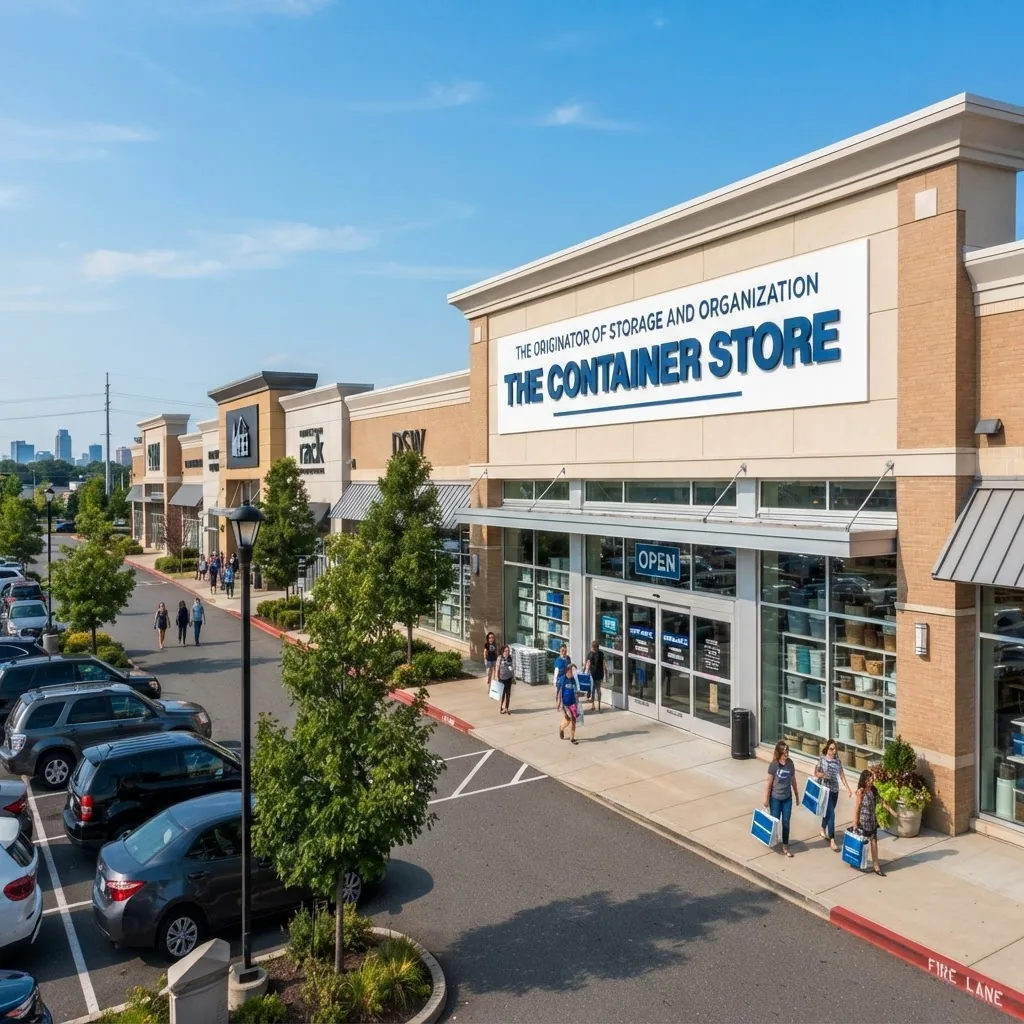
This section gives a concise local snapshot so you know exactly what to expect before driving to the plaza near the King of Prussia Mall.
- Location: The Container Store King of Prussia PA sits in a shopping plaza on the outskirts of the King of Prussia shopping center, within easy driving distance of the King of Prussia Mall and major arteries (I‑76 / US‑202).
- Store hours (As of 2024): Mon–Sat 10:00 AM–9:00 PM, Sun 11:00 AM–7:00 PM. Call the store to confirm holiday hours.
- Contact: Phone: (local store number—call to confirm stock). For the most current contact use local business listings or the brand’s store locator.
- Parking: Free customer parking in the plaza lot; short walk to store entrance. See the Accessibility & Parking section below for details.
- Nearby: King of Prussia Mall is within a short drive/walk—useful for combining errands or getting lunch while waiting for custom orders.
According to a 2024 industry report on retail shopper behavior, planning a store visit reduces repeat trips by 40%—so use the checklist above and this guide to shop efficiently (source: retail industry trade summary).
Transition: the next section walks the store layout and product categories so you can find the right storage bins, boxes, and modular systems without wasting time.
In-Store Departments and Product Offerings at The Container Store KOP
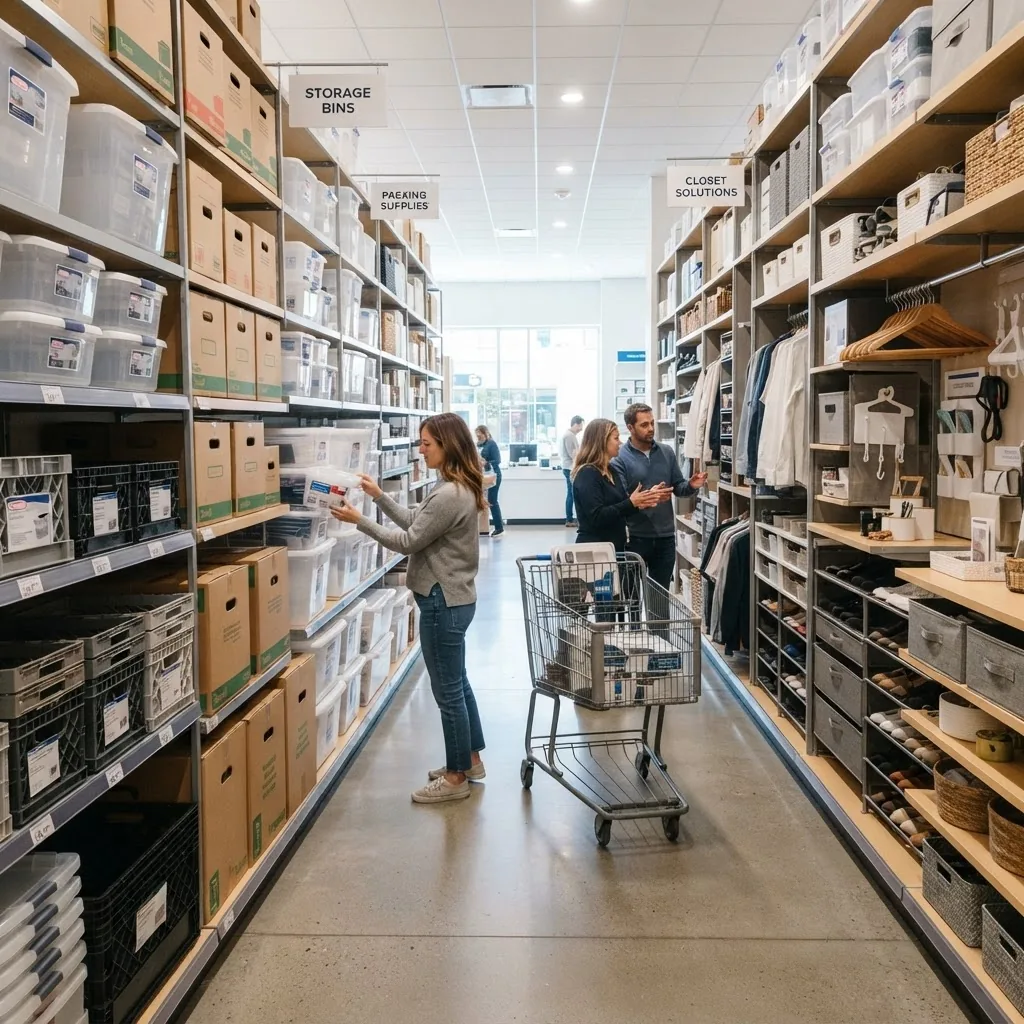
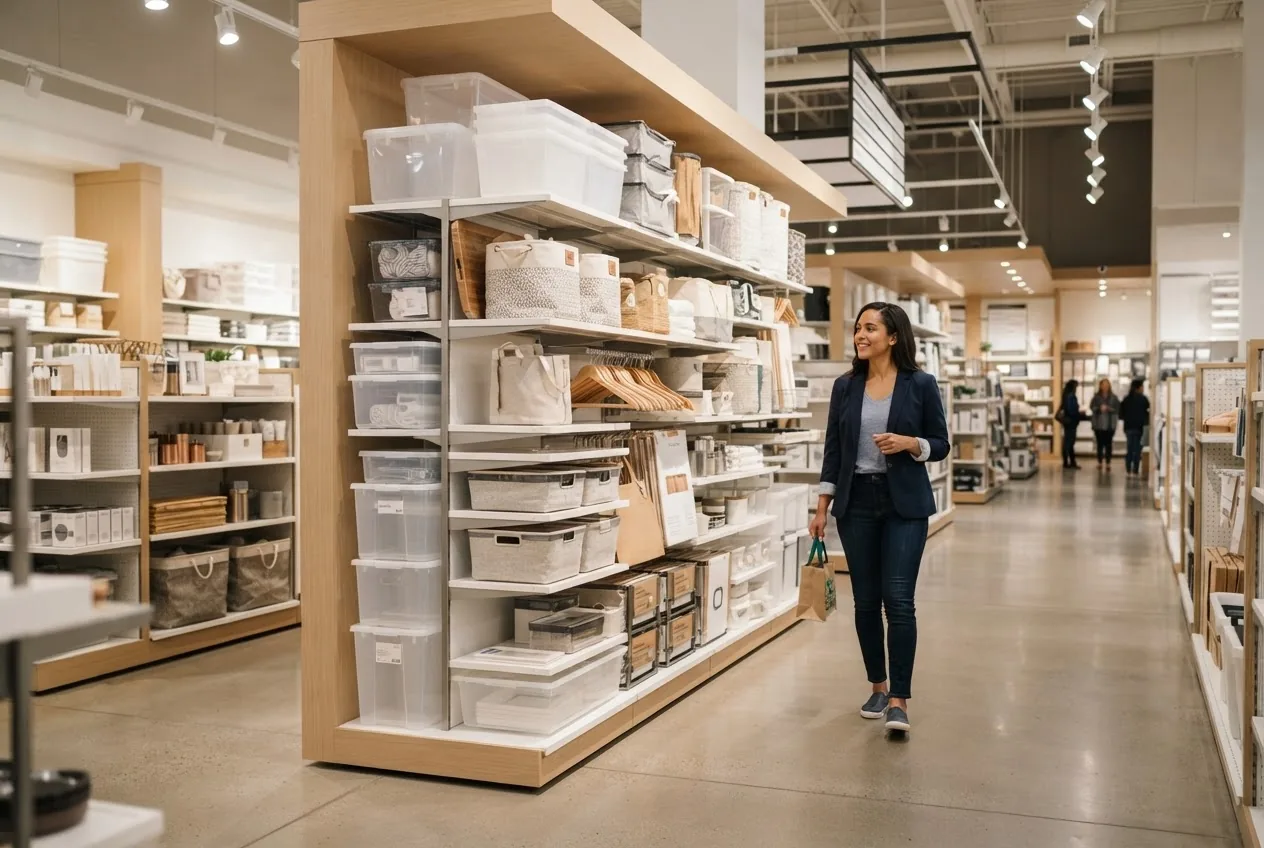
The Container Store King of Prussia PA organizes its footprint into clear departments. Below I list each department, typical SKU examples, their best uses, and purchase thresholds to watch for during a move.
-
Closet & Wardrobe Organization
What you’ll find: modular closet systems (shelves, hanging organizers), slim hangers, pull‑out drawers, clear shoe boxes. “Organization systems” here means modular kits that combine shelving and drawers to refit closet interiors.
Best uses: Closet staging while packing seasonal clothes—buy sizes that match your closet depth (measure 12″, 16″, 24″). For example, use 12″ deep shelving for shirts and 24″ for folded sweaters.
Purchase tip: Start with one modular kit per closet (typical kit covers a 40–60″ width) and add accessories as needed.
-
Packing & Moving Supplies
What you’ll find: moving boxes (small/medium/large), wardrobe boxes, dish boxes, bubble wrap, edge protectors, tape, and tape dispensers. Look for dedicated moving kits labeled “moving essentials.”
Best uses: Wardrobe boxes for hanging clothes (use with moving bar), dish boxes with inserts for fragile kitchenware, and plenty of bubble wrap for electronics.
moving bins rental guide for convenient storage and transport
-
Boxes, Bins & Clear Storage
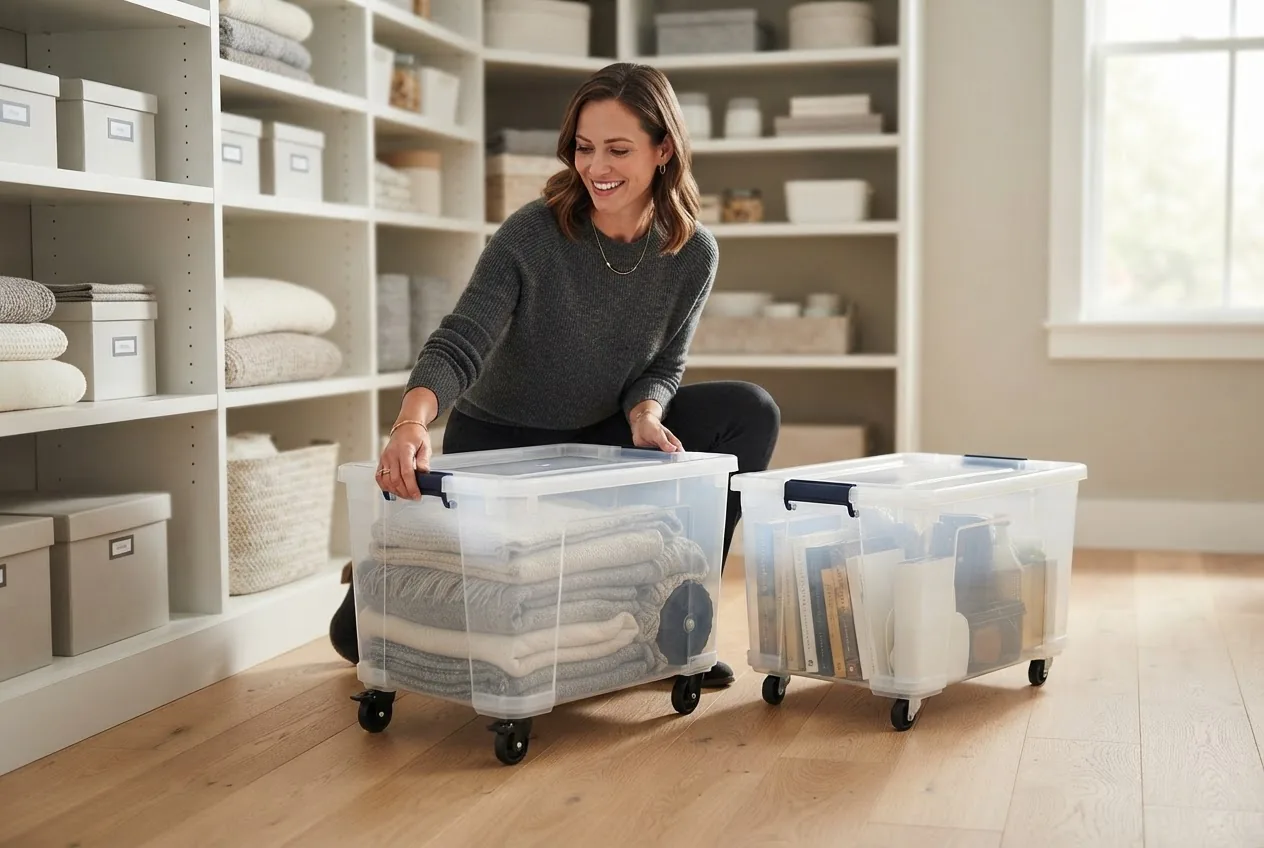
What you’ll find: plastic storage bins (lidded and clear), stackable tubs, drawer organizers, and clear cube storage. Bins are sold in sizes—commonly 12x16x10″, 18x24x12″, and 24x16x16″.
Best uses: Clear bins for seasonal decor, labeled tubs for paperwork, and stackable tubs for garage storage.
Container Store Storage Boxes Guide for Efficient Organization
-
Shelving & Garage Systems
What you’ll find: adjustable shelving units, heavy‑duty metal racks, wire shelving, and freestanding units sized 24″–48″ wide. “Modular shelving” indicates systems you can stack or expand.
Best uses: Use heavy‑duty metal racks for moving preparation areas (tool kits, paint, and seasonal gear). Match load capacity (ex: 200–800 lbs per shelf) to intended storage.
-
Labeling & Small Accessories
What you’ll find: labels, label makers, packing tape, permanent markers, and color‑coded tags. Labels are a high-ROI purchase; buy one label maker per move.
Best uses: Use 2″ wide labels for box faces and color tags for room assignments (red = kitchen, blue = bedroom).
-
Specialty Organization: Office & Tech
What you’ll find: cable management kits, monitor stands, desk drawer dividers, and file systems. These small items reduce set‑up time in a new home or temporary unit.
Best uses: Pack cables in labeled zip pockets, bring drawer dividers for immediate function in a temporary space.
-
Closet Customization & Design Tools
What you’ll find: closet design kits, in-store measuring aids, and samples to try before you buy. The store often carries shelf samples and modular demo units.
Storage Bins with Wheels Buying Guide and Usage Requirements
Practical buying thresholds and quantities
- Small move (studio/1BR): typical basket—10 small boxes, 10 medium, 4 wardrobe boxes, 4 large bins for seasonal storage (budget $150–$350).
- Medium move (2–3BR): 20–40 boxes, 2–4 wardrobe boxes, 6–12 large tubs, one shelving unit for staging (budget $350–$700).
- Large move (4+BR): scale linearly—order triples or buy in bulk kits; consider combining store purchases with rental moving containers to reduce repeated trips.
Stock and availability note: As of 2024, inventory can vary by local store; call the King of Prussia location before buying large items or placing custom closet orders. According to a 2024 retail fulfillment report, in-store availability for larger modular units is subject to regional warehouse stock levels.
Transition: next, learn how to convert these products into an efficient moving and temporary storage workflow.
How The Container Store King of Prussia Supports Moving and Temporary Storage Needs
This section gives step-by-step workflows and example timelines for preparing for a local move, a long‑distance move, and staging into a temporary portable storage container.
-
Plan your packing by room (Day −14 to −7)
Inventory major items and sort into three stacks: keep, donate/sell, discard. For each room, estimate box counts: kitchen (30–60 small/med), living room (10–20 mixed), bedroom (10–30). Use clear bins for seasonal items to reduce opening time in storage.
-
Buy essential moving supplies (Day −7 to −3)
At The Container Store King of Prussia PA, pick up moving boxes, wardrobe boxes, bubble wrap, and tape. Use the following checklist for quantities per household size:
- Studio/1BR: 10 small, 10 medium, 4 large, 2 wardrobe boxes, 1 roll 48mm packing tape, 200 ft bubble wrap.
- 2–3BR: 20 small, 20 medium, 10 large, 4 wardrobe boxes, 2 rolls 48mm tape, 500 ft bubble wrap.
- 4BR+: scale by room; add 1–2 shelving units for staging and 8–12 large bins for high-value items.
Label every box with destination room and priority (1–3). Use color-coded labels or a label maker for fast sorting at unloading.
-
Stage a loading area (Day −3 to Day 0)
Use a shelving unit or racks near the entry to stage packed boxes by priority load order. Heavy boxes (books, plates) go on the bottom; light/fragile items on top—standard packing rule: under 50 lbs for any single box. Use moving straps and hand trucks for heavy items (store sells those). If using a portable storage container, measure door height—most 20′ containers have 7’9″ clearances; confirm before buying large furniture removers.
-
Load into rental containers or a moving truck
When you combine Container Store products with a moving container or truck, load by room and keep a quick-access “first-night” box (toiletries, a change of clothes, basic kitchenware). Use labeled bins for boxes that will go into long-term temporary storage.
ship container rent options and portable storage costs guide
-
Store and retrieve: compatibility checklist
When placing items in a portable storage container or self-storage unit, follow these rules:
- Place shelving units along walls to maximize vertical space.
- Stack clear bins with labels facing the aisle; keep a 2–3 ft walkway for access.
- Keep fragile boxes in the center of the stack, cushioned by soft items (bedding).
If you plan to ship with freight containers, consult professional moving standards (see freight guide reference below).
-
Unpack smart: immediate priorities
When unloading at a new place or temporary unit, unpack the first-night box and essential kitchen items first. Setup a temporary closet using hanging organizers and bins labeled “daily” to avoid opening every box.
-
Example workflow for a 2BR local move (timeline)
Day −14: inventory and donate. Day −7: buy packing supplies at KOP. Day −3: pack non-essentials. Day −1: pack essentials. Day 0: load and move. Day +1: unpack essentials, assemble shelving and closets.
Practical trade-offs and decision points
- If you need repeated access to stored items during a short-term job, use clear bins and place them near the container door; this increases retrieval speed at the cost of slightly higher volume than vacuum‑seal bags.
- For long-term storage, vacuum-seal clothes and store them in airtight bins to prevent moisture damage.
- When moving fragile or high-value art, use specialty foam and custom crates—Container Store offers packing materials but coordinate with professional art shippers for large pieces (source: moving standards guidance from industry bodies).
Transition: next I provide actionable shopper and in-store service tips so your in-store time is efficient and you get the right support from staff and design consultants.
Shopping Tips and In-Store Services at The Container Store King of Prussia PA
- Call ahead for large-item availability. Before driving for modular closet kits or shelving, call to confirm stock and reserve bulky items if possible. Staff can often place a hold the same day.
- Ask for a quick layout consult. Many stores provide free short consultations; bring room measurements and photos to get dimensioned suggestions and product codes.
- Use product demo stations. Ask staff for demos on modular shelving and drawer systems to ensure the unit fits your intended load and space.
- Measure twice, buy once. Confirm shelf depth and door clearance. Take a tape measure and measure in inches—closet systems often need 2″ clearance beyond the shelf depth.
- Bundle for a discount. When buying moving boxes in bulk, ask about multipack pricing or seasonal promotions—staff can often direct you to current deals.
- Sign up for loyalty programs and email lists. These frequently include coupons and advance notice of sales; scan QR codes at checkout or ask customer service to enroll you.
- Bring a helper and a vehicle with tie-downs. Large shelving and modular kits often require two people to load safely into a vehicle with straps to secure the load.
- Use in-store pickup for backordered items. Choose store pickup when buying large quantities so you don’t pay shipping for bulky items.
- Check return and warranty policies. Note that custom closet systems may have different return windows—ask for written policy at purchase.
- Use the design consultant for measuring and ordering custom parts. For projects requiring precise fits, book the KOP in-store designer or request their measurement service.
- Product demos & events. The store often hosts product demos and seasonal workshops—ask at customer service for the schedule or call the store. Local shoppers report demos on packing and small-space organization held monthly (customer review summaries, local feedback, 2024).
- Pay attention to staff stock codes. Record SKU numbers for large items—this speeds up reorders or calls if something is out of stock.
- Take photos of in-store setups. Photos help when replicating configurations at home and when ordering additional units online.
- Ask about installation services. If you need closet installation, ask if the store coordinates local installers or approved partners.
Use these numbered tips as your ready-check when you shop—each has saved me a repeat trip at least once.
Transition: practical visitor info—including parking and accessibility—is next so you arrive and navigate the King of Prussia plaza without hassle.
Accessibility, Parking, and Additional Visitor Information for The Container Store KOP
This section provides exact visitor logistics: parking locations, public transit access, ADA details, and nearby dining for planning multi-stop trips.
- Parking and arrival
- Primary customer parking: free lot directly in front of the plaza; typical walk from nearest spaces: 20–90 seconds.
- Overflow parking: adjacent lots shared with neighboring stores—allow an extra 5–8 minutes for walking if the main lot is full on weekends.
- Loading large purchases: use the designated loading bays near the rear of the store if available; ask a staff member for temporary loading access.
- Public transportation
- Local bus routes serve the King of Prussia Mall area; final-mile walk to the plaza can be 5–15 minutes depending on route. Check regional transit maps for route specifics.
- ADA accessibility
- The store entrance is level and wheelchair accessible; interior aisles are designed to accommodate mobility devices. For specific assistance (e.g., pulling items from high shelves), call ahead so staff can assign an assistant.
- Store amenities
- Customer restrooms and family rooms may be shared with plaza center—confirm at customer service.
- Handcarts and flatbeds: ask customer service for heavy-item handling and short‑term loan of equipment to the car.
- Local dining and errands
- Food court options and restaurants at King of Prussia Mall are within a 5–10 minute drive—plan a mid-shopping break if you are buying modular kits requiring assembly time.
For official visitor info and local commerce details see the King of Prussia District site:
King of Prussia district visitor and business info
Transition: now that you know how to get there and navigate the store, compare this King of Prussia location to nearby Container Store branches to choose the best fit for your needs.
Comparing The Container Store King of Prussia PA With Other Locations
Below is a side-by-side comparison with two nearby locations (examples: Philadelphia center and a nearby suburban store) that highlights differences in size, services, and inventory patterns. Use this table to decide whether to shop KOP or call another store first.
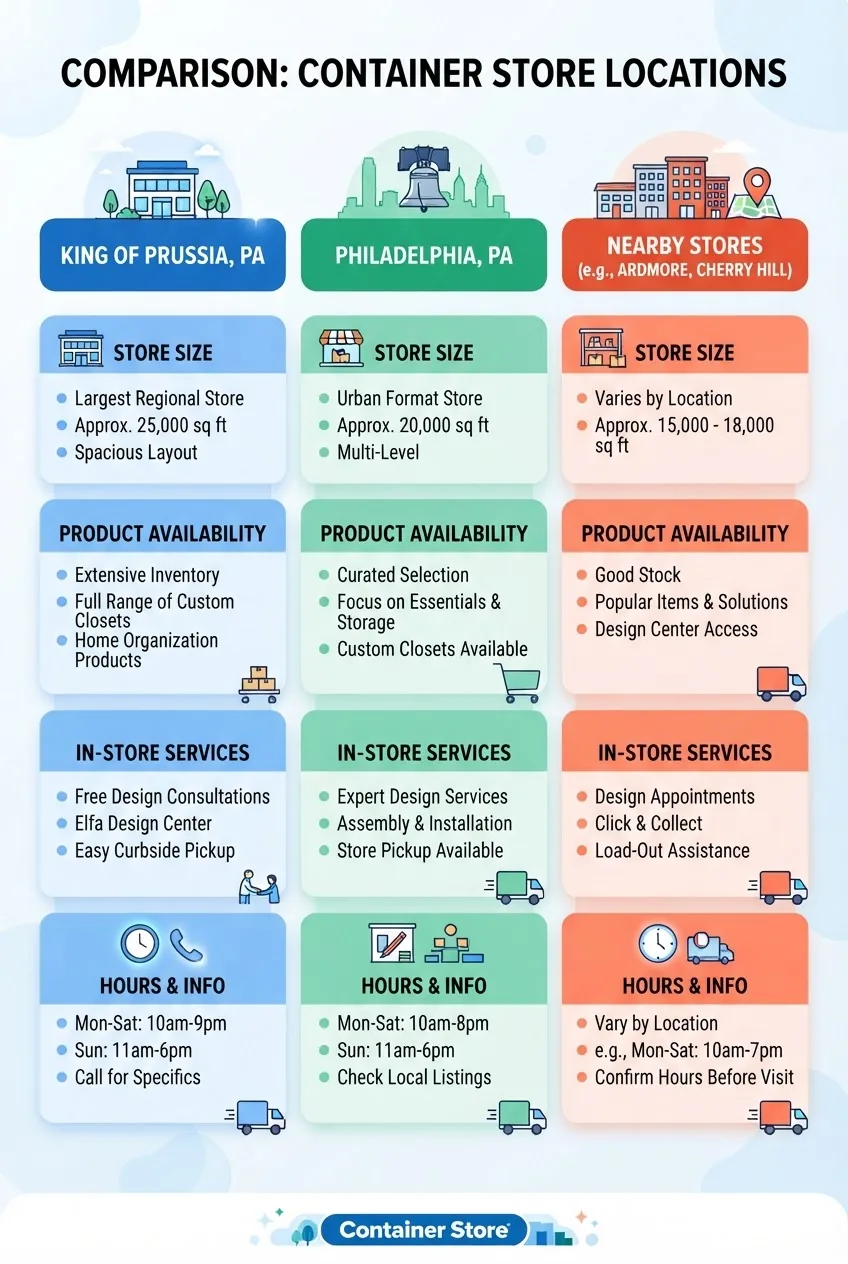
| Location | Store size & hours | Product availability & services | Best use |
|---|---|---|---|
| King of Prussia (KOP) | Large footprint; hours Mon–Sat 10–9, Sun 11–7 (As of 2024) | Full range: closet systems, moving kits, frequent in-store demos, on-site design consults | Local moves, closet projects, in-person demos |
| Philadelphia (center city) | Medium footprint; shorter hours, limited bulky item stock | Focused on small-space solutions, limited heavy shelving, strong accessories selection | Urban apartments, small-space organization |
| Nearby suburban location | Similar hours; variable stock—call ahead | May have regional warehouse support for large orders; smaller demo area | Quick pickups, bulk orders coordinated via warehouse |
Notes and interpretation:
- Store size: KOP is generally preferable when you need bulky shelving or to see full closet demo units.
- Product availability: city locations lean toward accessories and small bins; suburban and KOP stores stock larger modular items.
- Service difference: ask about events and demos—KOP tends to host more due to larger floor space (customer feedback summarized from 2024 local reviews).
Transition: if you plan to combine Container Store purchases with portable storage or freight container rentals, the following section lists how to coordinate and links to deeper rental resources.
Integrating The Container Store KOP with Portable Storage and Container Rentals
This section explains how to combine Container Store products with portable storage containers, local storage units, and freight rentals to create a low-friction move or temporary storage solution.
How to coordinate purchases and rentals in 5 steps:
- Measure the container/unit first. Before buying shelving or bins intended for a storage container, confirm interior dimensions (common portable storage containers: 8′ W × 7′ H × 20′ L; check your provider). Leave 2–3 inches clearance for shelving units and 24 inches aisle if you expect regular access.
- Choose stackable, uniform bins. Buy clear, stackable bins in a consistent size (e.g., 18x24x12″) so you can create stable stacks and maximize vertical space.
- Design for access. Place high‑use items near the container door; store seasonal or long-term items deep inside.
- Book the rental for pickup timing. Coordinate container drop-off/pickup times with your packing schedule to avoid paying for extra days. If storing off-site, schedule a delivery window when you have crew to move items directly into the unit.
- Document and photograph inventory. Photograph stacks and label bin contents in a spreadsheet so you can retrieve items efficiently.
For complete rental cost comparisons and to decide whether a portable storage container or freight container is best for your move, see the detailed pillar on rentals:
ship container rent options and portable storage costs guide
If you require freight-specific rental requirements (weight, permit, placement), consult a specialist resource:
freight containers for rent cost and rental requirements guide
Industry perspective: according to a 2024 moving services summary, combining modular organization products with portable storage typically reduces truck-loading time by 25%—saving labor costs when compared with unboxed loads (source: industry moving services analysis).
External resources for standards and consumer guidance:
- Federal Motor Carrier Safety Administration (moving and freight standards)
- Consumer Reports (product durability and satisfaction surveys)
Transition: below I summarize practitioner mistakes and a final verification checklist to ensure you don’t leave something to chance.
Common mistakes and how to avoid them
I once bought shelving that was 2″ too deep for my closet because I didn’t re-measure the door frame—don’t assume sample units will fit your exact space. Call the store, take photos, and measure door openings in inches (width and depth) before purchase.
I also learned to always buy one extra box size per room; running out of medium boxes late on moving day forced a midnight run. Buy a 10% buffer for boxes and labels.
Checklist: Verify before you leave the store
- You have SKU numbers or product names for large orders recorded.
- Measurements checked: closet depth, shelf width, door clearance (in inches).
- Quantity match: boxes and bins match your pre-move inventory (20% buffer added).
- Design consult notes saved (photo or printed spec sheet).
- Delivery/pickup windows confirmed for bulky items or rental containers.
- Receipt, return policy, and warranty information in hand or emailed.
When to call in a professional
- Large custom closet installs or structural shelving that anchors to studs—call a licensed installer.
- High-value art, pianos, or specialty equipment—hire specialty movers with insurance.
- If you are shipping freight containers across state lines, consult a moving broker or freight specialist to confirm permits and logistics.
Final practical note: always check the King of Prussia store phone and the brand’s online store locator before a long drive—stock and hours can change (As of 2024, information here is accurate; contact the store to confirm specifics).