


packing services: By the end of this hands-on guide you’ll know which level of professional packing to hire, how pricing is calculated, and a step-by-step plan to prepare a 1–4 bedroom home for full or partial service. Expect to spend 2–6 hours reading and 1–2 days planning; skill level: homeowner or office manager with basic scheduling ability.
Before you start
- Permissions and dates: confirmed moving date, building move-in/move-out windows, parking permits.
- Documents: inventory list template (room-by-room), insurance policy copy, mover estimates.
- Contacts: moving coordinator, building manager, specialty-item service (piano, safe).
- Tools & materials to compare: tape dispenser, markers, box sizes reference — pros will bring most supplies.
- Budget threshold: set a packing budget (example: 10–20% of total move cost for full service).
What Are Professional Packing Services?
Professional packing services are offered by moving companies and specialist pack-and-move firms to wrap, box, label and/or unpack belongings during a relocation. They range from a single crew member handling fragile items to full service pack and move engagements where teams pack an entire home or office, load items onto transport, then optionally unpack at the new site.
These services are provided by trained movers and packers who use standardized packing procedures, commercial-grade materials, and SKU-style inventory labeling so items can be tracked through the move. When you search for movers and packers or moving companies with packing services, you’re buying labor, materials and liability management—professionals often carry higher limits of protection and follow industry best practices.
Typical deliverables include an on-site estimate, a written inventory, packing materials supplied (boxes, bubble wrap, specialized crates), shrink-wrapping for furniture, crating for antiques or artwork, and documented unpacking plans. For businesses, pack-and-move services include labeling for IT and workstation components and coordination with IT vendors.

For an in-depth resource that complements this hands-on guide, see the Professional Packing Services Guide and Cost Overview.
Transition: Now that you understand what professional packing services are, let’s map the types you’ll encounter so you can match service level to need.
Types of Packing Services Offered
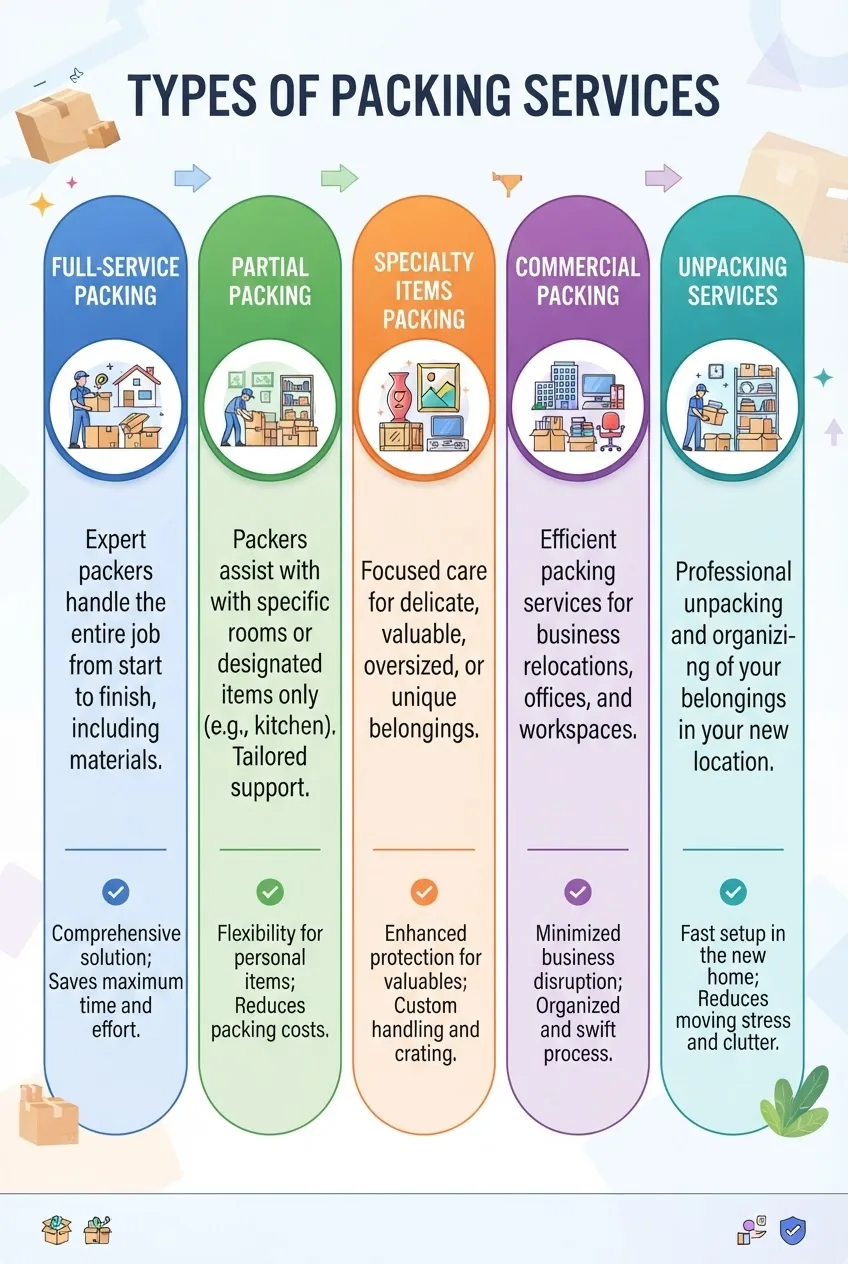
- Full service packing and moving — Crews pack every room, supply all materials, label boxes, load and transport. Best for 3+ bedroom homes or corporate relocations that require turnkey service. Expect 2–6 packers for 4–8 hours depending on size.
- Partial packing — You choose rooms or categories (kitchen, fragile items, artwork). Common when clients want to save money but avoid packing delicate or high-value items. Pricing often by the hour or per-box for selected items.
- Specialty item packing and crating — Custom crates, piano rigging, gun safes, antiques and fine art. These require experienced packers, special materials, and sometimes subcontracted riggers. See heavy item procedures in the heavy duty boxes cost and buying guide.
- Residential/home packing services — Standard household item packing with room-by-room inventories and labeling for unpacking. Often paired with short-term storage solutions.
- Commercial/business packing services — Workstation disassembly, IT labeling, archival box management, phased packing to keep operations running. Usually priced with project management fees and time windows outside business hours.
- Packing and unpacking services — Full or partial unpacking at the destination (kitchen setup, closet organization). Some companies provide staged unpacking with placement and removal of materials.
- White-glove and concierge packing — Highest level: curated materials, in-home project manager, detailed inventories, reassembly and installation at the destination. Ideal for high-value collections or executive relocations.
- On-demand or hourly pack help — Short visits from a packer or two for a few hours to clear closets or prepare boxes. Useful when you need help with a deadline or last-minute items.
Transition: With those types outlined, next we’ll walk through how professional packing actually works on a job so you can plan timing and responsibilities.
How Professional Packing Services Work
This section explains the packing process, typical moving services packing and unpacking steps, and what house packers do from estimate to completion. Industry trade association best practices guide many movers; learn more about standards at International Association of Movers.
- Schedule an on-site or virtual survey. A certified estimator inventories rooms and specialty items, confirms stairs, elevator access, and parking. Surveys typically last 30–90 minutes for a 2–4 bedroom home.
- Receive a written estimate and scope of work. Estimates include labor method (per-hour vs flat rate), materials list, insurance options, and a packing timeline. Ask for a signed scope that lists excluded items (e.g., hazardous materials).
- Agree materials & labeling system. Pros use standardized color-coded labels and an inventory sheet or barcode system for large jobs. Ask for a sample label format and whether they scan items for liability tracking.
- Pre-pack action items. You clear small valuables, prepare an essentials box (48-hour kit), and note any fragile collections. The crew typically arrives with boxes, paper, bubble wrap, mattress bags, furniture blankets and tape.
- Packing day: team deploys by rooms. Crews follow a room sequence to minimize cross-room contamination and speed. For example: kitchen (most time-consuming) → living → bedrooms → garage. A 3-bedroom home typically takes 6–10 packer-hours (two packers × 3–5 hours).
- Specialty packing and crating. Items like artwork are crated on-site or in a local facility; pianos and safes may require separate rigging appointments scheduled 1–2 weeks in advance.
- Loading and transport coordination. A moving foreman matches packed trucks to inventories, secures items, and plans route. For commercial moves, technicians tag IT equipment for reassembly.
- Unpacking and placement (if contracted). Unpacking is planned by room; crews place items, assemble furniture, remove packing debris upon request. Unpacking a 3-bedroom home often adds 25–40% to labor time compared with packing-only.
- Final walkthrough and sign-off. You and the team review inventory and damage claims process. Obtain a final invoice and photographed condition report for recordkeeping.
Case study (typical client timeline): A medium move—3-bedroom single-family home—booked two weeks out. Day 0: survey and estimate. Day 7: confirmation, materials ordered. Day 14 AM: 3 packers arrive at 8:00, finish packing by 2:00 PM (6 packer-hours each total 18 packer-hours). Day 14 PM: load and depart. Day 15: unpacking team (if ordered) returns for 6 hours. This workflow minimizes in-home disruption and keeps packing within a predictable 24–48 hour window.
Pros use tools and materials that differ from DIY: grade-A double-wall boxes, custom crating materials, furniture dollies with straps, moving blankets, torque tools for disassembly, and barcode scanners or inventory apps. For a deeper look at typical supplies, consult the moving supplies guide and packing materials.
Transition: Understanding the process helps with pricing expectations. Next, a detailed cost overview shows how pack-and-move services are billed and typical price ranges.
Cost Overview of Professional Packing Services

Pricing for packing services varies by pricing methodology: per-hour labor rates, per-box pricing, crew-day flat rates, or bundled flat-fee packages. Below is a practical stat block with current ranges and clear notes on variables.
| Service | Typical Price Range | Notes |
|---|---|---|
| Hourly packing labor (per packer) | $35–$75 per hour | Higher in metro areas; includes labor only. |
| Per-box packing | $5–$40 per box | Small boxes cheaper; specialty crates much higher. |
| Full service pack (3BR home) | $900–$3,000+ | Depends on house contents and specialty items. |
| Specialty crating | $150–$2,000 per item | Art and antiques require custom crate work. |
| Unpacking services | $30–$75 per hour per unpacker | Often billed separately from packing. |
Pricing variables explained:
- Labor method: Per-hour pricing is transparent for small jobs; flat-rate quotes are common for full-service moves and include material and management fees.
- Volume & density: Number of boxes, fragile items, and bulky furniture increases labor time and materials used. A densely packed 3BR with many fragile items pushes costs toward the high end.
- Specialty needs: Instrument moving, gun safes, and pianos require specialized crews and separate quotes.
- Location & access: Elevator access, long carry distances, stairs, and parking permits add time and fees.
- Insurance and declared value: Declared or full-value protection raises quotes in exchange for higher liability limits.
Example pricing methodologies and trade-offs:
- Per-hour charging: Example: Two packers at $50/hour for 6 hours = $600 labor. Pros: pay for actual time. Cons: less predictable for large homes.
- Per-box charging: Example: 120 boxes at $12/box = $1,440. Pros: predictable if box count is accurate. Cons: complex when boxes vary widely in size and content weight.
- Flat packing package: Example: full-service 3BR family home flat quote $2,200 includes materials and labor. Pros: single price and less oversight. Cons: may be higher if work is straightforward.
According to a 2023 Consumer Affairs report, many consumers underestimate the packing time and budget by about 20–30%; companies that offered flat-rate packing reduced unexpected costs for customers in 62% of sampled cases (source: consumer review study, 2023). For national standards on pricing disclosure and contracts see government consumer protection guidelines.
Budgeting rules of thumb (quick reference):
- Small apartment (studio/1BR): $200–$700 for partial or hourly pack help.
- 2–3 bedroom home full pack: $800–$2,500 depending on specialty items.
- 3+ bedroom full-service with many antiques: $2,000–$6,000+ when crating is required.
Extra materials note: readers ordering some supplies themselves should see the extra large moving boxes guide for large item requirements and cost estimates.
Regional pricing disclaimer: Costs vary significantly by metro area and local labor rates; request at least three written quotes and confirm what materials and liability are included. According to a 2024 industry report, metropolitan centers show average hourly labor costs 10–35% above national averages (industry report, 2024).
Transition: Having the numbers helps weigh the value. Next we compare the benefits of hiring pros versus DIY packing so you can decide which route actually saves money or reduces risk.
Benefits of Hiring Professional Packers vs DIY Packing
This comparison highlights why hiring packing companies can be a pragmatic investment versus doing everything yourself.
| Consideration | Professional Packers | DIY Packing |
|---|---|---|
| Time | Saves 50–70% of your time; crews work full days. | Requires many off-hours; can delay move readiness. |
| Damage reduction | Lower damage incidence due to materials and technique. | Higher risk for fragile and specialty items. |
| Cost | Higher up-front, but often offsets replacement costs and time loss. | Lower immediate cost but may increase move days and lost productivity. |
| Stress | Reduces logistical overhead; one coordinator handles details. | High stress and decision fatigue for owners. |
- Time savings: Professionals routinely pack a kitchen in 3–6 hours; DIY may take 1–3 days for a busy household.
- Damage reduction: Pros use archival paper, double-boxing for electronics, and crating for artwork; these techniques materially reduce breakage.
- Liability & insurance: Movers often offer declared-value protection; DIY losses rely on homeowner insurance and are often more cumbersome to claim.
- Cost trade-offs: If labor cost for you (lost work hours, overtime) exceeds professional rates, hiring pros is economically sensible.
According to a 2023 consumer review analysis, households using professional packers reported 40% fewer claims for damaged items versus DIY moves (consumer review analysis, 2023). However, professional services are not cost-effective for minimal-item moves where the total packing time is under 4–6 person-hours.
Transition: If the benefits above lean you toward hiring, the next section explains exactly how to vet and pick the right team.
How to Choose the Right Professional Packing Service
Choosing movers that will pack for you requires a mix of verification, quoting discipline, and local knowledge. Use the following step-by-step evaluation criteria and local resource checks before signing.
- Verify licensing and insurance. For interstate moves confirm USDOT or FMCSA numbers; for local moves check state mover licensing. Consult government consumer protection guidelines at FTC moving tips for recommended contract items.
- Request detailed written estimates. Ask for line-item breakdowns: labor hours, materials list, per-box costs, crating fees and fuel/surge charges. Avoid verbal-only quotes.
- Check trade membership and standards. Membership in a trade association (e.g., International Association of Movers) signals adherence to industry best practices and training standards.
- Read verified reviews and dispute records. Look for patterns in claims, timeliness, and packing quality on ConsumerAffairs, Better Business Bureau, and independent review platforms. A long track record with consistent positive feedback is preferable.
- Compare on a like-for-like scope. Ensure competing quotes assume the same scope: number of packers, included materials, and whether unpacking is part of the price.
- Test communication and project management. A single point of contact and a clear timeline are critical. Ask for a sample packing day schedule and confirmation of arrival windows.
- Confirm liability and claims process. Know the difference between released value and full-replacement coverage, and ask for the claims flowchart in writing.
- Explore local alternatives and shipping complements. If you need drop-off shipping or partial store-pack services, compare pack-and-ship locations. Helpful references: package service guide and shipping service near me and pack and ship near me guide.
Quick vetting checklist:
- Written estimate and inventory? ✔
- License and insurance verified? ✔
- References or recent reviews provided? ✔
- Clear packing/unpacking scope? ✔
Transition: The next section answers common customer questions with concise, featured-snippet-ready responses.
FAQs About Professional Packing Services
Below are concise answers to frequent questions about professional unpacking services, move unpacking services, house unpacking services, and related packing and unpacking questions.
Transition: After the FAQs, finish with final operational tips and a checklist to set expectations for the day the packers arrive.
Final Tips & What to Expect When You Hire Professional Packers
Preparing for packers reduces day-of friction. Expect crews to arrive within a two-hour window, work in teams of two to four, and follow a room-by-room plan. Set aside an essentials box for the first 48 hours and label anything you need immediate access to in bright marker.
- Labeling protocol: ask for both room and content category on each box (e.g., “KIT — Pots & Pans — 1 of 8”).
- Packing timelines: kitchens take 3–6 packer-hours; bedrooms 1–3 packer-hours each; garages and attics vary widely.
- Food & perishables: clear or freeze and transport perishable food separately; most moving companies refuse perishable items.
- Valuables & documents: keep passports, jewelry, and original documents with you, not in the mover’s custody.
- Site prep: clear walking paths, disconnect electronics if you prefer, and protect floors if requested in the contract.
If you want low-cost packing supplies or to augment services, check local sourcing in the where to buy moving boxes.
Common mistakes and how to avoid them
I once accepted a verbal estimate for a full-service pack that omitted crating for an antique. The crew arrived and quoted additional crating the next day, adding 20% to the bill. I now always get line-item written scopes that list specialties and crating needs. Learn from this: insist on written scopes, confirm excluded items, and require signature on final change orders.
Hands-on numbered steps (core actions to execute a professional pack-and-move)
- Book a physical or virtual on-site survey — Schedule within 14–30 days of moving; have a room-by-room inventory ready. Ensure the estimator records stairs, elevator dimensions, and exact parking access.
- Choose pricing model and confirm inclusions — Decide per-hour vs flat-rate. For full service, target three written quotes and compare labor hours, materials, and insurance.
- Prepare the home 48 hours before packing — Remove personal valuables, defrost freezers, and put aside items not for the movers. Create an essentials kit: 2 days of clothing, toiletries, chargers, medications.
- Label and tag key items — Pre-label anything you will need immediately at the destination using neon stickers; this saves unpacking time and prevents misplacement.
- Supervise the pack sequence — Verify crew starts with fragile and high-effort areas (kitchen, artwork) and ends with the least critical spaces to avoid mid-job delays.
- Document condition and inventory — Take room photos and request a photographed condition report from the mover for high-value items before they pack each crate.
- Confirm crating and specialty schedules — Schedule piano/safe/antique rigging 7–14 days in advance; confirm arrival windows on moving day.
- Review unpacking scope — If you purchased unpacking, provide a placement map for furniture and a kitchen arrangement plan to speed the process (allocate 4–6 hours for a modest kitchen).
- Finalize sign-off and claims process — Obtain final invoice and the mover’s claims procedure in writing prior to payment; keep receipts and photos for 90 days after the move.
Common mistakes I see
- I underestimated the kitchen: I ignored counting kitchen boxes, which underquoted my needs. Solution: do a preliminary box count or ask the estimator to cite box count estimates.
- I accepted “materials included” without specifics: the crew brought only basic boxes, not specialty wardrobe boxes. Solution: list required box types in the contract.
- I skipped confirming parking permits: the truck couldn’t park close and extra carry time added two hours. Solution: secure parking and elevator reservations in advance.
Final checklist before packers arrive
- Written estimate signed and scope confirmed.
- Essentials box packed and set aside.
- High-value items removed to personal custody.
- Parking/elevator permits confirmed.
- Designated point person assigned for the day.
When to call in a professional instead
Call in specialty packers when you have pianos, safes, firearms, or artwork valued over $2,000; for commercial moves where downtime exceeds $500/hour per department; or when your move timeline is under 72 hours and you require turnkey packing and unpacking to meet deadlines.