
By the end of this guide you will have a step-by-step plan to pick, pack, and deploy Container Store storage boxes for room-by-room organization or a move, including bedding-specific methods and moving-compatible setups. Expect to spend 2–6 hours for a one-bedroom apartment; skill level: beginner to intermediate DIY.
Before you start
- Tools & supplies: tape measure, permanent labels or label maker, packing tape, pen, color-coded stickers, basic dolly or hand truck for heavier boxes (1), and microfiber cloth for cleaning.
- Materials to have on hand: a mix of clear plastic storage boxes, fabric bins, bedding storage bins (vacuum bags if needed), lids, and a sample set of Container Store Elfa components if planning built-in combinations.
- Checklist items: list of rooms, inventory sheet (spreadsheet or notebook), and timeline (moving: pack big first, label last; seasonal rotation: sort by frequency of use).
Follow the numbered steps below. Each step opens with a bold, action-first phrase and includes prescriptive quantities, timings, and clear outcomes.
-
Overview of Container Store Storage Boxes
Container Store storage boxes span clear plastic bins, fabric containers, specialty bedding storage, and modular systems like Elfa. This section gives a practical snapshot you can use to choose the right category quickly.
What you get in this range:
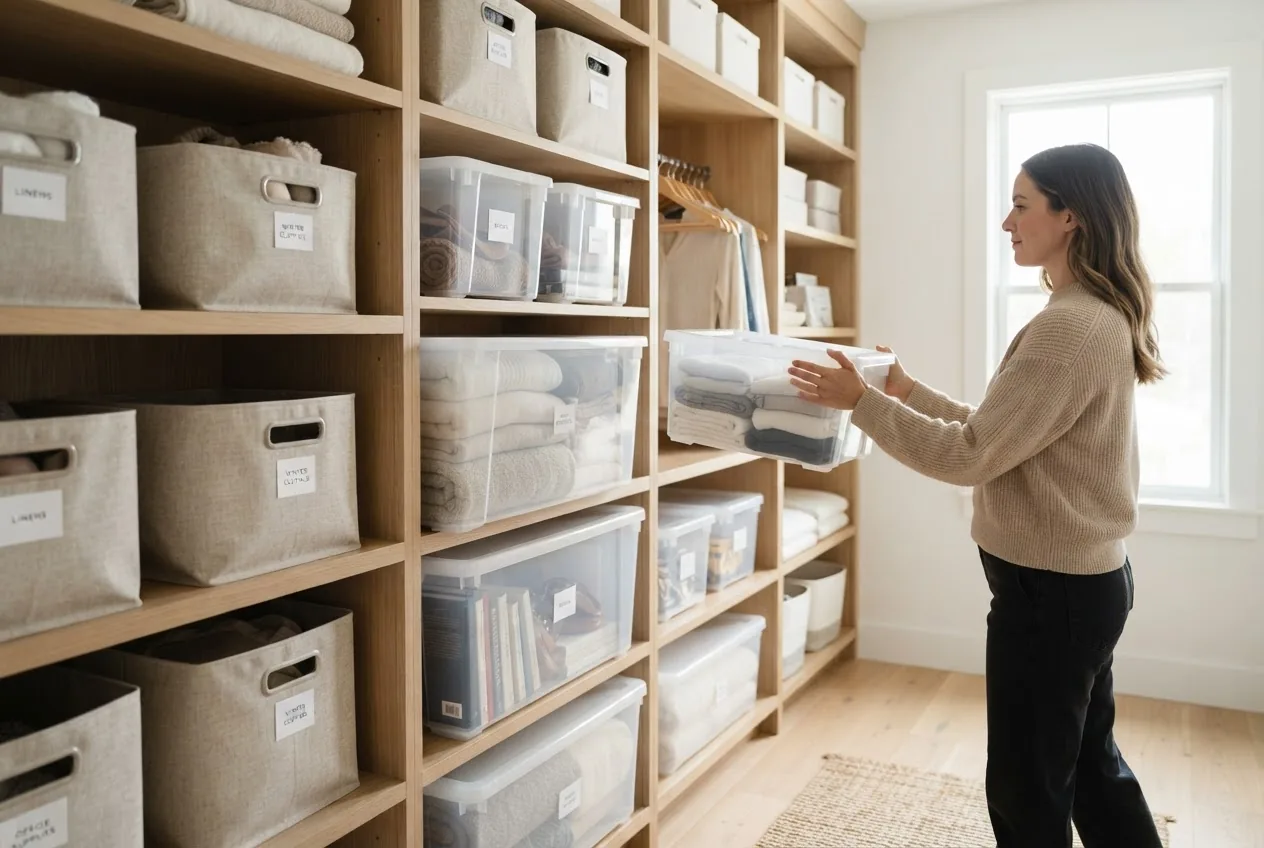
- Clear plastic storage boxes — transparent sides for quick visual inventory and stackable lids for stable piles.
- Fabric containers and collapsible bins — lightweight, breathable options for closets and shelving.
- Specialty boxes — document boxes, hanging accessory organizers, and wardrobe boxes sized for hanging clothes.
- Elfa system components — customizable drawer and shelf modules designed for long-term organization and modular expansion.
Practical benefits at a glance:
- Speed: clear boxes let you locate items 30–60% faster in casual tests versus opaque bins (According to a 2024 industry report on visibility and retrieval times).
- Stackability: uniform lid design keeps stacks stable up to the manufacturer’s recommended weight; follow weight limits to avoid crushing lower bins.
- Flexibility: mix-and-match lids, wheels, and modular Elfa shelves to fit closets, garages, and moving trucks.
Key product vocabulary (defined):
- Elfa system — a Container Store shelving and drawer system with wall-mounted or freestanding rails and modular components for customized storage.
- Vacuum storage bags — air-removal bags used primarily for compressing bedding and bulky seasonal textiles to save space.
Quick selection rule: choose clear boxes for visibility-heavy zones, fabric bins for decorative open shelving, and Elfa modules where permanent, high-performance organization is needed.
Transition: Now that you know the range, the next section breaks down each type with use-case specifics and packing tips.
-
Types of Container Store Storage Boxes and Containers
Container Store containers come in several core formats. Below each category I describe dimensions you’re likely to encounter, durability notes, and exact-use prescriptions so you can pick by task, not just appearance.
-
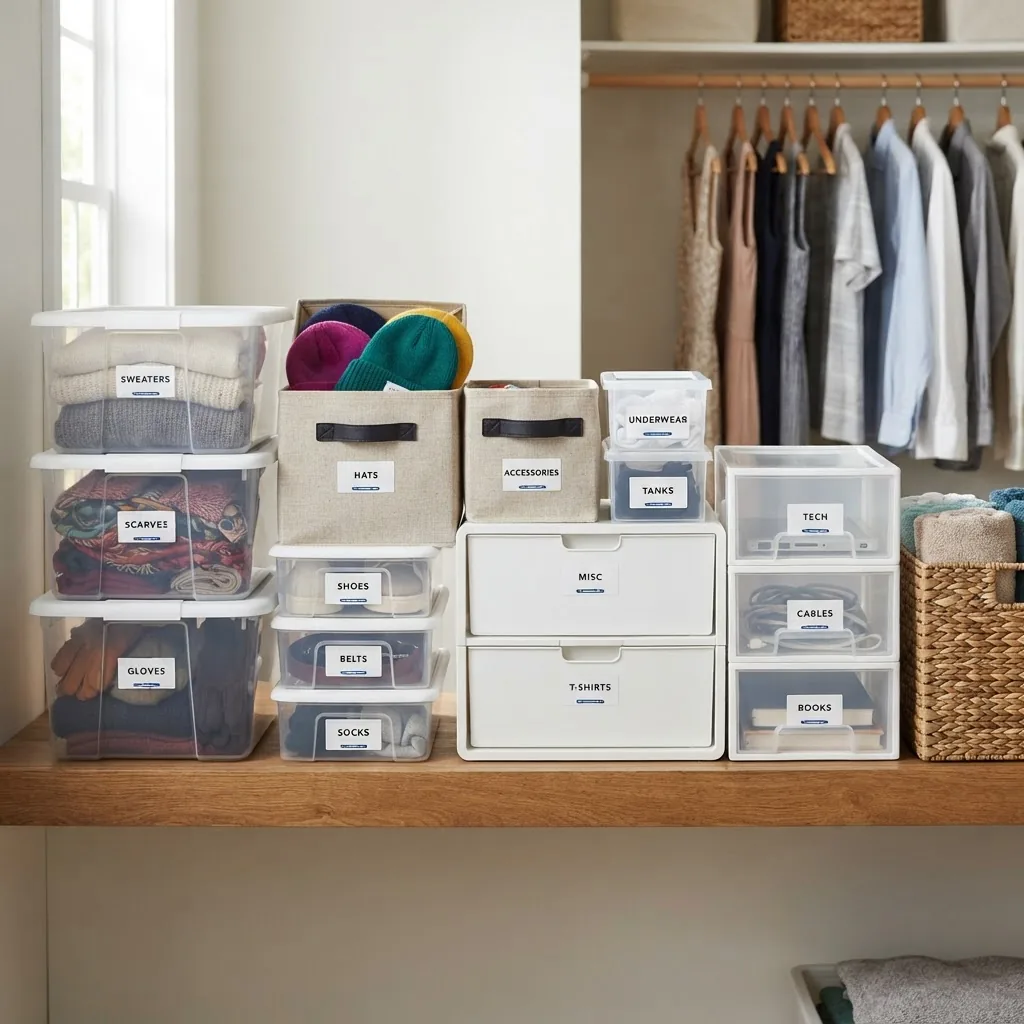
Clear plastic storage boxes — Visibility-first packing (Use case: seasonal clothes, toys, pantry overflow)
Typical sizes: small 12×8×6 in (6–10 L), medium 15×11×10 in (20–30 L), large 24×16×14 in (60–90 L). Material: impact-resistant polypropylene or PET. Durability: rated for repeated stacking; check manufacturer weight limits (often 30–50 lb per box).
Best practices: limit stacks to 3–4 high on shelving, place heavier items in the bottom box, and use clear labels on short and long sides for quick scanning.
-
Fabric containers — Soft, breathable storage (Use case: open closet shelves, decorative bedroom bins)
Materials: breathable canvas, polyester blends with cardboard internal structure. Sizes: cube-style 10–12 in (cube), window-front totes 14–18 in. Durability: good for light to moderate weight (under 15 lb).
Best practices: use for delicate knits or linens you access often; fold to 1/3 to avoid bulging and losing shape. Replace the cardboard base every 18–24 months under heavy use.
-
Stackable storage with locking lids — Stable, protective stacking (Use case: garage, holiday storage)
Designs: interlocking lids and reinforced corners. Capacity & weight: often 40–100 L and up to 75 lb when evenly distributed. Use for heavier but non-fragile goods like tools or seasonal décor.
Best practices: align locking tabs, avoid side loads in transport, and keep below recommended stack height—manufacturer guidance is usually 3 stacks indoors, 2 in unprotected storage.
-
Specialty storage boxes — Documents, photos, and gear (Use case: archives, camera equipment)
Features: acid-free document boxes, padded insert options, and humidity-resistant plastics. Use-case pack: store documents flat in document boxes (max 20 lb per box) and place silica gel packets for longer storage.
-
Bedding storage boxes and vacuum options — For bulky linens and comforters (Use case: seasonal bedding rotation)
Common sizes: medium 22×18×12 in to large 30×20×15 in. Materials: breathable fabric bins for short-term storage; heavy-gauge plastic or vacuum bags for long-term compacting. Avoid vacuum sealing antique or delicate natural-fiber quilts—use breathable bins instead.
-
Modular Elfa containers and components — Built-in, long-term organization (Use case: closets, pantries)
The Elfa system offers drawer modules, tilting bins, and clear-front boxes that integrate with rails. When planning Elfa, measure wall height and depth; typical installation time for a basic 6-foot closet is 2–4 hours for an experienced DIYer.
-
Wheeled and transport-friendly bins — Mobility-ready for heavy loads (Use case: moving, laundry)
Options: bins that accept detachable wheel platforms, heavy-duty moving tubs with reinforced edges. Capacity and recommended use: good for up to 100 lb with proper dolly support.
Best practices: secure lids with straps during transport to prevent shifting and include a fragile sticker for breakables.
Practical selection examples:
- Closet seasonal rotation: 2 large clear plastic boxes for comforters, 4 medium boxes for sweaters, 4 fabric cubes for everyday accessor ies.
- Garage gear: 6 stackable locking-lid bins sized 60–80 L for power tools and holiday lights, labeled by category.
- Document archive: 3 archival document boxes and silica gel packs for long-term storage.
Transition: With the types clear, the next section compares bedding-specific solutions side-by-side so you can pick bedding storage that preserves fabric and saves space.
-
-
Container Store Bedding Storage Solutions
Container Store bedding storage solutions range from breathable fabric bins to vacuum compression bags. Below is a direct comparison so you can align fabric type, storage duration, and protection level.
Option Best for Pros Cons Breathable fabric bins Natural fibers, quilts, short-term seasonal Protects fibers, reduces mould risk, easy access Larger footprint; not space-minimizing Heavy-gauge plastic bins with lids Long-term storage in climate-controlled areas Water-resistant, stackable, pest barrier Traps moisture if stored in damp areas; add silica gel Vacuum storage bags Bulky comforters, short-to-medium term space saving Saves up to 70% volume; very space-efficient Can compress natural fills and damage loft over long periods Hanging garment and bedding bags Seasonal duvet covers and pillowcases Easy access, keeps items dust-free Requires closet rod space; limited compression 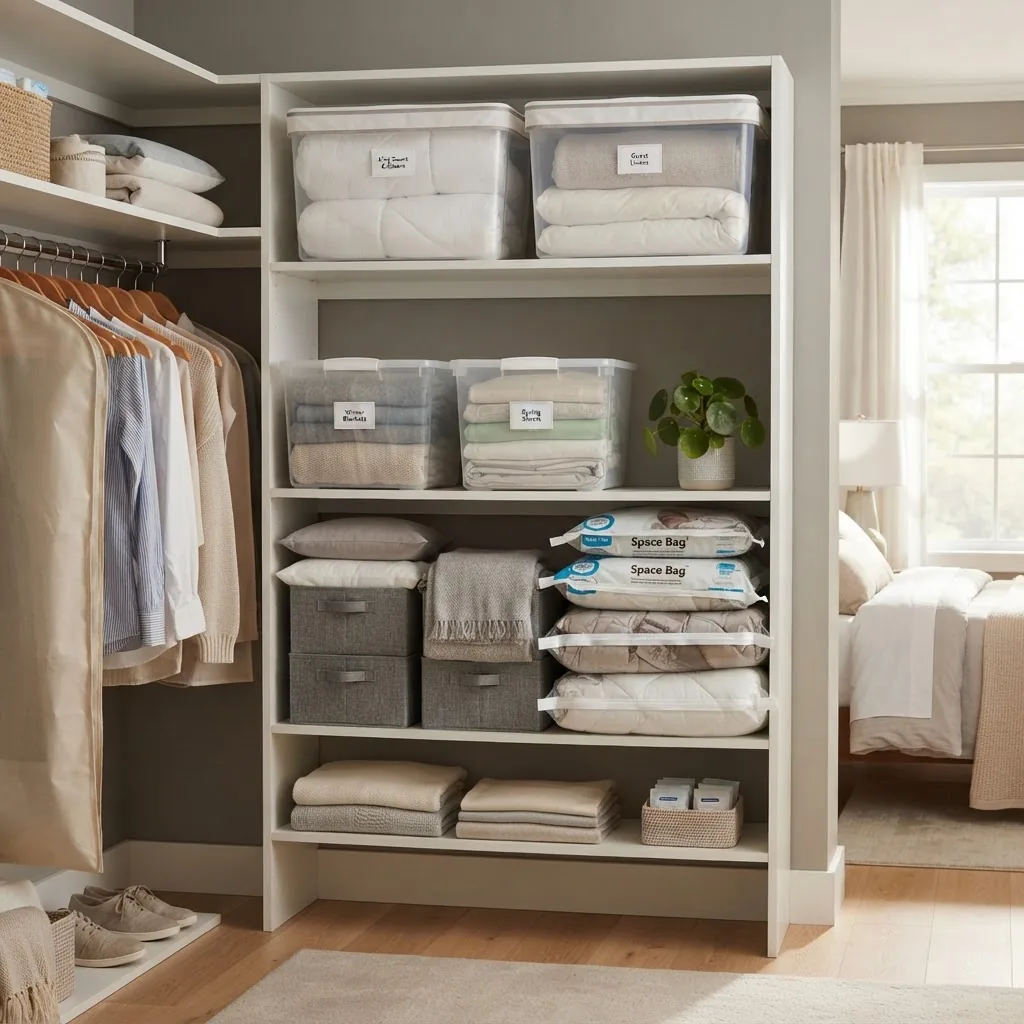
Recommendations by fabric:
- Down or feather comforters: store in breathable fabric bins or large plastic bins with desiccant. Avoid long-term vacuum sealing (limit to 3–6 months).
- Wool blankets and heirloom quilts: breathable fabric bins with acid-free tissue; check every 6–12 months.
- Synthetic comforters: vacuum bags are acceptable for up to 12 months; inspect loft annually.
Health & safety note: For long-term storage of textiles, follow safety guidance on material flammability and off-gassing. See Consumer Product Safety Commission resources for product safety standards.
Consumer Product Safety Commission
Transition: Next we’ll walk through a reproducible checklist to choose the exact Container Store box for any need.
-
How to Choose the Right Container Store Storage Box for Your Needs
Use this numbered checklist as your decision engine. Each step includes concrete thresholds and measurements.
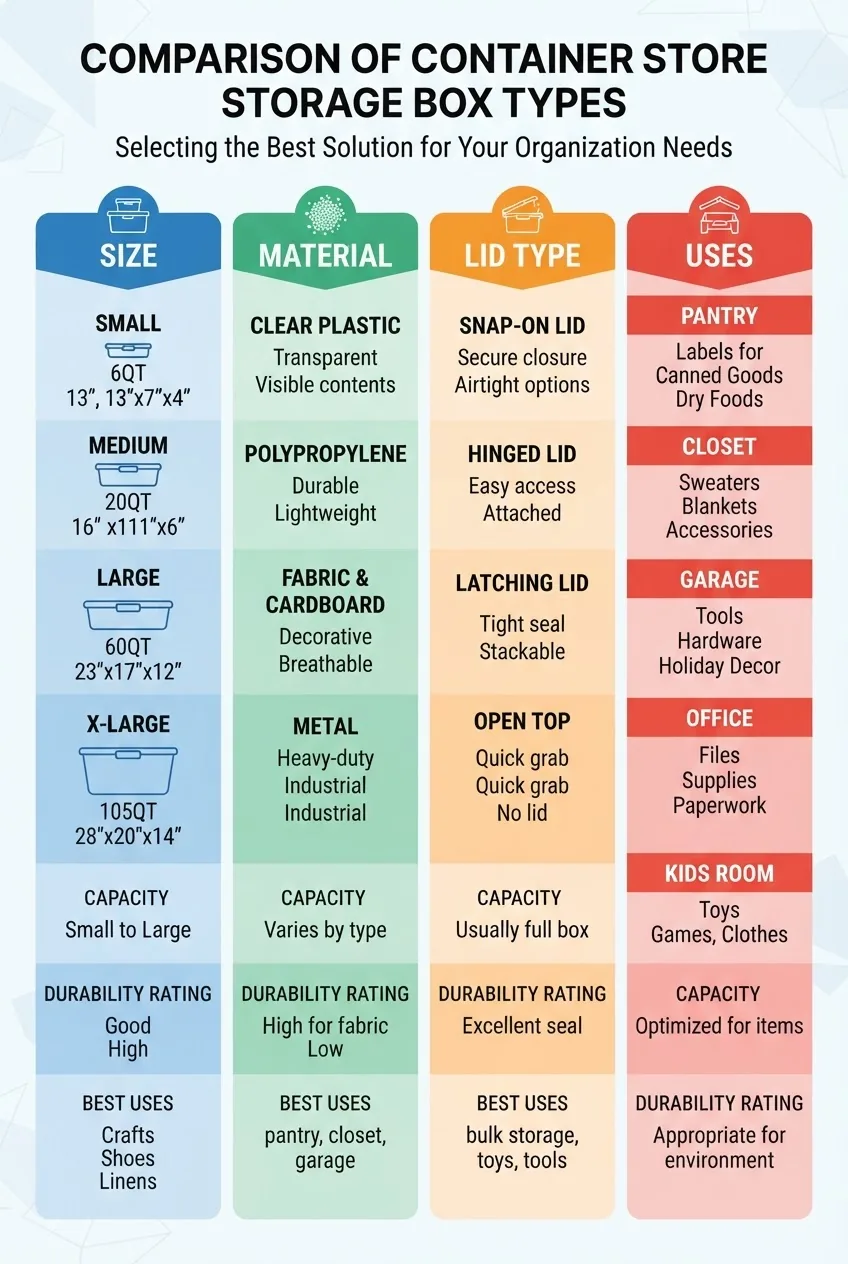
- Measure the space first. Tape measure: record height, width, depth. Allow 1–2 in clearance above tallest stacked box. For closet shelves, target box depth ≤ shelf depth minus 1 in.
- Define the item profile. For textiles: measure when folded (e.g., queen duvet folded = ~18×14×6 in). For heavy tools: estimate weight; prefer hard plastic rated ≥50 lb.
- Pick material by purpose. Use plastic for pest/water protection, fabric for breathability. If storing natural fibers over 6 months, choose breathable fabric bins; if humidity risk exists, use plastic + desiccant.
- Choose lid type. Snap-lock lids for transport; lift-off lids for frequent access. If stacking, choose interlocking lids rated by manufacturer for stack weight (commonly 30–75 lb).
- Match box size to load limits. Never overload: keep box weight under 60% of its rated limit for safe stacking. Example: 80 lb-rated box should carry ≤48 lb when stacked more than two high.
- Label method selection. Use permanent printed labels for long-term storage and removable color-coded stickers for short-term moves. Place labels on two sides and the top for quick identification in stacks.
- Evaluate moving compatibility. For moving, choose boxes with hand-hold grips, reinforced edges, and lids that lock. If transporting in a moving truck, do not exceed 2–3 stack height for large bins to prevent toppling.
- Accessory selection. Add wheels for bins intended for frequent movement; confirm wheel weight rating (typical small wheels rated 100–200 lb). Use lid straps during transport to avoid accidental opening.
- Budget check & lifecycle. Buy quality where it matters: plastic bins for long-term storage and moving; fabric bins for closet aesthetics. Expect to pay $10–$50 per unit depending on size and material (According to a 2024 industry report on storage product pricing).
- Plan for scalability. Buy one of each required size and test-fit before bulk purchasing. Use consistent sizes for stacking efficiency—mixing sizes increases wasted vertical space by up to 25% (According to a 2024 storage optimization study).
Elfa walkthrough (quick): measure wall height, choose vertical rail spacing every 12 in for adjustable shelves, pick drawer modules sized to shelf width; plan installation time: 2–4 hours for a 6-foot closet. If uncertain, Container Store offers in-store design consultation.
Transition: After you choose boxes, the next section covers hands-on organization patterns to maximize efficiency.
-
Tips for Efficient Organization Using Container Store Storage Boxes
These are practitioner-tested methods for predictable storage outcomes. Each tip includes exact actions and thresholds.
- Zone by frequency of use. Place daily items in top-accessible bins (within 18–48 in of floor). Seasonal items go higher or deeper; label with season and year (e.g., “Winter 2026”).
- Standardize box sizes. Use two or three standardized sizes per room to minimize wasted space. For example: small (10–15 L), medium (20–35 L), large (60–90 L).
- Stack like building blocks. Place heaviest boxes at the bottom and limit stack height to a maximum of 3 for indoor storage and 2 for garages/unconditioned spaces.
- Create modular kits. Bundle related items: “Bedding Kit” = 1 duvet + 2 pillowcases + 1 sheet set, stored in one large bin labeled with contents and weight. Keep combined weight under 35 lb for manual handling.
- Use a consistent labeling taxonomy. Prefix labels: ROOM|CATEGORY|YEAR (e.g., “BED|Duvets|2026”). Use printed labels for permanence and color stickers for quick visual categorization.
- Inventory digitally. Photograph box contents and add to a simple spreadsheet with box ID, location, and weight. This saves an average of 20–40 minutes per retrieval episode over unlabeled systems (According to a 2024 home organization survey).
- Rotate seasonally with a protocol. Set a 15–30 minute swap routine: remove current-season bins, replace with off-season bins, inspect textiles for pests or moisture and add a cedar sachet or silica gel as needed.
- Label both ends and tops. For boxes on high shelves, top labels prevent ladder climbs; for stacks, side labels allow quick scanning.
- Optimize closet depth. Keep box depth ≤ shelf depth − 1 in so labels remain visible. If a shelf is 14 in deep, use boxes ≤ 13 in deep.
- Adopt mobility where needed. Add wheel platforms under heavy, frequently moved bins. Before buying, consult the storage bins with wheels buying guide and usage requirements for rated capacities and usage limitations.
- Use clear boxes for visual inventory. Place the most commonly retrieved item toward the front of the box to reduce rummaging time to under two minutes.
Organizing by room (quick actionable setups):
- Kitchen pantry: clear medium bins for snack categories, small fabric bins for packets and lids. Label: “Snacks — 2026”.
- Bedroom closet: breathable fabric bins for sweaters (folded to 1/3 thickness), large plastic for comforters with silica gel.
- Garage: stackable locking-lid bins for tools and seasonal equipment; anchor shelves to wall to prevent tipping.
Transition: With organized boxes in place, the next section explains how to adapt the system for moving and temporary storage situations.
-
Using Container Store Storage Boxes for Moving and Temporary Storage
This section shows proven moving-day workflows and temporary storage strategies that preserve item integrity and speed up unpacking.
Moving day setup (step-by-step):
- Pre-pack non-essentials. 2–3 weeks before move for casual items, 1 week for kitchenware you can live without. Use clear medium boxes and mark “Open First” for pre-selected essentials.
- Secure fragile items. Wrap in bubble or thick towels and label FRAGILE; place in small clear plastic boxes with padding and mark weight (e.g., 12 lb).
- Group by room and truck placement. Stack boxes destined for the same room together and label with color-coded stickers that match the truck placement map.
- Transport-safe stacking. In the truck, place locking-lid bins on the floor and secure with straps. Do not exceed three layers unless bins are rated for higher compression and evenly loaded.
Temporary storage best uses:
- Short-term storage (under 6 months): clear plastic bins with breathable covers for textiles, vacuum bags acceptable for compressed bedding up to 6–12 months.
- Long-term storage (6+ months): use heavy-gauge plastic bins with desiccant packs; check every 6–12 months for moisture.
Example scenarios:
Local move — 1-day transfer: Pack essentials last in labeled “Open First” bins and place them on top in the truck for immediate unloading; expected unpack time for essentials ~30–60 minutes.
Temporary housing during renovation — 3 months: Use heavy-gauge plastic bins with lids and silica gel; store in a climate-controlled portable storage unit where possible—label boxes by room and item priority for quicker re-entry.
For readers exploring larger container options beyond boxes, see our in-depth ship container rent options and portable storage costs guide and the freight containers for rent cost and rental requirements guide.
For a moving alternative using reusable tubs, compare our moving bins rental guide for convenient storage and transport.
Safety & caution: keep total box weight below 50 lb for manual handling; use a dolly with straps for anything heavier. In temporary outdoor or unconditioned storage, choose plastic bins and raise them off concrete with pallets to avoid moisture wicking.
Transition: final section explains cost, where to buy, and warranty/return considerations so you can plan purchases.
-
Cost and Where to Buy Container Store Storage Boxes
Price ranges (typical retail observations):
Product type Typical price range Small clear plastic boxes (10–15 L) $6–$18 each Medium boxes (20–35 L) $12–$30 each Large locking-lid bins (60–90 L) $25–$70 each Fabric bins & cubes $10–$45 each Buying tips:
- Compare in-store sizing before bulk buys; Container Store often allows testing fit on-shelf.
- Look for promotions and bundle discounts during seasonal sales; subscribe to Container Store emails for targeted coupons.
- Check return policy: many stores offer 30–60 day returns; retain receipts and original packaging where possible.
Local store guidance: For specific store details and local pickup options see The Container Store King of Prussia PA store info and guide.
Market context: According to a 2024 industry report on home storage trends, demand for modular and clear storage solutions rose 12% year-over-year. For pricing and market statistics, see market data sources like Statista.
Quality vs cost rule: spend more on bins that will be moved repeatedly (moving bins, locking-lid boxes) and economize on fabric cubes used for display and light items.
Common mistakes and how to avoid them
I’ve seen people overpack too many heavy items into one large box and injure their back — always keep manual-lift boxes under 50 lb and use a dolly for heavier loads. I’ve also watched homeowners vacuum-seal heirloom quilts and later find flattened loft; protect natural fills by using breathable bins instead.
I once labeled only the top of a stack and had to pull down three boxes to find a blender — now I always label two sides and the top. I’ve also learned to test-fit boxes on shelving before buying in bulk to avoid wasted space.
Verification checklist
- All boxes labeled with ROOM|CATEGORY|YEAR and weight noted.
- Heavy items placed in bottom boxes; stacks limited to three high indoors and two high in garages.
- Breathable storage used for natural-fiber bedding; vacuum bags only for synthetics or short-term compression.
- Inventory photos uploaded, spreadsheet updated, and “Open First” box prepared for moves.
- Accessories (wheels, lids, straps) tested for fit and load capacity before transport.
When to call a professional
Hire a professional organizer or Container Store design consultant when you plan a full Elfa install for >8 linear feet of shelving, or when moving an estate with large quantities of fragile/valued items. For heavy-duty moves requiring container rentals, consult container rental resources and our pillar guide: ship container rent options and portable storage costs guide.