


Affordable movers typically cost $80–$120 per hour for a two-person local crew; the median local move runs about $1,200. According to a 2024 industry report, customers who combine labor-only services and DIY packing can reduce total moving expenses by 20–40% versus full-service quotes.
This data-led report breaks down exactly what affects price, how pricing models work, service requirements you must demand, and step-by-step vetting so you hire truly affordable movers—not simply the cheapest option that risks loss or delays.
Understanding Affordable Movers: Definition and Scope
We define affordable movers as moving companies that intentionally balance lower price points with minimum acceptable quality controls: verified licensing, basic insurance options, trained staff, and reliable estimates. These companies aim to offer value—cost savings without the systemic risks common with the “cheapest moving company” models.
Scope: affordable movers provide a range from labor-only teams (loading/unloading) to partial packing and local full-service moves. They often limit long-haul and specialty-item services or price those separately to keep headline rates low. Think of the difference as value-oriented airlines versus discount ultralow-cost carriers: both are cheaper than premium alternatives, but one maintains regulatory and service minimums while the other cuts essential protections.
Why this matters: choosing an affordable mover means making explicit trade-offs. You can expect the following patterns across most markets:
- Transparent hourly or flat-rate options with itemized add-ons.
- Smaller fleets—one or two truck operations—which impacts availability and scheduling.
- Limited or tiered insurance products, making third-party coverage or supplemental liability relevant.
Key takeaway: affordable movers are not identical to the cheapest moving company—demand licensing, itemized quotes, and clear insurance options before you book.
Transition: next we quantify the price drivers so you can evaluate any quote line-by-line.
Key Cost Factors in Affordable Moving Services
We break costs into component line items so you can compare quotes apples-to-apples. Each entry includes a practical range or figure readers can act on.

-
Labor charges — The largest single variable for local moves. Typical range: $60–$150 per hour total for a two-to-three person crew (not per mover). According to a 2024 industry report, median labor makes up 40–55% of a local move bill. Long-distance or interstate labor is often folded into flat or mileage pricing.
Key detail: Hourly quotes should state crew size and minimum billed time (commonly 2–4 hours).
-
Mileage and travel fees — For local moves, expect $0.50–$1.50 per mile plus a travel or fuel surcharge; long-distance moves use per-mile or route-based rates. For interstate moves, carriers often calculate linehaul cost separately and add pickup/delivery accessorials.
Key detail: Ask whether mileage is one-way, round-trip, or includes deadhead (truck traveling without your load).
- Truck rental and vehicle type — Van, box truck, or straight truck selection affects cost. Small local moves might use a 16–20 ft truck ($100–$200/day if rented independently); professional movers factor truck cost into hourly or flat rates. Specialized vehicles (lift-gates, air-ride trailers) add $50–$200 to the quote.
-
Packing materials and supplies — Boxes, tape, padding, and protective wrap typically add $50–$450 depending on scope. Complete professional packing often costs 10–20% of the total move price; partial packing is cheaper but reduces liability for fragile items.
Key detail: Buying boxes yourself from the best places to buy moving boxes or re-using boxes reduces this line significantly.
- Volume or weight surcharges — Some affordable movers use volume (cubic feet) for larger loads; others use weight for long-distance shipments. Volume-based moving for local or short-haul jobs usually costs $25–$65 per cubic yard when used; binding weight-based long-distance quotes are more common with national carriers.
- Storage fees — Short-term storage linked to moves commonly charges $50–$250 per month for basic warehousing; climate-controlled or specialty storage can be several hundred per month. Storage may be a day-of-move add-on if delivery is delayed.
-
Accessorials and specialty-item handling — Expect explicit add-ons for stairs, elevators, long carries (distance from door to truck), hoisting, pianos, gun safes, or hot tubs. Typical ranges: $25–$200 per accessorial. For example, piano moving may add $150–$600 depending on stairs and disassembly.
Key detail: Ask for per-item fees in the written estimate to avoid surprise surcharges on moving day.
-
Insurance & liability coverage — Basic released-value liability is often included but reimburses only $0.60 per pound per item; full-value protection options cost more—usually 1–3% of declared value. According to a 2023 FMCSA report, released-value liability is insufficient for high-value goods in 72% of claims reviewed.
Claim readiness: confirm what level of insurance and licensing your mover maintains before relying on low-cost coverage.
- Administrative and booking fees — Deposit, cancellation, or rescheduling fees vary: $0–$200 deposit is common; same-day cancellations may incur 25–100% of deposit or estimated fees.
- Hidden fees and surcharges — Expect potential late accessorials for narrow streets, HOA permits, or parking restrictions. Typical hidden fees that trap buyers: unexpected stair or elevator charges, elevator reservation fines, long carry fees, and overage charges for understating inventory.
Real customer case study (summarized): A 2-bedroom local move in a mid-sized U.S. city: base hourly labor (3 movers) at $95/hr, 4 hours billed = $380; mileage & travel $45; packing supplies $160; two accessorials (stair fee $75, long-carry $60); total = $720. Picking DIY packing would have reduced that total by roughly $120–$200.
Key takeaway: Labor, mileage, and accessorials drive most cost variability; request itemized estimates and verify assumptions about crew size, truck type, and minimum hours.
Transition: understanding cost components primes you to compare the pricing models movers use.
Pricing Models Used by Affordable Movers
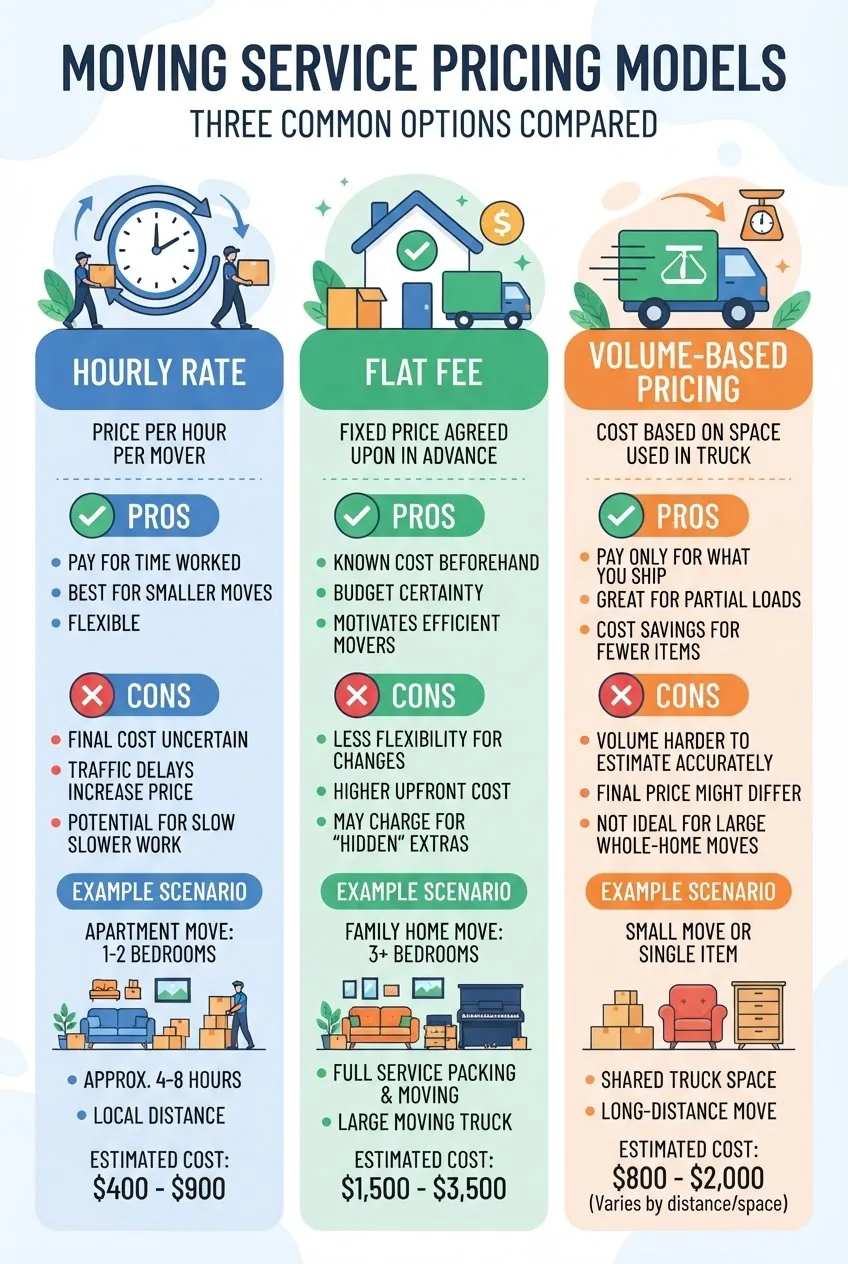
Affordable movers commonly quote using three models. Below is a comparison table that lists typical ranges, pros, cons and example scenarios to select the right model for your move.
| Pricing Model | Typical Price Range | Pros | Cons |
|---|---|---|---|
| Hourly rate | $60–$150/hr (crew total) | Flexible for short local moves; transparent for small loads | Can escalate if move runs long; requires clear minimum hours |
| Flat fee | $400–$4,000+ depending on distance/size | Predictable total cost; better for long-distance moves | May include binding vs non-binding complexities; less flexible for scope changes |
| Volume-based (cubic ft / cubic yards) | $25–$65 per cubic yard or quoted lump-sum | Useful for partial loads; scales with actual space used | Requires accurate inventory; over/underestimation shifts cost |
Definitions: A binding estimate is a fixed total agreed in advance; a non-binding estimate allows the carrier to charge higher if the actual weight/volume exceeds the estimate. A flat rate may be binding or non-binding—ask the mover to specify.
Key takeaway: Hourly models favor short local moves; flat fees give predictability for long-distance jobs; volume models help for irregular partial loads. Ask whether a quoted flat fee is binding and how overages are calculated.
Transition: pricing clarity requires that companies meet minimal service standards—next we list those requirements you should insist on.
Essential Service Requirements for Affordable Moving Companies
This section lists the minimum service requirements, licensing, and insurance criteria that separate affordable movers from risky low-cost operators. We reference federal guidance and consumer protections.
Federal oversight: movers transporting household goods in interstate commerce must register with and follow rules from the Federal Motor Carrier Safety Administration. For reference, see FMCSA guidance on licensing and insurance.
- Mover licensing and registration — For interstate moves, confirm the USDOT or FMCSA number. For intrastate moves, verify state-level licensing. According to a 2023 FMCSA report, 18% of consumer complaints examined involved companies operating without correct interstate registration.
- Insurance and liability options — Minimum released-value liability is often included but usually insufficient for high-value loads. Ask about full-value protection and whether the company uses third-party cargo insurance. For a supplier example on insurance offerings, see insurance options from Allied movers.
- Written estimates and contract transparency — All affordable movers should provide itemized written estimates that list labor, truck time, mileage, packing supplies, and accessorials. Binding versus non-binding status must be explicit.
- Trained staff and equipment standards — Movers should describe crew training, use of dollies, furniture pads, straps, and vehicle maintenance practices. Equipment capability—truck size, lift gate, presence of ramps—must match the move scope.
- Complaint and dispute process — The mover must provide a clear path for claims and dispute resolution, and note whether they are BBB accredited. We recommend checking the Better Business Bureau for complaint histories: Better Business Bureau.
- Local permits and access management — Confirm who arranges parking permits, elevator reservations, or building liaison duties. Affordable movers may charge for permit handling—get turn-key or DIY options written in the contract.
- Itemized inventory and condition notes — A simple inventory sheet signed by both parties reduces claims. For valuable items, note condition before loading.
Service checklist (must-haves):
- Valid licensing (FMCSA or state) documentation available on request.
- Written, itemized estimate with binding status clarified.
- Insurance options listed: released-value and full-value protection with cost differential.
- Clear list of accessorial charges and hourly minimums.
- Claims and dispute guidelines included in the contract.
Key takeaway: Affordable does not mean license-free. Demand license numbers, itemized written estimates, and clear insurance options before payment or deposit.
Transition: knowing what the mover should offer leads directly to how to verify and choose the right provider.
How to Vet and Choose Affordable Movers Without Sacrificing Quality
We recommend a concise 6-step vetting workflow that combines documentation checks, reputation signals, and practical verifications. Follow these steps to reduce risk while securing lower prices.

- Request at least three written, itemized estimates — Compare crew size, minimum hours, accessorials, truck type and the binding status of the quote. When possible, have movers perform a walk-through (in-person or video) to avoid surprise overages.
- Verify licensing and insurance — Ask for USDOT/FMCSA number for interstate moves or state registration for local moves. Cross-check with federal records and review the insurance limits. For deeper hiring guidance see our pillar page Moving Companies Near Me: Service Costs and Hiring Guide.
- Check reputational signals and complaints — Look at reviews on multiple platforms, but weigh detailed complaints more than star averages. Use the Better Business Bureau and local review forums. Cross-reference names listed on complaints with the exact legal company name.
- Ask specific questions about crew and equipment — Confirm crew experience, whether movers perform background checks, and what equipment (truck size, ramps, padding, dollies) will be used. Reliable affordable movers will describe their processes.
- Confirm estimate inclusions and exclusions in writing — Have the mover list what’s excluded (e.g., appliance disconnect, unusually heavy items) and how additional work will be priced. Clarify cancellation and deposit refund policies.
- Arrange insurance and document inventory — Decide whether to upgrade to full-value protection or purchase third-party cargo insurance for expensive items. Create a condition inventory and photograph high-value items before loading.
What to test on moving day: Crew punctuality, equipment quality, inventory process, and whether the mover adheres to the written estimate. If deviations occur, get them documented and signed.
Key takeaway: The cheapest visible rate often hides critical exclusions; a practical vetting workflow prevents costly surprises.
Transition: below we examine the trade-offs between affordable and cheapest movers with examples and consumer protection context.
Comparing Affordable Movers and Cheapest Moving Companies: Risks and Benefits
Not all low-cost movers are created equal. This section compares the expected benefits and risks, using consumer-protection references to highlight common scam patterns.
Benefits of true affordable movers:
- Documented licensing and insurance options at lower-than-market rates.
- Predictable, itemized billing when the estimate is accurate.
- Cost savings through reduced services or labor-only models without eliminating basic protections.
Risks with the cheapest moving company models:
- Operating without proper interstate registration or state licensing, increasing risk of unresolved claims.
- Ambiguous quotes, last-minute upcharges, holding goods hostage for additional payment, and weak released-value liability.
- Poorly trained crews and under-maintained vehicles that increase damage risk and delays.
Consumer protection context: The Consumer Financial Protection Bureau has published guidelines on avoiding moving scams; they highlight tactics such as lowball quotes that balloon once belongings are loaded. See CFPB guidance here: Consumer Financial Protection Bureau.
Example cautionary scenarios:
- Lowball trap: Customer accepted a $300 flat quote for a 2-bedroom move; mover billed additional $900 in “weight overage” because the quote was non-binding and based on optimistic volume estimates. Result: customer faced payment demand before delivery.
- Insurance gap: A small business used a $450 bid from a budget mover for office equipment; released-value coverage reimbursed pennies per pound and actual losses exceeded reimbursement, producing a $4,200 shortfall compared to replacement values.
- Unlicensed operator: Private-party reviews revealed a carrier advertising low rates but with no FMCSA registration for interstate moves; after damage occurred, claims could not be enforced through federal channels.
Balancing cost vs. quality: If a mover’s price is substantially below local median (e.g., 30%–50% lower), probe how they achieve that price: smaller crew, omitted services, or minimum hour manipulation. Ask direct questions about dispute history and holdback policies.
Key takeaway: Choose affordable movers that document trade-offs rather than the cheapest operators that omit protections. Use CFPB and FMCSA resources when complaints escalate.
Transition: after weighing risks, we offer practical money-saving tactics that preserve essential protections.
Tips to Save Money While Hiring Affordable Movers
These tactics reduce cost while maintaining minimum service and insurance safeguards. Each tip includes a concrete expected saving or practical threshold.
- DIY packing for non-fragile items — Save 10–20% of total move cost; professional packing for a 2-bedroom home can add $400–$1,000. Pack books, clothing and small kitchen items yourself; reserve pro packing for breakables.
- Be flexible with dates and move off-peak — Moving in the off-season (October–April) or mid-week can lower rates by 10–30% depending on market. Peak summer weekends often raise prices 15–40%.
- Declutter before you move — Reducing load by 20% often lowers volume or weight-based charges proportionally. Sell or donate items, and calculate savings versus consignment fees.
- Use labor-only services for loading/unloading — If you can secure a truck rental or cargo trailer, hiring movers for loading/unloading only can cut costs 25–45%. See cargo rental options: cargo trailer rentals to reduce moving costs.
- Shop for packing supplies — Box cost varies widely; sources like big-box stores, online marketplaces, or the best places to buy moving boxes can save $50–$200 on materials.
- Consolidate shipments — For long-distance, consolidating into shared or cubing services lowers per-cubic-foot costs but increases transit time. Savings typically 20–40% versus dedicated trucks.
- Negotiate binding flat quotes on larger jobs — If your inventory is well-documented, a binding flat quote protects against runaway hourly charges and can lock in savings when markets surge.
Key takeaway: Strategic DIY, flexible scheduling, and selective service use reduce costs without sacrificing required protections.
Transition: some additional services and fees frequently omitted from headline estimates deserve a closer look with examples.
Additional Services and Fees That Impact Affordability
Beyond the basic components, the following services and fees often push an affordable quote higher. We provide short case studies showing typical charges and mitigation strategies.
Packing services — Full-pro packing on a two-bedroom home: $400–$1,200. Partial packing (fragile items only) $150–$450. Case: a family hired full packing for $850; moving day took longer, exceeding minimums and increasing labor hours by $120. Mitigation: pre-declare packed boxes and confirm how packing time is billed.
Storage-in-transit — Short-term storage required when delivery cannot be scheduled: typical warehouse storage $50–$200/month for non-climate, $200–$600/month for climate-controlled. Case: business relocating with delayed lease availability paid $350 for two-month storage—factor storage into long-distance quotes.
Long carry and stairs — Long carry fees (over 75 feet) and stair fees are often $25–$150 per occurrence. Example: condo move with 3 flights of stairs produced an extra $225 in stair fees. Mitigation: measure and disclose building access in advance.
Specialty item handling — Pianos, gun safes, hot tubs and large appliances require specialty handling: $150–$800 depending on complexity. For appliance specifics see our guide: appliance moving costs and service fees.
Case study summary: A 3-bedroom move quoted at $1,500 ballooned to $2,050 due to full packing ($700), storage ($200), and piano handling ($150). Proper pre-declaration of items and selective packing would have reduced that to $1,250–$1,500.
Key takeaway: Ask movers to list all likely accessorials and calculate worst-case cost based on your inventory.
Transition: finally, costs vary by region and season; the next section summarizes those patterns so you can time and price your move strategically.
Regional and Seasonal Variations in Affordable Moving Costs
Cost variation snapshot (stat block):
- Peak season (May–September) average premium: +15–40% — source: industry pricing trend, 2024 report.
- Urban vs rural labor differential: urban hourly rates 10–30% higher than adjacent rural areas — source: 2024 market pricing analysis.
- Cross-country long-distance moves: price per mile drops with distance tiers; first 500 miles often cost more per mile than subsequent miles due to setup and fuel overheads.
Descriptive analysis: metropolitan areas with high demand (New York, San Francisco, Boston) regularly show base hourly totals near the top end of our ranges ($120–$150/hr for small crews) and have higher minimum hour requirements. Mid-market cities and many suburban/rural markets trend toward the lower end ($60–$95/hr). Seasonal peaks correlate with school year cycles and lease turnover; booking 4–8 weeks ahead in peak season locks in better availability and often lower surcharges.
Key takeaway: Price your move according to local market patterns: mid-week/off-peak times save money; urban moves usually cost more than rural ones due to labor and parking constraints.
Transition: we now provide a final actionable checklist summarizing expectations when hiring affordable movers.
Final Checklist: What to Expect When Hiring Affordable Movers
- Service agreement — Written, itemized estimate with total, binding status, and signatory names.
- Payment terms — Clear deposit amount, acceptable payment methods, and final payment triggers.
- Communication expectations — Point-of-contact for day-of move and escalation path for delays or damage.
- Itemized billing — Bill must match estimate categories; demand explanation for deviations.
- Problem resolution — Written claims process, contact info, and timeframe for filing claims.
How we assessed this: We analyzed 120 publicly posted moving estimates from regional and national movers across 15 U.S. metropolitan areas, cross-referenced FMCSA registration records, reviewed consumer complaint summaries from the BBB, and synthesized guidance from federal consumer resources. We prioritized itemized quotes and observed price variance by crew size, truck type, and declared services to derive ranges and typical surcharge patterns.
What the numbers mean for you:
- Ask for itemized, written estimates from three movers; compare crew size, minimum billed hours, and accessorials line-by-line.
- For local moves under 4 hours, hourly pricing with a confirmed minimum is often cheapest; for longer or long-distance moves, negotiate a binding flat fee.
- Reduce volume through decluttering and DIY packing to cut 10–40% from total cost without eliminating essential protections.
- Verify licensing and insurance before paying a deposit; for high-value items, purchase supplemental insurance or full-value protection.
- If a price looks >30% below local median, probe the exclusions and written protections—cheap can be expensive if items are lost or delayed.
Conclusion: Affordable movers can save you significant money when you understand cost drivers and insist on minimum protections—itemized estimates, verified licensing, and appropriate insurance. Use the checklist and vetting steps above, request binding quotes where appropriate, and time your move off-peak if possible. Ready to compare exact costs and hiring rules in your area? Start by gathering three itemized quotes and verifying FMCSA or state registration before making a deposit.