

Estate cleanout — by the end of this hands-on guide you will be able to plan, estimate, and execute a full residential estate cleanout or manage one as an executor. Expect to spend 6–48 hours of organized work for a typical 2–3 bedroom house; skill level required: basic project management plus 1–2 helpers or a hired crew.
Before you begin, this guide lists explicit legal, logistical and disposal requirements, shows the full, field-tested step-by-step process, gives regional cost examples and hidden-fee traps, and explains when to call specialists.
Before you start
- Prerequisites: estate executor authority or written permission from owner/estate (bring documentation).
- Essential tools and materials: heavy-duty work gloves (size to fit), N95 masks, contractor trash bags (30–55 gal), moving blankets, furniture sliders, 2–3 folding hand trucks, locking padlock for temporary storage, sharpie labels and pre-printed donation tags.
- Recommended consumables: packing tape (3 rolls), marker labels (2 packs), 5–10 medium moving boxes, 5–10 clear tote bins for valuables.
- Safety and permits: check local bulky item pickup schedules and hazardous waste days before scheduling labor or containers.
Transition: First, understand exactly what an estate cleanout involves and how it differs from one-off junk removal.
What Is an Estate Cleanout?
A estate cleanout is a coordinated service to clear a residence of personal property, debris, and unwanted items after a life event — commonly a death, downsizing, relocation, or foreclosure. Think of the estate cleanout like a combination of junk removal and estate management: it involves sorting belongings for heirs, cataloguing valuables, arranging donation or sale, and disposing of what remains.
Key components of an estate cleanout include: contents removal, inventorying valuables for estate records, targeted disposal of hazardous items, and preparing the property for sale or handover. The process differs from general property cleanouts because it often includes probate requirements, greater emotional considerations, and more careful handling of documents, jewelry, and family items.
Common service models: full-service cleanouts (labor, sorting, disposal and final cleaning), labor-only crews (you provide disposal), and container rental (you load; hauler disposes). Each model has trade-offs in time, cost, and liability.
Real-world nuance: in many estates, the first 1–2 days are devoted to identifying high-value or sentimental items (documents, jewelry, electronics) to avoid accidental disposal. That prioritization reduces estate disputes and loss of irreplaceable items.
Transition: Next, review the typical reasons families call for a full estate cleanout.
Common Reasons and Situations for Estate Cleanouts
Estate cleanouts are triggered by events that require clearing a property quickly or responsibly. Common situations include:
- Deceased estate / probate cleanout — Executors must clear personal items while following probate rules and inventory requirements.
- Downsizing — Seniors moving to assisted living often need an estate cleanout to reduce household goods for the new space.
- Inherited property — Siblings or heirs deciding whether to retain, sell, or dispose of a property’s contents.
- Relocation or foreclosure — Banks or owners clearing a property for sale or transfer.
Examples:
- Probate cleanout after a family death: executor inventories documents and hires a full-service crew to sort over seven days to avoid missing probate deadlines.
- Downsizing move: a 1-bedroom apartment is cleared in a single day using a labor-only crew and a donation run.
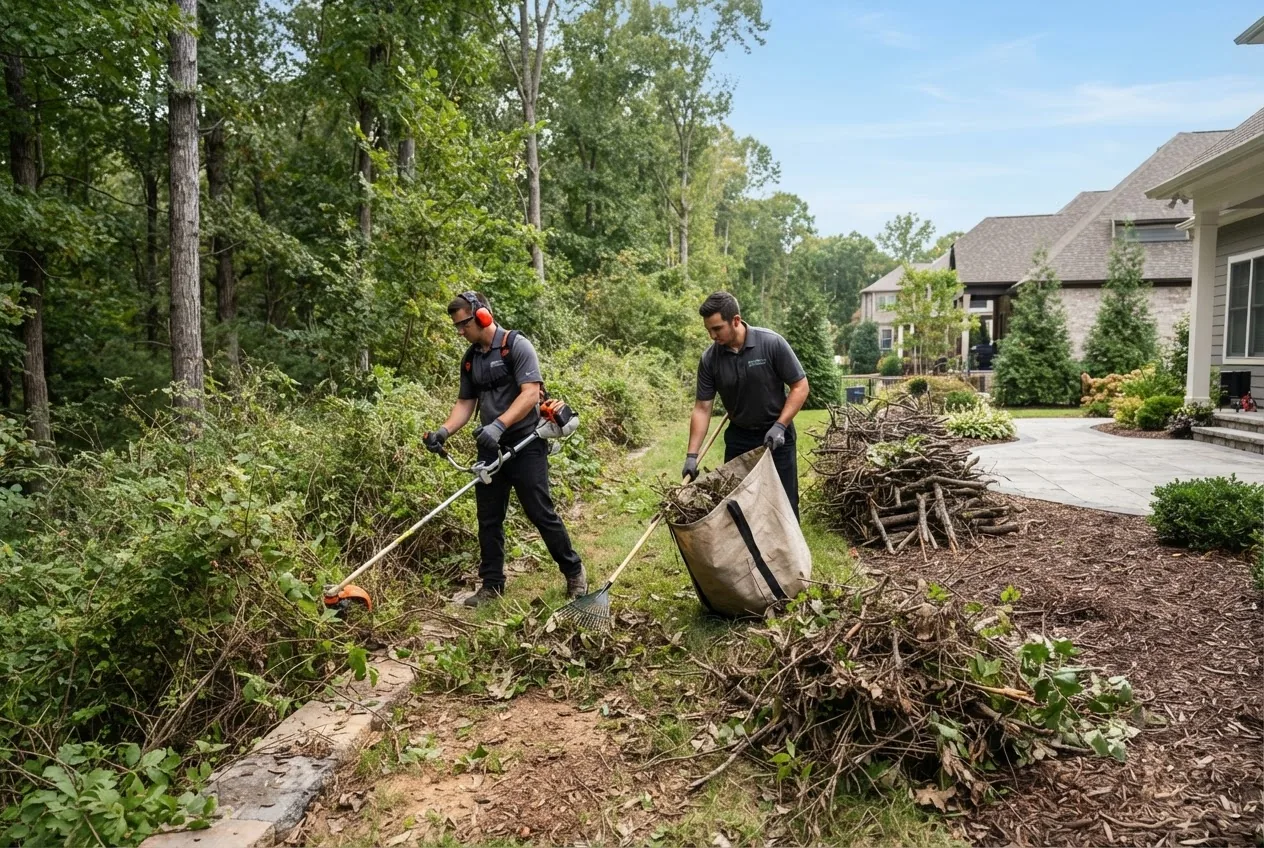
- Inherited rural property: a two-week cleanout includes brush and outbuilding debris requiring brush-specific disposal services.
Transition: If you’re ready to act, follow the field-tested step-by-step process below; it’s written as actionable steps with timing, roles, and checklists.
Step-by-Step Estate Cleanout Process

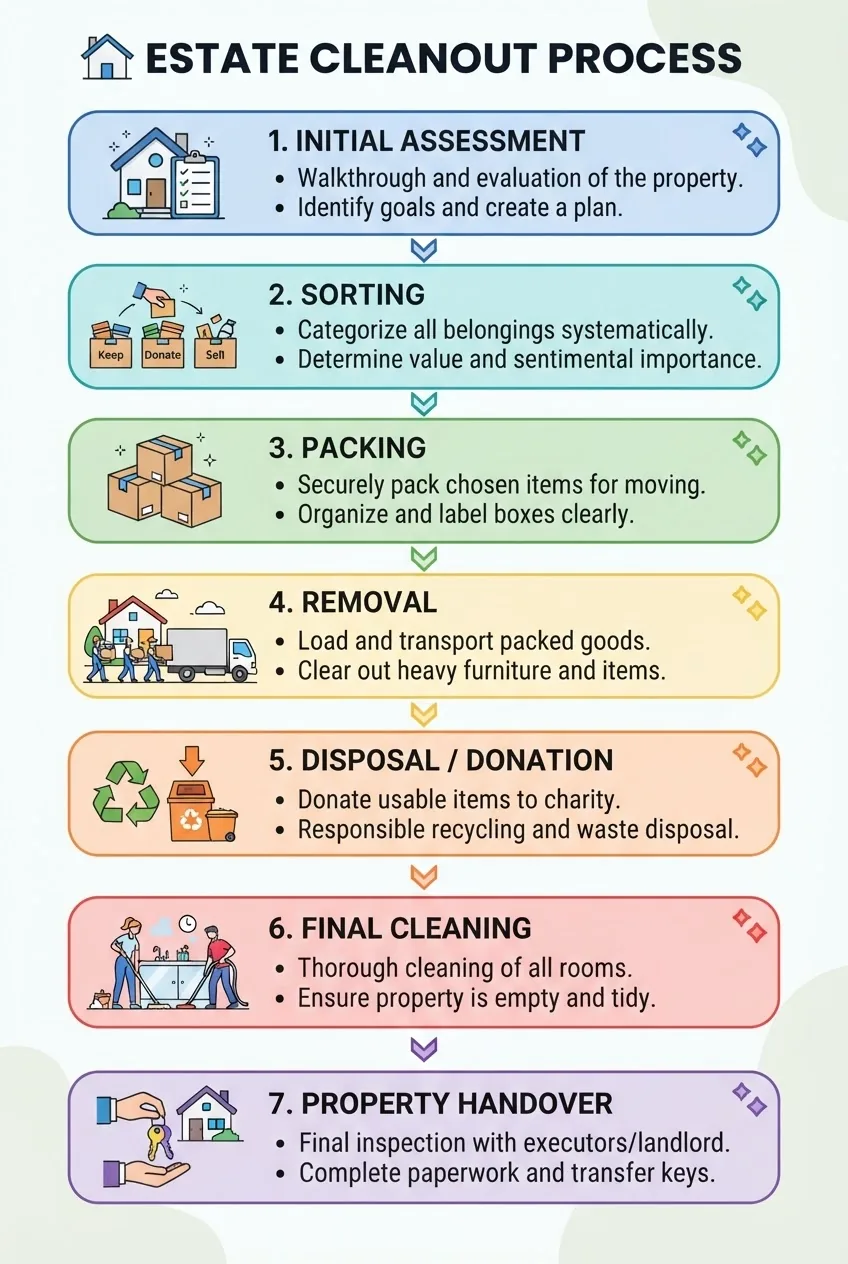
- Start with documentation and authority verification — 0.5–2 hours.
Confirm executor status or written permission from the estate owner. Photocopy government ID and court documents. Make a single “authority packet” folder to carry on-site. If you lack written authority, pause: improper disposal can lead to legal liability and estate disputes.
- Perform an initial property assessment — 1–3 hours for a 1–3 bedroom home.
Walk every room, cellar and outbuilding with a notebook or tablet. Record the following: approximate volume of discards (cubic yards), presence of hazardous materials (paint, solvents, batteries), large items (sofas, pianos, appliances), and signs of pests or mold. Photograph each room and any potentially valuable items. Create a prioritized action list: immediate hold items, donation candidates, items for sale, trash, and hazardous materials.
Example inventory line: “Living room: 2-seat sofa (keep for heir A), 1 recliner (donate), bookshelf (sell), 6 boxes of books (sort).” Use tags or colored tape to represent each disposition.
If sale or salvage is planned, set aside at least 1–2 hours for photographing and listing high-value items online.
- Set scheduling, crew roles, and timeline — block 4–8 hours and calendar slots.
Decide on staffing: 2–3 movers for a small home; 4–6 for a 3+ bedroom. Typical hourly labor rate for crews ranges from $75–$150/hour depending on region (see cost section). Schedule the work window as contiguous blocks (e.g., 8am–4pm) to reduce on-site setup time.
Assign roles: Lead (oversees inventory and decisions), Sorting Team (labels and boxes), Heavy Lifting Team (furniture/appliance removal), Hazard Specialist (handles paints, batteries, medical waste), and Logistics (loads containers/hauler coordination).
- Sort belongings by disposition — estimate 0.5–1 hour per room.
Use four main lanes: Keep/hold, Donate/Sell, Recycle, Trash/Dispose. Label items clearly using numbered tags. For sentimental items, photograph and list location in the inventory before moving.
Guidelines: Place household hazardous waste and documentation in separate sealed bins. Use clear tote bins for valuables to avoid loss. Limit “keep” staging area to 20% of floor space to prevent scope creep.
furniture haul away and disposal is often necessary at this stage for bulky sofas and mattresses; coordinate measurement and door clearance before attempting removal.
- Pack and protect — 1–3 hours depending on volume.
Box small items, wrap fragile items in moving blankets, and bolt down/remove furniture legs if required for transport. Label boxes with room and content summaries (“Kitchen — Glassware — Fragile”). For documents, use a secure, locked box for anything with personal data.
If moving expensive items to storage, specify insurance coverage and get written receipts for transfer. For items going to sale, photograph and price them as you pack to speed listing.
- Remove large items and appliances — 1–6 hours; call appliance specialists for old fridges.
Calculate required crew and tools. For refrigerators and large appliances that require certified handling, coordinate an appliance pickup and disposal appointment in advance. Disconnect gas appliances only with licensed technicians.
office furniture removal may require specialty movers for modular workstations.
- Containerization and transport — align with selected service model, allow 1–2 hours for container placement and 2–8 hours for loading.
Options: roll-off container (you load), trucked full-service hauler (crew loads and hauls), or multiple donation runs. Match container capacity to volume: 10 cubic yards for small cleanout, 20–30 cy for 3–4 bedroom homes. Charge models vary (see cost section).
- Disposal, donation, and recycling runs — 2–8 hours depending on stops.
Coordinate donation center drop-offs during their open hours; obtain donation receipts and list items donated on estate inventory. For items accepted by nonprofits, call ahead to confirm pickup capabilities. For bulky brush or yard waste, consider specialist brush removal services.
- Handle hazardous materials safely — treat as priority items and plan disposal before main loading.
Common hazardous items: paint, pesticides, motor oil, fluorescent tubes, lithium batteries, and medical sharps. These cannot go to standard landfills. Follow local hazardous waste collection schedules or hire a certified hazardous waste hauler. Package sharps in approved rigid containers and label appropriately.
- Final clean, inspection, and property handover — 2–6 hours.
Perform a final sweep, basic cleaning (vacuum, wipe counters), and photograph the vacant property for records. Prepare a final inventory list and hand it off to the executor or realtor. If a lease or sale requires specific state of cleanliness, follow those specifications precisely.
- Closeout: receipts, disposal manifests, and documentation — 1–3 hours.
Collect landfill or transfer station receipts, donation receipts, hazardous waste manifests, and crew invoices. File these in the estate record. If disputes arise later, this documentation proves proper chain-of-custody and legal compliance.
Mini case study (experience): I coordinated a two-day cleanout of a 3-bedroom suburban home where the family wanted items sorted for sale and donation. Key challenge: an attic full of paint cans. I scheduled a hazardous waste pickup, saved 4 hours of crew time, and avoided a $400 surcharge from the landfill. Final cost: $2,850 including labor, roll-off, and hazardous disposal; see cost breakdown below.
Transition: Now that you know the operational sequence, let’s break down costs so you can budget accurately.
Cost of Estate Cleanout Services — What to Expect

Estate cleanout pricing depends on four primary factors: labor hours, volume (cubic yards), the contents being removed (hazardous vs inert), and local disposal costs. Expect regional variation; always request an on-site estimate for accuracy.
High-level price ranges (typical U.S. averages, 2024):
- Small cleanout (studio/1BR): $300–$1,000.
- Medium cleanout (2–3BR): $1,100–$4,000.
- Large cleanout (4+BR, multi-structure): $3,500–$12,000+.
According to a 2024 industry report by the National Waste & Recycling Association, labor and disposal fees combined account for roughly 70–80% of total cleaning costs in residential cleanouts; travel and administrative fees make up most of the remainder.
Cost components explained:
- Labor: Crew rates vary by region. Typical hourly crew cost: $75–$150/hour for a 2–3 person crew; larger crews scale up. Labor increases with narrow staircases, long carry distances, or complex disassembly.
- Volume-based disposal: Many haulers charge by cubic yard. Common per-cubic-yard rates: $40–$85 in urban areas. Roll-off bins are priced by size (10/20/30 cy) plus a landfill or transfer station disposal fee.
- Item-specific fees and appliance disposal: Refrigerators, air conditioners, and mattresses can carry special fees ($30–$200 each) because of refrigerant handling or mattress disposal surcharges.
- Hazardous materials: Hazardous household waste disposal is priced separately; expect $50–$500 depending on quantity and type. According to a 2023 EPA report, hazardous household items require specialized disposal to prevent groundwater contamination.
- Donation and hauling logistics: Donation pickups may be free from nonprofits but could require staff/crew time for loading. Some nonprofits accept free pickup; others require drop-off. Value capture (tax receipts) depends on the nonprofit’s appraisal.
- Travel, permits, and wait time fees: Remote locations, permit requirements for curbside container placement, or restricted access (HOA rules) can add $50–$500 in fees.
- Hidden charges to watch for: late cancellations, extra labor for unanticipated hoarding conditions (add 25–50% labor), bulky item surcharges, and additional permits.
Sample pricing table (illustrative examples):
| Service | Typical cost | Notes |
|---|---|---|
| 2-person crew, 4 hours | $400–$1,200 | Short jobs, minimal heavy lifting |
| Roll-off 20 cy (rental + disposal) | $600–$1,400 | Best for 3BR houses |
| Hazardous waste pickup (per site) | $150–$900 | Paints, solvents, batteries |
| Full-service 3BR cleanout | $1,600–$5,500 | Includes labor, hauling, basic clean |
Price-estimating examples:
- Example A — Medium suburban cleanout: 3-person crew x 8 hours = $1,800 (labor) + 20 cy roll-off $900 + disposal fees $400 = $3,100 total.
- Example B — Small apartment: 2-person crew x 3 hours = $450 + donation runs $0 + small appliance disposal $75 = $525 total.
- Example C — Large estate with hazardous waste: 5-person crew 2 days = $5,000 + hazardous manifests $700 + multiple dumpsters $2,500 = $8,200 total.
Practical tips to control cost:
- Pre-sort and donate usable items to reduce volume charged by cubic yard.
- Schedule hazardous waste pickups to avoid landfill surcharges.
- Get three written estimates that specify labor, disposal per-cubic-yard rates, and fuel/travel fees.
- Ask for written clarity on bulky-item fees like pianos, hot tubs, or built-in removals.
Transition: Costs are one side of the equation; compliance and permitting are equally important to avoid fines and legal complications.
Legal and Regulatory Requirements for Estate Cleanouts
Estate cleanouts intersect with probate law, local municipal regulations, and environmental rules. Below are the main legal obligations you must check before proceeding.
- Executor authority and probate timelines: Executors or personal representatives must follow probate court orders. Verify authority in writing and preserve inventories as required by probate. For U.S. federal guidance on probate procedures, consult the U.S. Courts resources at U.S. Courts.
- Permits for container placement: Many municipalities require a temporary use or curbside permit to place a roll-off container in the public right-of-way. Fees vary; plan 3–10 business days for municipal approvals in some jurisdictions.
- Hazardous waste disposal: Paints, solvents, and certain electronics cannot be disposed in regular landfills. Follow local hazardous waste guidelines; refer to federal environmental guidance from the EPA at EPA. Many states provide specific Household Hazardous Waste (HHW) programs.
- Landfill and transfer station manifests: Certain materials require manifests to track disposal. Keep all receipts and manifests for the estate file.
- Asbestos, lead, and mold: Renovation-related cleanouts that disturb suspected asbestos or lead-containing materials typically require licensed abatement contractors and notification to local agencies. Test if the structure was built before 1980 and contains peeling paint or insulation.
- Medical waste and sharps: Disposal of medical sharps and pharmaceuticals often has specific collection and packaging regulations; do not place sharps into household trash without an approved sharps container and disposal route.
- Insurance and liability: Use insured, licensed contractors. Confirm general liability and workers’ compensation coverage. Require proof of insurance before the crew starts work.
Regional variability disclaimer: permit needs, hazardous waste rules, and landfill acceptance vary widely. Confirm rules with your municipal public works or solid waste authority.
External resources for compliance and best practice:
- Federal environmental guidance: EPA.
- Probate and executor guidance: U.S. Courts.
- Donation and reuse partners: see selected nonprofit options below at the Disposal & Donation section, and also consider local Goodwill branches at Goodwill.
Transition: With legal checks in place, you can make sustainable disposition choices — donation, recycling, or disposal.
Choosing the Right Estate Cleanout Service Near Me
When searching for estate cleanout services near me, you’ll encounter three main provider types. Evaluate price, scope, reviews, and insurance. Use the table below to compare options.
| Service type | Best for | Pros / Cons |
|---|---|---|
| Full-service cleanout | Executors, time-limited situations | Pros: turnkey; Cons: higher cost |
| Labor-only crew | When you arrange disposal | Pros: cheaper labor; Cons: you arrange dumpsters |
| Container rental (roll-off) | DIY loading, large volumes | Pros: controlled timing; Cons: heavy lifting by family |
Selection tips:
- Verify licensing and insurance; request COI (certificate of insurance).
- Ask for itemized written estimates with clear cubic yard rates and appliance fees.
- Check reviews and request references for estate-specific work.
- Confirm what the company will do with donations and provide receipts for tax-deduction documentation.
- When removing large furniture during an estate cleanout, refer readers to the detailed couch removal guide for furniture haul away and disposal on the pillar page for measurement, door clearance, and disposal options.
- If you plan to retain or move furniture rather than dispose of it, consider using furniture pickup and delivery services to relocate items to storage or a new residence.
Transition: After choosing your service, plan how items will be diverted to donation, recycling or landfill.
Disposal, Donation, and Recycling Options in Estate Cleanouts
Sorting items for donation and recycling reduces disposal costs and can produce tax receipts for the estate when done properly. Below are common options and benefits.
- Donation centers — Goodwill, Salvation Army, and local charities often accept furniture, clothing, and household goods. Some offer free pickup for large donations; call ahead for schedule. For national info, see Goodwill.
- Recycling facilities — Electronics, metals, and plastics can often be diverted; fees or drop-off requirements vary by facility.
- Landfill/transfer stations — Use for inert trash not accepted elsewhere. Keep disposal receipts as proof of final disposition.
- Hazardous waste programs — Use municipal HHW days or contracted pickups for paints, pesticides, and solvents. Do not mix hazardous waste with general trash.
- Appliance disposal — Use certified appliance pickup programs for refrigerators and air conditioners due to refrigerant handling rules; see appliance guidance in this section and call a certified technician when disconnecting gas lines.
Benefits of donation and recycling:
- Lower disposal costs by reducing cubic yardage.
- Tax-deduction documentation for the estate when charities provide receipts.
- Community benefit and reduced landfill usage: according to a 2022 waste diversion report by industry sources, donation and recycling can divert up to 30% of estate material from landfill.
When to use specialized services:
- For extensive yard debris, hire specialized brush removal services.
- For appliances like fridges, schedule appliance pickup and disposal and secure refrigerant manifests.
Transition: Even with a plan, challenges arise during estate cleanouts; below are the common ones and how to manage them.
Common Challenges and How to Troubleshoot Them
Estate cleanouts present practical and emotional challenges. Below are typical problems and practitioner-tested solutions.
- Difficult-to-move items: Problem: oversized furniture stuck through stairwell. Solution: measure doorways in advance, consider partial disassembly, or hire specialty rigging. If a piano or hot tub is involved, get three specialty quotes.
- Emotional disputes among family: Problem: multiple heirs claim the same item. Solution: pause removal, photograph the item, add to an “on-hold” list, and involve the executor or a neutral mediator. Preserve chain-of-custody notes.
- Hidden hazardous materials: Problem: paint cans and solvents found during loading. Solution: stop loading, segregate items into clearly labeled drums, and schedule an HHW pickup. I once had to add a same-day hazardous pickup that cost $480 but avoided a landfill surcharge and potential fines.
- Scheduling delays and access issues: Problem: HOA restrictions on container placement. Solution: secure permits or HOA approvals 7–14 days prior, or arrange off-site container placement with longer carries.
- Unclear legal authority: Problem: non-executor family members attempt to direct the cleanout. Solution: request written executor authorization; if unavailable, consult probate counsel. Never dispose of items without clear written instructions.
Transition: To keep your cleanout on track, follow the checklist below and learn from common mistakes we’ve seen.
Estate Cleanout Checklist for Executors and Families
- Confirm executor authority and bring documentation.
- Perform full visual inventory with photos and list of hold items.
- Identify hazardous materials and schedule HHW pickup.
- Decide donation partners and confirm pickup windows.
- Measure large items and doorways for removal plans.
- Book crew or container and obtain written estimates.
- Label boxes by room and item type; secure valuables in locked boxes.
- Collect donation and disposal receipts and file them in estate records.
- Complete final cleaning and take handover photos.
- Keep all documentation for probate or tax purposes.
Transition: Before you act, learn from the mistakes others typically make so you can avoid them.
Common mistakes and how to avoid them
I once accepted a lowball estimate and discovered after three laborers arrived that the quote excluded hazardous waste and heavy bulky fees. We stopped work, negotiated an amended contract, and added $900. From that failure I learned to always insist on itemized, signed estimates before any work starts.
Another frequent mistake: families underestimate the time for sorting. I’ve seen a “one-day” cleanout expand into four days because the team didn’t reserve time for inventorying heirlooms. Schedule buffer days: add 20–40% contingency to labor estimates.
I also encountered improper disposal of paint cans which led to local fines. Lesson: segregate hazardous materials on day one and schedule proper collection; don’t rely on the landfill to accept these items.
When to call a professional: if you identify suspected asbestos, require gas appliance disconnection, face legal disputes among heirs, or the property has extensive biohazard contamination — these are beyond standard cleanout crews and need licensed specialists.
When to call in a professional
- Mold or suspected asbestos remediation — call a licensed abatement contractor.
- Gas appliance disconnections and complex electrical work — call licensed tradespeople.
- Large estates with storage units, outbuildings, or vehicles — call a full-service estate cleanout company with logistic experience.
- Estate disputes or unclear executor authority — consult probate counsel before removal.
Conclusion — Key takeaways: plan with documentation, prioritize hazardous materials and valuables, get itemized estimates, and use donation/recycling to reduce costs. If the estate contains specialized hazards or you lack clear authority, call licensed professionals. Ready to proceed? Start with a documented inventory and one written estimate from a reputable local provider and you’ll avoid the most common pitfalls.
Next step: If you need measurement or couch-removal specifics, review the pillar resource on couch removal for exact clearance and handling steps.