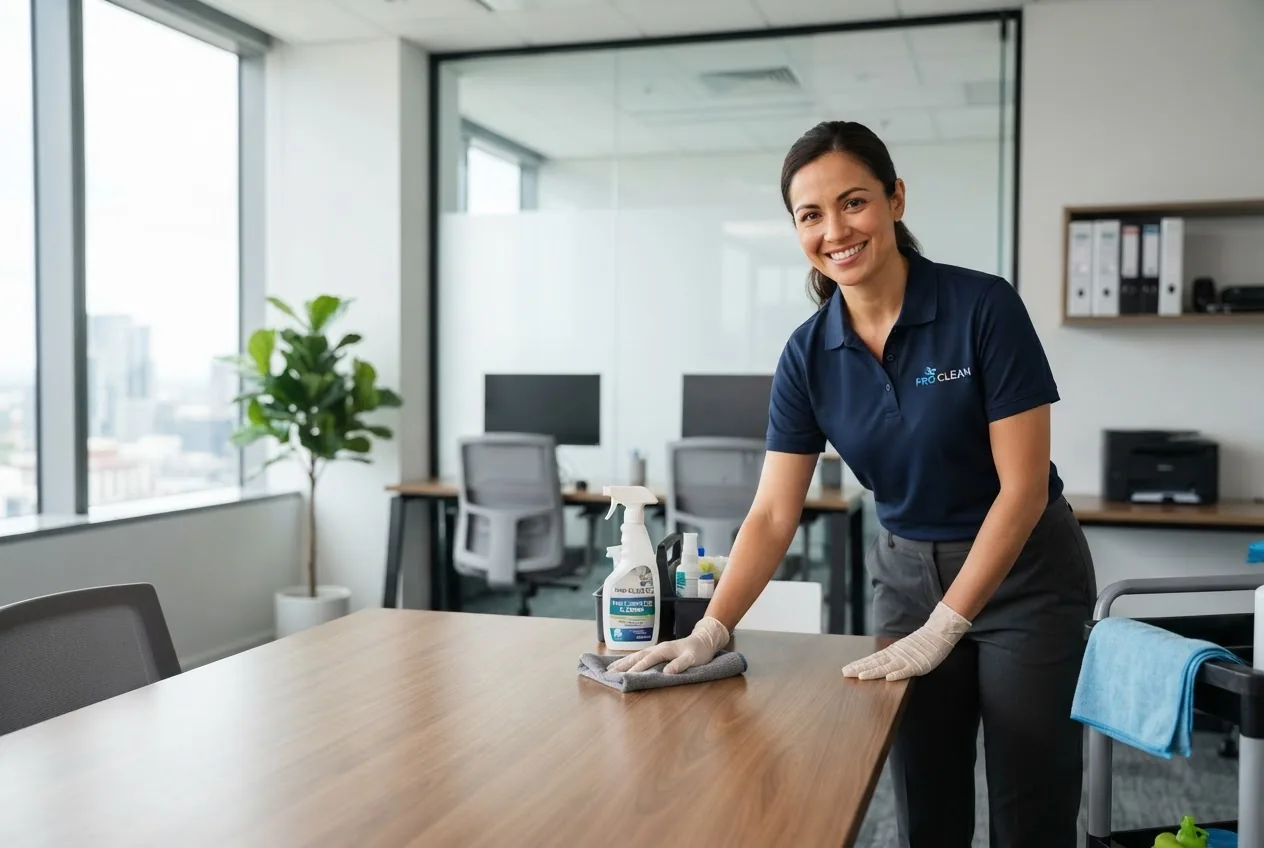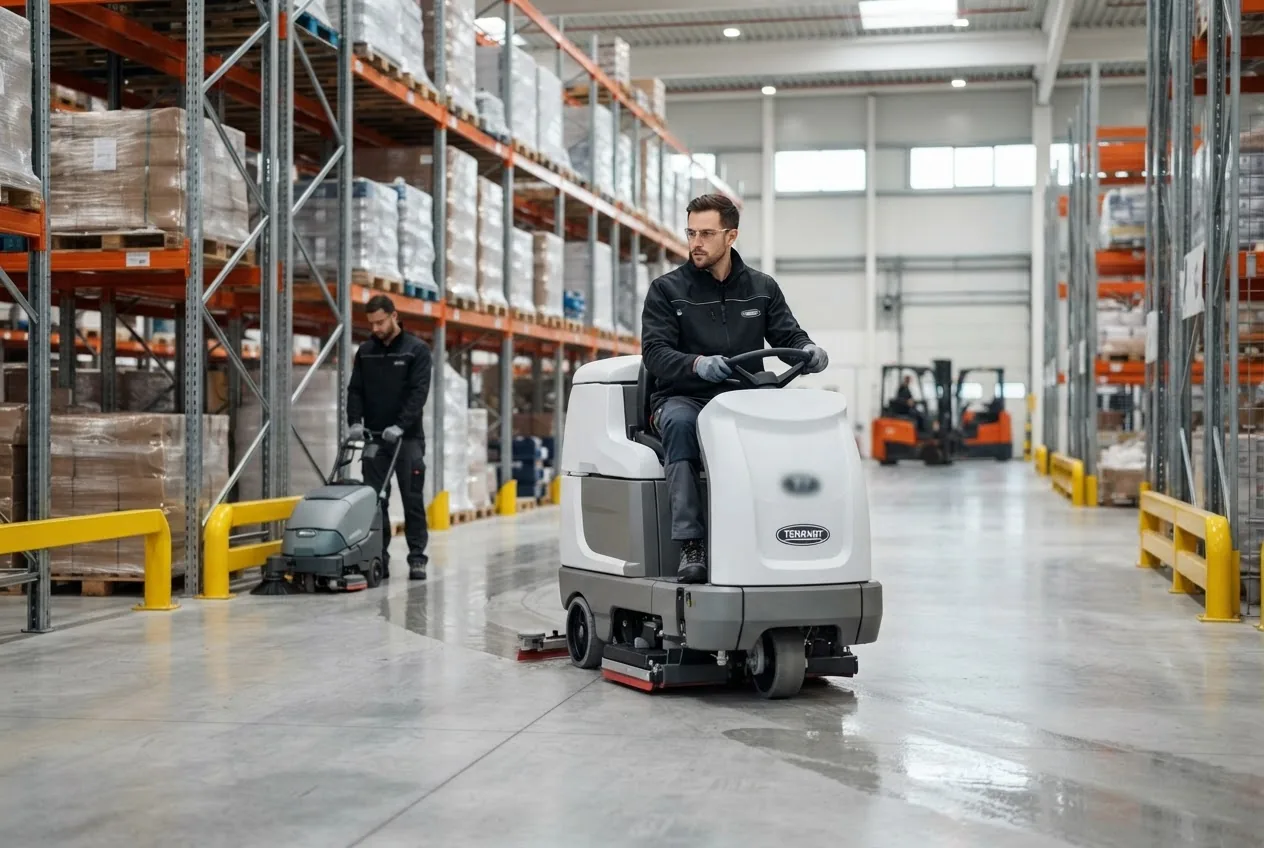
Store cleaning services are professional commercial cleaning solutions that maintain hygiene, appearance, and safety in retail spaces, combining daily janitorial work, periodic deep cleaning, and specialty services. Small and medium retail businesses use them to protect customers and staff, preserve store assets, and support brand image through tailored cleaning schedules and trained crews.
Term: Janitorial services — routine cleaning tasks (sweeping, trash removal, restroom maintenance) performed regularly to keep a commercial space functional and presentable.
Introduction to Store Cleaning Services and Their Importance
Answer: Store cleaning services keep retail environments sanitary, attractive, and safe for customers and employees by combining routine janitorial work, specialized maintenance (floors, windows, restrooms), and scheduled deep cleanings tailored to store size and foot traffic.
Clean retail premises directly affect customer perception, employee productivity, and regulatory compliance. For small and medium businesses, effective store cleaning services reduce slip-and-fall risks, minimize product damage from dust or spills, and lower staff sick days through targeted hygiene practices. According to a 2023 industry survey, visible cleanliness is cited by 61% of consumers as a primary factor in repeat visits, highlighting the business value of consistent cleaning (According to a 2023 industry survey).
Operationally, store cleaning services are often packaged as:
- Daily janitorial programs for opening/closing tasks and high-touch surface wiping.
- Scheduled maintenance (floor finish, window polish, restroom deep cleans) to extend asset life and maintain aesthetics.
- Event or post-construction cleaning to prepare the store for customers after disruptions.
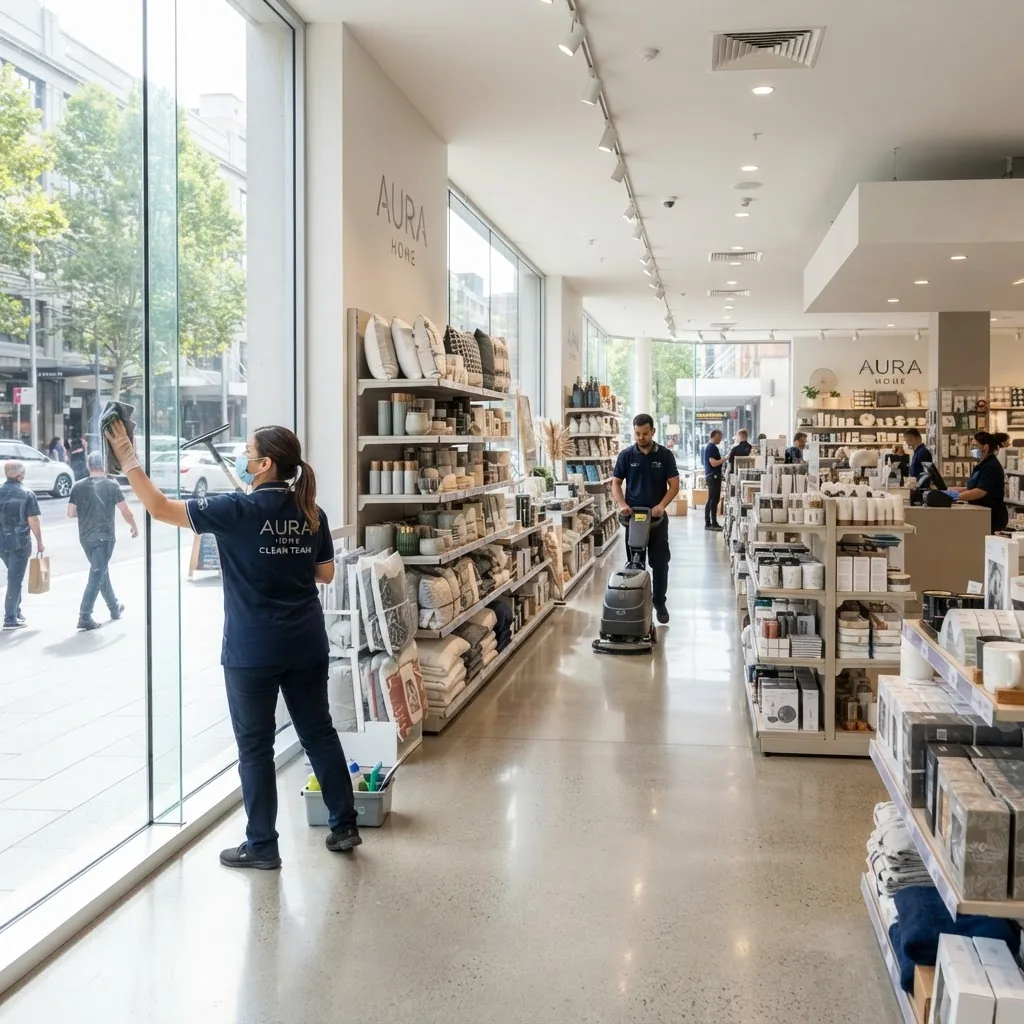
Transition: Understanding the specific types of store cleaning services available helps match a solution to your store’s layout, traffic, and budget.
Types of Store Cleaning Services Explained
Answer: Store cleaning services include janitorial routines, floor care, window cleaning, restroom sanitation, specialty services (display and aisle care), and emergency/post-event cleaning—each tailored by frequency, equipment, and safety requirements.
Term: Floor care — the full set of processes for maintaining hard and soft flooring, including sweeping, scrubbing, stripping, refinishing, and carpet extraction.
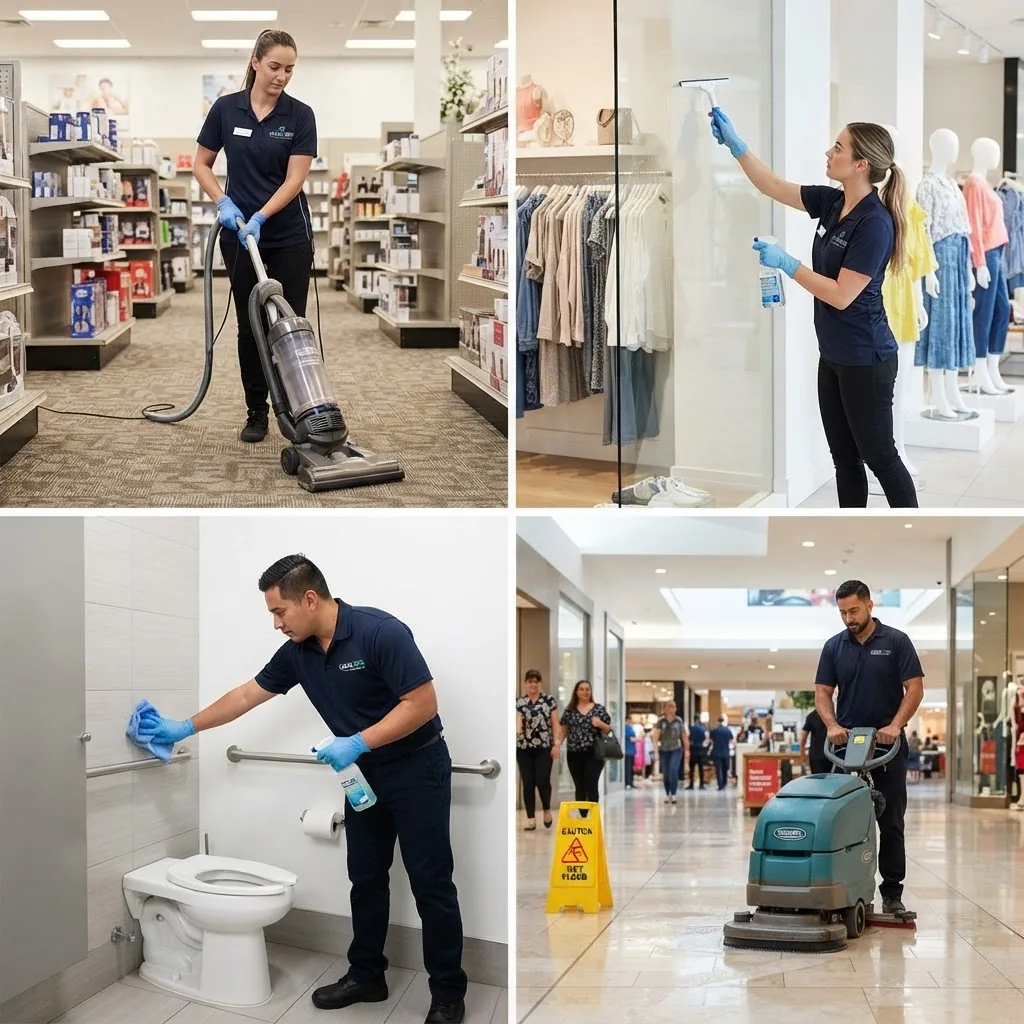
- Daily Janitorial Services — Basic duties performed daily: trash removal, sweeping/vacuuming, dusting, restroom checks, and spot mopping. These services prioritize high-traffic zones and high-touch surfaces to control immediate appearance and hygiene.
- Floor Care (hard floors) — Includes buffing, auto-scrubbing, stripping, and finish application for tile, vinyl, and sealed concrete. Frequency depends on foot traffic: entryways and checkout lanes often need daily maintenance while back stockrooms can be weekly. commercial floor care services
- Carpet Cleaning — Hot-water extraction, bonnet cleaning, and spot treatment to remove soil and allergens; recommended quarterly to annually depending on traffic and merchandise type.
- Window and Glass Cleaning — Interior and exterior window washing, glass door polishing, and display case cleaning done weekly to monthly; frequency increases when visibility impacts sales.
- Restroom Sanitation — Deep restroom cleaning and disinfecting, replenishment, odor control, and fixture maintenance; typically daily with more frequent checks during peak hours.
- Dusting and Display Maintenance — Shelves, product displays, and signage dusting to protect merchandise and brand presentation; schedule varies by product sensitivity.
- Specialty Cleaning (fixtures and finishes) — Polishing metal fixtures, cleaning decorative surfaces, and maintaining specialty finishes that require vendor-approved products to avoid damage.
- Back-of-House and Warehouse Cleaning — Sweeping, spill clean-up, pallet area decontamination, and waste management for attached storage or receiving docks. warehouse cleaning services guide
- Food-Handling and Kitchen-Adjacent Cleaning — For stores with food prep or sampling stations; follow food safety cleaning protocols and often require specialized crews and chemicals. commercial kitchen cleaning services kitchen cleaning service guide
- Restaurant/On-site Dining Cleaning — Dining area cleaning, upholstery care, and grease-prone surface maintenance; retail operations with customer dining may use restaurant-focused services. restaurant cleaning service guide
- Emergency and Post-Event Cleaning — Rapid-response teams for spills, biohazards, or event clean-up; includes stain removal, odor control, and full-area sanitation. post construction cleaning services post construction clean up
- Specialty Services: Inventory Prep & Fixture Protection — Cleaning before merchandising displays or seasonal rollouts, often timed with deliveries or installs.
- Green and Low-VOC Cleaning — Uses environmentally preferred products and methods to reduce chemical exposure for customers and staff.
- Inspection & Compliance Cleaning — Cleaning targeted toward meeting health inspections or retailer chain standards, often with documented checklists and photo reports.
Transition: Once you know the types of services, you’ll want to compare store cleaning with other commercial cleaning categories to decide if a retail specialist is necessary.
Comparing Store Cleaning Services with Other Commercial Cleaning Options
Answer: Store cleaning services differ from office and residential cleaning mainly in customer-facing presentation, higher-frequency floor and display care, and the need for retail-specific safety and merchandising sensitivity; office and residential services prioritize workspace or living-area comfort and privacy.
Term: Residential and office cleaning — Residential cleaning focuses on private living spaces while office cleaning targets workstation hygiene, communal areas, and confidential document handling.
| Feature | Store Cleaning Services | Office Cleaning | Residential Cleaning |
|---|---|---|---|
| Primary focus | Customer-facing appearance, displays, floors | Workstation hygiene, conference rooms | Living areas, kitchens, bathrooms |
| Frequency | Daily to several times daily in high traffic | Daily/weekly depending on occupancy | Weekly or biweekly typical |
| Specialized equipment | Floor machines, display-safe tools, POS-safe dusting | Commercial vacuums, ergonomic tools | Domestic vacuums, handheld tools |
| Staff training focus | Merchandise protection, customer interaction, safety | Confidentiality, office workflow | Home privacy, possessions care |
| Regulatory concerns | Food sampling, ADA access, retail codes | Workplace safety policies | Local licensing in some areas |
In practice, store cleaning often requires more frequent floor care and display maintenance than offices. For very small retailers, overlaps with small office cleaning occur—tasks like desk sanitization or light vacuuming mirror office services, but merchandising sensitivity and customer pathways increase complexity. For details on office-focused options, consult the office cleaning jobs career guide and the best office cleaning services near me. For very small shops, compare with the small office cleaning services guide.
Transition: Knowing the distinctions, you can create selection criteria to hire a cleaning company suited for retail environments.
How to Choose the Right Store Cleaning Service for Your Business
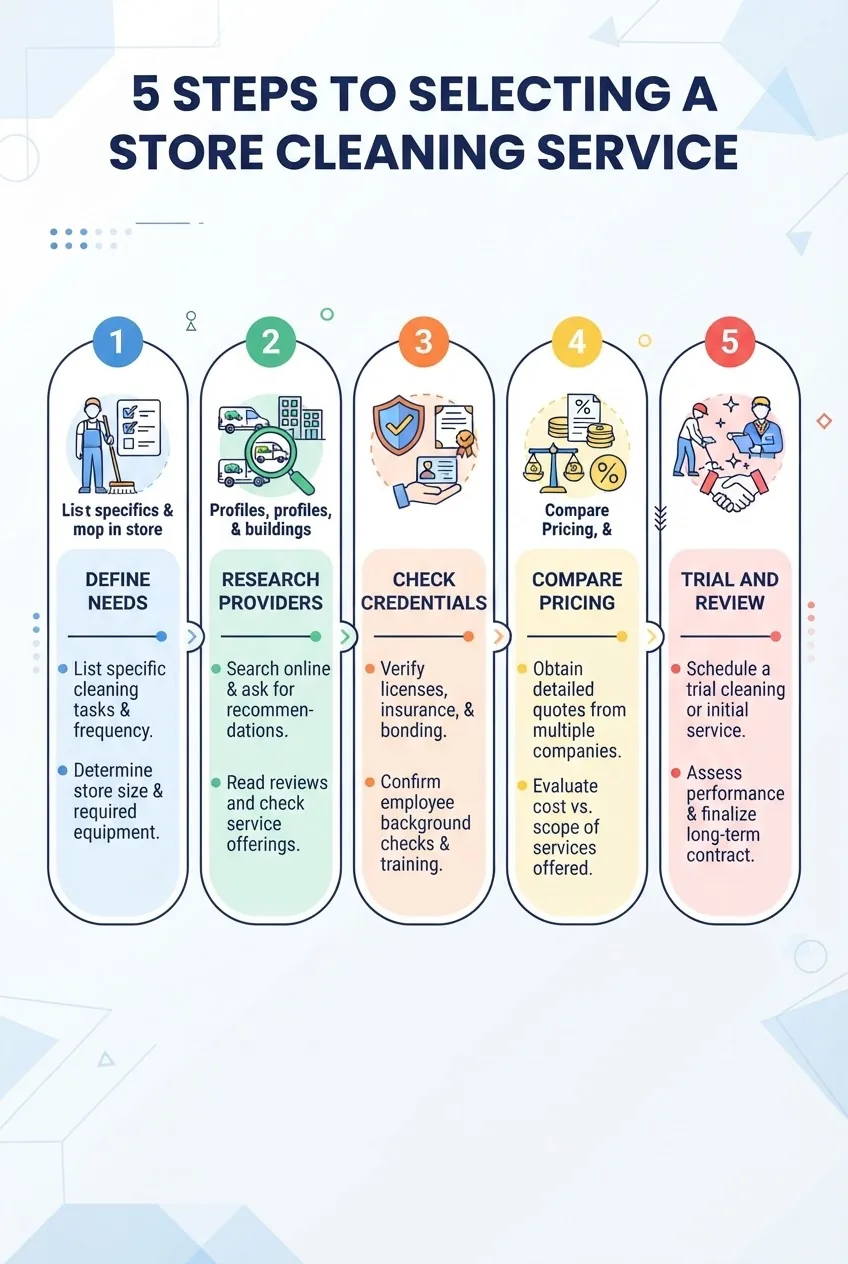
Answer: Choose a store cleaning service by defining needs, vetting credentials, comparing contracts and pricing models, confirming safety and insurance, reviewing references, and running a short trial to evaluate performance.
Term: Cleaning contracts — written agreements defining scope, frequency, liabilities, pricing model (hourly, flat, or per-visit), and termination terms.
- Step 1 — Define your needs and priorities
- List spaces (sales floor, fitting rooms, restrooms, stockroom) and identify peak traffic times.
- Decide required frequency for each task (daily, weekly, monthly) and any non-standard needs like overnight access or weekend events.
- Step 2 — Research providers and gather quotes
- Request three bids with identical scopes so comparisons are apples-to-apples.
- Ask for references from similar-sized retail clients and photo or checklist reporting samples.
- Step 3 — Vet credentials, insurance, and training
- Confirm general liability and workers’ compensation insurance and ask for certificate of insurance.
- Verify staff training, background checks, and any certifications (ISSA or vendor-specific training).
- Step 4 — Compare pricing models and contract terms
- Decide between hourly, flat-fee, or bundled service contracts based on predictability and control needs (see Pricing Models section for examples).
- Look for flexibility clauses for seasonal increases and clear performance metrics.
- Step 5 — Confirm safety, environmental standards, and compliance
- Ask about cleaning agents used, MSDS availability, and protocols for chemical handling.
- Ensure practices align with local codes and any chain requirements.
- Step 6 — Pilot period and performance reviews
- Arrange a 30–90 day trial with agreed KPIs: punctuality, checklist completion, customer-impact metrics.
- Use photo reports and manager sign-offs to document quality and adjust scope if needed.
Checklist for selecting a provider:
- Defined cleaning scope and frequencies for each area
- Written contract with cancellation and dispute terms
- Certificate of insurance and bonded staff
- Training and background check verification
- Sample reports or digital tracking of work
- Trial period with measurable KPIs
For businesses in California or those seeking region-specific norms and cost expectations, see the cleaning companies in California. For firms that rely heavily on janitorial-style services, review the qualifications of janitorial services companies.
Transition: With a provider selected, create a cleaning schedule that fits store operations and peak flows.
Typical Cleaning Schedules & Frequencies for Stores
Answer: Typical retail cleaning schedules combine daily frontline tasks (trash, floors, restrooms), weekly tasks (detailed dusting, window cleaning), and quarterly deep cleans (carpets, floor refinishing) tailored by store size and customer volume.
Below is a sample weekly schedule for a small-to-medium retail store (approx. 2,000–5,000 sq ft). Adjust frequencies upward for malls or high-footfall locations.
| Task | Daily | Weekly | Monthly/Quarterly |
|---|---|---|---|
| Trash removal | X | ||
| Sweep & mop high-traffic areas | X | Floor machine maintenance (quarterly) | |
| Restroom sanitation | X (checks throughout day) | Deep clean weekly | |
| Display dusting | X | ||
| Window/glass cleaning | X (more frequent for storefronts) | High-reach wash quarterly | |
| Carpet extraction | Quarterly |
Day-to-day workflow used by professional cleaning companies typically includes a morning check (entryways, restrooms), midday touch-ups for high-traffic periods, and an evening close that records completed tasks in a checklist or app. According to a 2024 industry report, companies that use digital checklist reporting reduce missed tasks by up to 35% (According to a 2024 industry report).
Transition: Scheduling affects price—understanding pricing models helps anticipate costs.
Pricing Models and What Affects Store Cleaning Costs
Answer: Store cleaning costs depend on pricing models (hourly, flat-fee per visit, per-square-foot, or bundled contracts) and are influenced by store size, frequency, required specialty services, equipment needs, access hours, and compliance demands.
Common pricing structures:
- Hourly rates — Flexible for variable scopes; common for small or irregular jobs.
- Flat-fee per visit — Predictable monthly billing for routine scopes; often used for daily janitorial contracts.
- Per-square-foot — Useful for one-off deep cleans or move-in/move-out services.
- Bundled packages — Combine janitorial, floor care, and specialty services at a discounted rate.
Factors that increase costs:
- High foot traffic requiring daily intensive floor maintenance
- Specialty surfaces or finishes needing trained crews and approved chemicals
- After-hours or weekend access fees
- Insurance and background-check requirements for staff on site
- Rapid-response or emergency availability
Example pricing scenarios (illustrative):
- Small boutique (1,500 sq ft), daily light janitorial: flat-fee $350–$650/month (According to regional provider benchmarks, 2023).
- Mid-size store (4,000 sq ft), daily janitorial + weekly floor care: bundled $1,200–$2,500/month depending on finish work and foot traffic (According to a 2023 industry report).
- One-off post-event deep clean: per-square-foot $0.20–$0.75 depending on soil category and required labor (According to a 2023 industry report).
Caveats: These scenarios are representative estimates; local labor rates, supply chain issues for chemicals or replacement parts, and regional market competition alter actual bids. For retail-focused cost analysis, consult the retail store cleaning services guide.
Transition: Pricing and contracts should align with environmental, safety, and regulatory practices to protect customers and comply with rules.
Environmental, Safety, and Regulatory Considerations for Store Cleaning
Answer: Store cleaning must meet occupational safety standards, use approved chemicals responsibly, follow industry best practices for disinfection when needed, and incorporate green cleaning options to reduce environmental impact and customer exposure.
Term: Disinfection — the process of using approved chemical agents to reduce pathogenic microorganisms on surfaces to safe levels as specified by health guidance.
Key compliance and safety actions:
- Maintain Material Safety Data Sheets (MSDS) for all chemicals on site and ensure staff training in chemical handling and PPE use. OSHA provides standards and guidance for workplace safety relevant to cleaning staff. OSHA
- Adopt green cleaning products certified by recognized programs (e.g., EPA Safer Choice) for lower VOC emissions and reduced environmental impact. EPA Safer Choice
- Follow ISSA industry best practices for cleaning frequencies, equipment care, and documentation to maintain professional standards. ISSA
- Document disinfection protocols when required by local health authorities or corporate policy; this complements specialized commercial disinfection services for outbreak response or regulatory compliance.
Best practices include substituting low-toxicity products where possible, using dilution control systems to avoid overuse of chemicals, and scheduling high-chemical tasks during closed hours to minimize customer exposure. For small retailers, documented training and easy-to-audit checklists are effective trust signals for both employees and landlords.
Transition: Beyond compliance, hiring professionals yields measurable business benefits that justify investment.
Benefits of Hiring Professional Store Cleaning Services
Answer: Professional store cleaning services improve brand perception, customer satisfaction, employee health, and operational efficiency while extending the life of store assets and reducing liability risks.
Stat block:
- 61% of shoppers cite cleanliness as a reason to return (According to a 2023 industry survey).
- Professional floor maintenance can extend finish life by up to 40% (According to a 2022 flooring industry report).
- Documented cleaning and reporting reduce customer complaints by an estimated 28% (According to a 2024 industry report).
Operational advantages include predictable budgeting with service contracts, fewer store disruptions due to proactive maintenance, and access to trained crews with specialized equipment. Health benefits include reduced absenteeism when high-touch surfaces are managed systematically. For many retailers, the investment in professional services returns through higher customer retention and lower asset replacement costs.
Transition: Even with good providers, common challenges can arise—here’s how to troubleshoot them effectively.
Troubleshooting Common Store Cleaning Challenges
Answer: Address missed spots, inconsistent quality, scheduling conflicts, and workforce shortages by documenting issues, communicating clearly with the provider, specifying corrective actions in the contract, and keeping backup cleaning resources.
Common issues and fixes:
- Missed areas or inconsistent quality — Document with photos and timestamps, request corrective visits within a set SLA, and add penalty or remediation clauses in the contract.
- Scheduling conflicts — Agree on windows for work (e.g., before opening, after close) and include rigidity/flexibility terms in the agreement.
- Cost overruns — Require pre-approval for out-of-scope work and use bundled pricing to cap surprises.
- Chemical sensitivities among staff/customers — Request low-VOC or green products and post signage when stronger agents are used; ensure MSDS availability.
- Workforce shortages or turnover — Insist on staffing contingency plans and verification of hiring practices; see labor resources such as cleaning jobs and contract opportunities and janitor jobs near me.
- Post-construction or renovation debris — Use providers experienced in post construction cleaning services to avoid repeated touch-ups.
How-to steps for remediation:
- Log issues with evidence and timestamps.
- Notify the account manager and request a corrective action plan within 24–72 hours.
- Escalate per contract terms if unresolved; consider a trial with an alternate crew for comparison.
- Review KPIs monthly and adjust scopes or schedules based on data.
Transition: After vetting, scheduling, and troubleshooting, finalize next steps to secure a reliable cleaning partner.
Conclusion and Next Steps for Businesses Looking for Cleaning Services
Answer: Define your store’s cleaning needs, gather and compare bids, verify credentials and insurance, run a short trial, and use documented KPIs to finalize a long-term cleaning contract that protects your brand and assets.
Recommended next actions:
- Create a simple scope document listing all areas, desired frequencies, and any special requirements (e.g., after-hours access).
- Request three written bids with the same scope and ask for references from similar retail clients.
- Verify insurance, background checks, and training; request sample checklists and photo reports.
- Run a 30–90 day trial and measure performance against KPIs: punctuality, checklist completion, and customer impact.
If you’re ready to start, request quotes with a clear scope and schedule a walk-through with shortlisted providers. For compliance-related cleaning beyond standard services, consider adding commercial disinfection services to your plan. Getting professional help is an investment in customer perception, employee safety, and long-term asset preservation—contact local providers today to arrange a site assessment and trial.