
Kitchen cleaning service Guide: by the end you’ll be able to specify, schedule, and supervise a full commercial kitchen deep clean and set a recurring maintenance plan; allow 6–10 hours for a full deep clean of a medium-size restaurant kitchen, skill level: intermediate facilities or kitchen manager.
Before you start, this hands-on guide assumes you already manage or operate a commercial kitchen and have basic PPE and access to service areas. It explains service types, detailed procedures, compliance checks, and hiring criteria so you can act as the on-site lead during a professional clean or manage vendor contracts.
Overview of Kitchen Cleaning Services for Commercial and Restaurant Settings
Commercial and restaurant kitchens require systematic cleaning to control cross-contamination, reduce fire risk from grease, and meet health code standards. This overview explains who does the work — from in-house crews and janitorial teams to specialized contractors — and clarifies how regular maintenance differs from episodic deep cleaning.
First, understand roles: in-house staff perform daily cleaning tasks (surface wiping, dishwashing, spill control) while professional commercial kitchen cleaners focus on scheduled maintenance, equipment disassembly, and tasks that require specialized training or certification. A cleaning crew’s responsibilities are often split across line cooks, porters, and external technicians who handle hoods, grease traps, and ducts.
Operationally, kitchens follow a layered approach: routine surface sanitation after each shift; weekly focused tasks (floor scrubbing, oven degreasing); and quarterly or semi-annual deep cleans for ventilation, grease traps, and back-of-house storage. Adopting a scheduled approach keeps a kitchen compliant with local health codes and reduces emergency closures.
Comparing kitchen cleaning to vehicle maintenance helps: daily checks are like checking oil, weekly maintenance is like tire rotation, and deep cleaning is a full service. That analogy helps managers justify budgets for preventive service rather than expensive repairs or shutdowns.
Commercial properties often combine kitchen cleaning into broader facility contracts or with vendors specializing in restaurant commercial cleaning services. For contrast with other commercial cleaning categories, consult resources for retail store cleaning services and store cleaning services.
Transition: now that you know the landscape, the next section breaks down specific service types and what each covers so you can match work to schedule and risk.
Types of Kitchen Cleaning Services Provided
- Standard kitchen cleaning services — daily and shift-based cleaning routines handled by staff or janitorial contractors.
- Commercial kitchen deep cleaning — scheduled, comprehensive cleans that disassemble and sanitize equipment, degrease surfaces, and validate sanitation.
- Specialty services — hood and ventilation cleaning, grease trap servicing, and post-construction clean up after remodels.
- Maintenance and verification — sanitation validation, ATP swab testing, pest prevention inspections, and documentation for health audits.
Standard Kitchen Cleaning Services
Standard cleaning covers routine, often daily tasks: wiping down worktops and walls, sanitizing food-contact surfaces, sweeping and mopping floors, emptying bins, washing dishware, and light equipment wiping. These tasks maintain visible cleanliness and reduce microbe build-up between deeper interventions.
Typical daily checklists include: surface disinfection with an approved food-contact sanitizer (use contact time: 60 seconds to 10 minutes per product label), floor degreasing at end of shift using a low-foaming alkaline cleaner, and trash removal with liners replaced. Use color-coded cloths to avoid cross-contamination: red for raw protein areas, green for produce zones, and blue for general surfaces.
Standard services are designed to be performed within 15–90 minutes per shift for most stations; larger prep lines or baking kitchens may take longer. In-house staff usually handle these tasks; however, some operators contract third-party janitorial teams for consistency and audit-ready documentation.
Commercial Kitchen Deep Cleaning
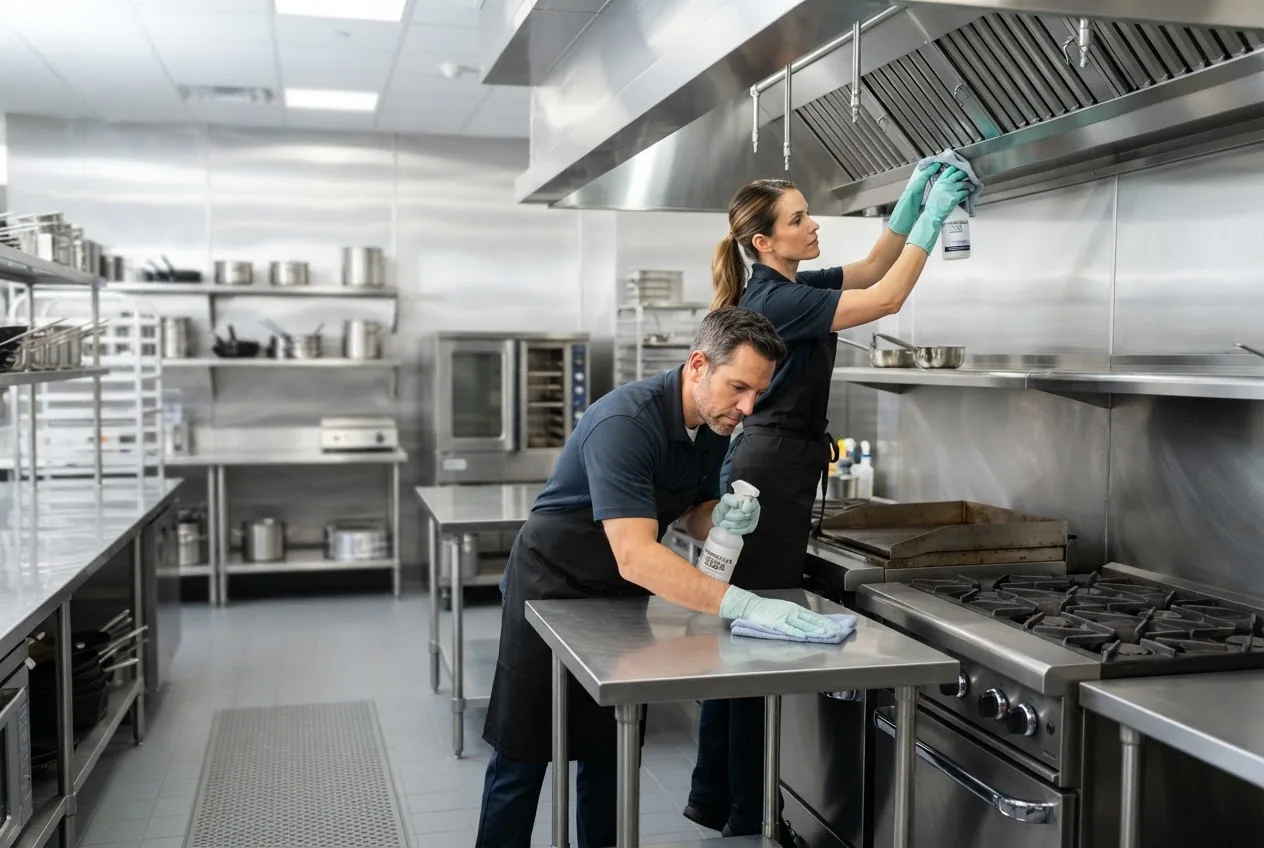
Deep cleaning is a planned, methodical process that goes beyond surface sanitation: it includes degreasing walls and ceilings, full equipment disassembly (ovens, fryers, combi ovens, mixers), pressure washing non-electrical items, and validated sanitization of food-contact surfaces. Deep cleans remove a season’s worth of grease, biofilm, and soil buildup.
Below is a step-by-step procedural core you can execute with a professional crew or lead while a vendor performs the main work. This section contains the hands-on numbered steps required by this guide.
- Lock out power and utilities: Cut power to equipment at the breaker, tag out sources, and turn off gas lines per site procedures. Verify zero energy state using a meter; record time and initials — required for safety and insurance.
- Clear and pre-sort: Remove loose items from counters, shelved ingredients, and small equipment. Bag and date perishable items; store offsite if the clean will last over 6–8 hours.
- Apply alkaline degreaser: Spray 1:10 — 1:20 dilution (manufacturer label) of high-alkaline degreaser to steel surfaces and allow 5–10 minutes dwell time. Use brushes rated for stainless steel to avoid scratching.
- Disassemble major equipment: Remove frypot screens, oven racks, burner grates, and splash guards. Place electrical components aside and protect with waterproof covers. Soak metal parts in 120–140°F sink solution with degreaser for 20–30 minutes.
- Pressure-wash non-electrical parts: Rinse with 800–1200 psi nozzle setting, keeping distance of at least 12–18 inches to avoid surface damage. For stubborn carbon, use a rotary brush or 0.5–1% caustic solution per product guidance.
- Clean hoods and filters next: Remove filters and soak in triple-sink or parts washer using high-alkaline solution. Scrub with nylon brushes and rinse until visually clear of grease. Replace or document filter condition if service requires replacement.
- Degrease ceilings and walls: Using a long-reach brush and degreaser at 5–10 minute dwell, scrub grease paths. Rinse with clean water and a mop, working top-to-bottom to prevent resoiling.
- Sanitize food-contact surfaces: After rinsing, apply a food-safe sanitizer (e.g., quaternary ammonium at manufacturer concentration or chlorine 50–200 ppm where material-compatible). Allow required contact time and air dry or follow rinse protocols.
- Reassemble and function-test: Dry and reinstall all components. Restore power and run equipment through operational cycles (e.g., heat fryers to 350°F, run ovens through bake cycle) to confirm performance and that no electrical or gas leaks occurred.
- Validate cleanliness: Perform ATP surface testing or visual swabs on at least 5 high-touch or high-risk surfaces; record results. Target ATP values should meet your vendor or facility thresholds (commonly <200 RLU for food-prep zones — verify with your testing device).
Tools and products I recommend in practice: a 5-gallon mixing bucket, 10–12″ nylon brushes, microfiber cloths, 800–1200 psi cold-water pressure wand for non-electrical items, a commercial steam cleaner rated 4–6 bar for grout and crevices, and manufacturer-approved alkaline degreasers (pH 11–13) plus a food-contact sanitizer for final treatment.
Case study (real-world example): a 120-seat downtown restaurant scheduled semi-annual deep cleaning after repeated minor health citations. The crew identified a 3″ grease ridge behind the fryers and found the grease trap not serviced quarterly. After a 9-hour deep clean including hood degrease, filter replacement, and grease trap pump-out, the facility passed the next health inspection with documented ATP results showing a 72% reduction in high-touch RLU averages. Lessons learned: document all steps and verify grease trap scheduling.
Common mistakes and how to avoid them
I once supervised a deep clean where the team restored power while parts were still wet; this caused a short and delayed reopening by 12 hours. To avoid this, always confirm full dry time, tag-out systems, and have a checklist signed before re-energizing equipment. Another recurring error is under-diluting degreasers: I observed residue left behind when crews diluted alkaline cleaners 1:40 instead of 1:10; follow label dilution exactly.
Quick verification checklist
- All equipment disassembled, soaked, rinsed, and reassembled with parts logged.
- Hood filters cleaned or replaced and documentation attached.
- ATP test results recorded for 5+ surfaces; values under facility threshold.
- Grease trap serviced with pump-out receipt and schedule set.
- Sanitizer contact times observed and recorded per product label.
When to call a professional: Call a certified hood/ventilation cleaner when filters require power-tool removal, for grease build-up above 1/4″ on hood interiors, or if your facility uses a multi-unit hood with ducts running beyond accessible reach. Also call professionals if you lack medical-grade PPE, ATP testers, or a documented lock-out/tag-out program.
Transition: after you can execute and verify a deep clean, understand the specialized hood, duct, and grease trap services that protect your ventilation and plumbing systems.
Specialty Services (Hood, Ventilation, Grease Trap)
Specialty services address components with higher risk and regulatory scrutiny. Hood cleaning (also called kitchen hood and ventilation cleaning) removes grease from the hood, filters, plenum, and ductwork; many jurisdictions require a hygenically-certified vendor and maintain a log of hood cleanings. Grease trap cleaning involves pumping accumulated FOG (fats, oils, grease) from interceptors and inspecting baffles and inlet/outlet for blockages. Duct cleaning may require access panels and mechanical cleaning tools.
Grease trap services should be scheduled by volume: light-use kitchens may require quarterly service; high-volume fryers often need monthly pump-outs. Hood cleaning frequency is tied to cooking type: heavy frying or wok stations typically need monthly hood cleaning, while low-fry operations may be on a quarterly schedule. Keep vendor receipts and hood cleaning certificates for health inspectors.
For kitchen renovation or major turnover, include post construction cleaning services or post construction clean up options to clear dust and contaminants before food prep resumes.
Transition: now that you know service types, the next section explains why professional restaurant cleaning services matter for safety, compliance, and business continuity.
Importance of Professional Restaurant Cleaning Services
Hiring professional restaurant cleaning services reduces foodborne illness risk, prevents pest infestations, lowers fire hazard from grease accumulation, and supports regulatory compliance. Compliance documentation and sanitation validation are as vital as the physical clean: health departments expect records showing scheduled hood cleanings, grease trap services, and sanitation verification.
Professional services bring trained technicians, equipment (power washers, parts washers, steam cleaners), and testing tools (ATP meters, microbiological swabs) that most kitchens do not own. They also provide liability coverage and certificates of completion that demonstrate due diligence to inspectors and insurers.
Key health compliance statistics
• According to a 2023 local health department audit, 35% of restaurant closures for sanitation issues were related to ventilation and grease accumulation (source type: 2023 local health department audit).
• According to a 2024 industry report, facilities with documented semi-annual deep cleaning show 45% fewer corrective actions during inspections (source type: 2024 industry report).
• According to a 2022 fire prevention study, unclean hoods were a contributing factor in 25% of restaurant kitchen fires (source type: 2022 fire prevention study).
Deep cleaning is often the precursor to targeted disinfection efforts; if you require advanced contamination control (e.g., after a confirmed foodborne outbreak), pair deep cleaning with commercial disinfection services for validated antimicrobial protocols and documentation.
Regulatory frameworks to reference: the FDA Food Code outlines basic food-safety and sanitation concepts; OSHA provides worker safety standards for chemical use and PPE; and local health departments issue jurisdiction-specific cleaning and hood certification requirements. For federal guidance, consult the FDA Food Code and OSHA resources directly: FDA food guidance and OSHA workplace safety.
Transition: with compliance reasons established, the next section helps you vet and choose the right commercial kitchen cleaning company for your facility.
How to Choose the Right Commercial Kitchen Cleaning Company
Selecting the right provider requires documentation checks, service customization, and compatibility with your operating hours. Use the checklist below when vetting vendors and when preparing bids or service contracts.
- Verify insurance and licenses: Confirm general liability, workers’ comp, and any local contractor licenses; request certificates. If the vendor works on gas or electrical, confirm sub-contractor credentials and permits.
- Confirm certifications and training: Ask for hood cleaning certification, EPA/OSHA chemical handling training, and ATP testing competence. Require verification of staff background checks for on-site access.
- Request references and audits: Obtain 3 recent client references, ideally within your city or service type (e.g., quick-service, full-service). Ask to see before-and-after photos and documented ATP or swab results.
- Compare scope-of-work documents: Ensure quotes list specific tasks, dilutions, contact times, reassembly steps, and sanitation validation methods. Avoid ambiguous language like “clean as needed.”
- Check chemicals and eco-practices: Review product SDS sheets and request green alternatives if required. Ensure products meet local food-contact regulations.
- Confirm scheduling flexibility: Select vendors who can work around service hours with documented lock-out/tag-out procedures and minimal downtime.
- Require written guarantees: Obtain service warranties for hood performance, filter integrity, and grease trap pump-outs, plus credit terms for missed schedules.
- Price vs. outcome trade-offs: Avoid lowest-bid prioritization; weigh staff certifications, response times, and documentation completeness. Value-based selection reduces inspection risk.
- Onboarding and SOP alignment: Ensure the vendor will produce a site-specific SOP and integrate with your HACCP plan or food-safety program.
- Escalation and emergency response: Confirm 24/7 availability or rapid-response options in case of fires, major spills, or contamination events.
cleaning companies in California
commercial kitchen cleaning services near me
restaurant cleaning service Chicago
office cleaning service near me
Vendor interviews: prepare 10 targeted questions (safety, documentation, ATP methods, disposal of wastewater, PPE supplied) and require a sample SOP delivered before award. Ask for an initial site walk-through fee to identify baseline scope; many vendors credit that fee against the first service.
Transition: once you’ve selected candidates, determine cleaning frequency across tasks to balance cost with risk — see the schedules comparison next.

Cleaning Schedules and Frequency for Commercial Kitchens
Cleaning frequency depends on activity: heavy-fry operations require more frequent hood and grease-trap work than bakeries or prep kitchens. Below is a practical comparison table you can adopt as a starting point. Adjust intervals based on inspection findings and ATP/swab results.
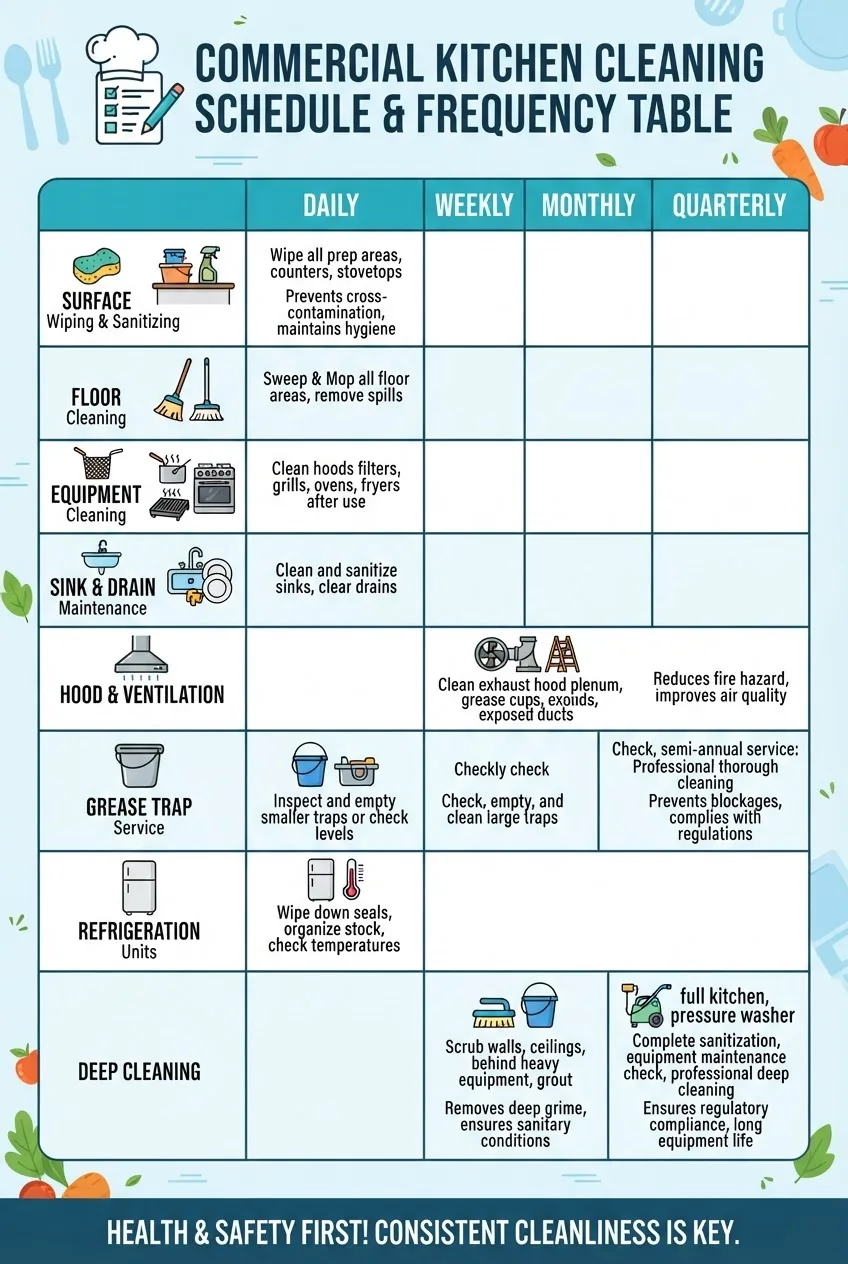
| Service / Frequency | Daily | Weekly | Monthly | Quarterly |
|---|---|---|---|---|
| Surface wiping & food-contact sanitation | After each shift | Deep wipe-down of prep stations | N/A | N/A |
| Floor scrubbing & degreasing | Spot clean during shifts | Full scrub/machine scrub | Strip & reseal (if epoxy/coating) | N/A |
| Hood & filter cleaning | Visual checks | Clean filters (if light use) | Professional hood clean for moderate use | Professional hood clean for heavy use |
| Grease trap pumping | Daily checks of inlet/outlet | Condition monitoring | Pump-out for moderate volume | Pump-out for high-volume kitchens |
| Full deep clean (equipment & ducts) | N/A | N/A | Semi-annual for many kitchens | Annual for low-use or twice-yearly for heavy use |
Use this table to draft a service contract specifying deliverables, frequency, and acceptance tests (e.g., ATP thresholds). Transition: next we discuss eco-friendly products and worker safety when cleaning kitchens.
Eco-Friendly and Safe Cleaning Products and Methods
Adopting green cleaning lowers environmental impact and often improves worker safety. Choose products labeled for commercial foodservice use with low VOCs and an EPA Safer Choice endorsement where possible. When switching products, verify they meet food-contact regulations and that contact times align with sanitation validation methods.
Best practices:
- Use concentrated cleaners measured by a calibrated dispensing system to reduce waste and ensure correct dilutions (example: 1 oz per gallon for certain quats; follow SDS).
- Prefer alkaline degreasers with biodegradable surfactants and neutralize rinse steps where required to protect stainless steel finishes (Rinse with potable water at 100–110°F).
- Adopt steam cleaning for grout and crevice work: use 4–6 bar pressure with surface temperatures of 180–200°F; this reduces chemical use and is effective on organic films.
- Ensure proper waste disposal: collected rinse water, grease trap solids, and used chemical containers must be processed per local environmental rules; consult your environmental agency guidance at EPA.
- Provide PPE: chemical-resistant gloves (nitrile), eye protection, and slip-resistant footwear. Train staff to read SDS and use spill kits for hazardous liquids.
Trade-offs: green products may require longer contact times or stronger mechanical action; test products in a controlled trial before full adoption. Always document efficacy with ATP or swab testing post-implementation.
Transition: next we’ll troubleshoot common on-the-job challenges and how to solve them with practical steps.
Common Challenges in Commercial and Restaurant Kitchen Cleaning
Commercial kitchens face routine obstacles that require operational and technical fixes. Below are common problems with stepwise troubleshooting drawn from hands-on experience and training recommendations.
- Troubleshooting grease build-up:
- Identify source zones: behind fryers, under exhaust plenums, and at hood flanges.
- Schedule immediate degreasing of hood interiors using high-alkaline cleaners with 10–15 minute dwell time.
- If grease is >1/4″ hardened, arrange a professional hood and duct cleaning to prevent ignition risk.
- Increase grease trap pump frequency and document receipts.
- Equipment access and disassembly:
- Map equipment with manufacturer disassembly guides and label parts to ensure correct reassembly.
- Use vendor-specific torque and reinstallation checklists; photograph setups before disassembly.
- If parts are corroded or fasteners are seized, escalate to certified technicians to avoid damage.
- Shift scheduling conflicts:
- Plan deep cleans during slow service windows or book vendors for overnight shifts; require vendor to guarantee equipment ready time with penalties for missed windows.
- Use temporary prep stations or off-site staging for multi-day cleans.
- Safety hazards and training gaps:
- Ensure staff complete chemical handling and PPE training; keep SDS accessible and logged.
- Implement lock-out/tag-out and verify with sign-off sheets before powering equipment back on.
- Hold quarterly refresher sessions and document attendance for inspection evidence.
- Verification and audit failures:
- Use ATP swabs or microbial testing to create objective pass/fail metrics; review and adapt cleaning frequency based on trends.
- Maintain a digital service log with time-stamped photos and results to present during inspections.
Staffing and credential requirements often match roles in broader cleaning professions. See hiring and training references for cleaning jobs requirements, floor care training and requirements, janitorial services training, and janitor jobs eligibility.
For broader career reference that overlaps cleaning skills, review office cleaning career guide and, where storage and logistics affect cleaning scope, warehouse cleaning services challenges.
Transition: having addressed problems and fixes, the closing section reviews business benefits so you can justify investment in regular, professional kitchen cleaning.
Benefits of Regular Commercial Kitchen Cleaning Services
Regular cleaning yields measurable operational and financial benefits: extended equipment life, reduced emergency repair costs, improved customer perception, and lower risk of health-code violations. Clean kitchens reduce pest attraction, improve food safety, and often result in faster service times due to properly functioning equipment.
Concrete outcomes to expect:
- Extended equipment life: properly maintained fryers and ovens can last 20–30% longer when carbon and grease are removed regularly.
- Lower insurance risk: insurers may reduce premiums when a facility demonstrates consistent cleaning schedules and documentation.
- Customer trust: visible cleanliness in front-of-house prep and visible hood maintenance can positively influence reviews and repeat business.
Caveats: DIY cleaning can suffice for daily maintenance but lacks the validation and liability protection of certified vendor services. If you choose in-house deep cleaning, ensure training, testing equipment, and insurance cover the increased workplace hazards.
Final transition into close: summarize key takeaways and what actions to take next.
Conclusion & next steps
Key takeaways: define required service types (daily, weekly, deep, specialty), adopt an evidence-based schedule, vet providers with strict documentation requirements, and validate cleaning outcomes with ATP or swab testing. Begin by drafting a site-specific SOP, scheduling a semi-annual deep clean, and confirming hood and grease trap maintenance calendars.
Call to action: assemble quotes from 2–3 certified vendors, require sample SOPs, and schedule an initial deep clean within 30–60 days to reduce inspection risk and protect your equipment.