

Handyman services are bundled home repair and maintenance offerings for small-to-medium tasks—everything from fixing a leaky faucet to patching drywall—delivered by skilled generalists so homeowners avoid hiring trade-specific contractors. This guide explains what they cover, how to hire local pros, typical pricing models, and when to DIY vs hire.
What are handyman services?
Answer: Handyman services are general home repair and maintenance tasks performed by professionals who handle a wide range of small jobs—plumbing, carpentry, painting, appliance installation, and minor electrical or cosmetic fixes—without the need for multiple specialized contractors.
Term: Handyman — a versatile home repair professional who performs a variety of small-scale maintenance, repair, and installation tasks that don’t typically require licensed specialty contractors.
Handyman services cover a spectrum of routine residential repair and maintenance work. Typical examples include replacing a kitchen faucet, repairing cabinet hinges, installing shelving, patching drywall, and tightening loose stair railings. These tasks are generally defined by limited scope, quick turnaround, and minimal permit requirements.
Illustrative examples:
- Kitchen faucet repair: shutoff, cartridge replacement, minor reseating—usually completed in 30–90 minutes.
- Minor electrical fix: replacing switches or fixtures on existing circuits (non-service-panel work).
- Drywall patch: cut, repair, skim coat, and texture match for small holes.

Scope limits: many handymen avoid major plumbing or electrical that requires a licensed contractor or permits; local rules vary, so always confirm licensing requirements before hiring.
Transition: Understanding what handymen do helps you evaluate candidates—next, learn how to hire a handyman step-by-step.
How do I hire a handyman: step-by-step guide?
Answer: Hire a handyman by defining tasks, sourcing local providers, vetting credentials and reviews, interviewing with specific questions, verifying insurance and licensing, obtaining a written quote, and scheduling clear terms before work begins.
Term: Handyman company — a business entity (often small) that employs or contracts multiple handymen and may offer broader scheduling, guarantees, and administrative support compared to independent handymen.
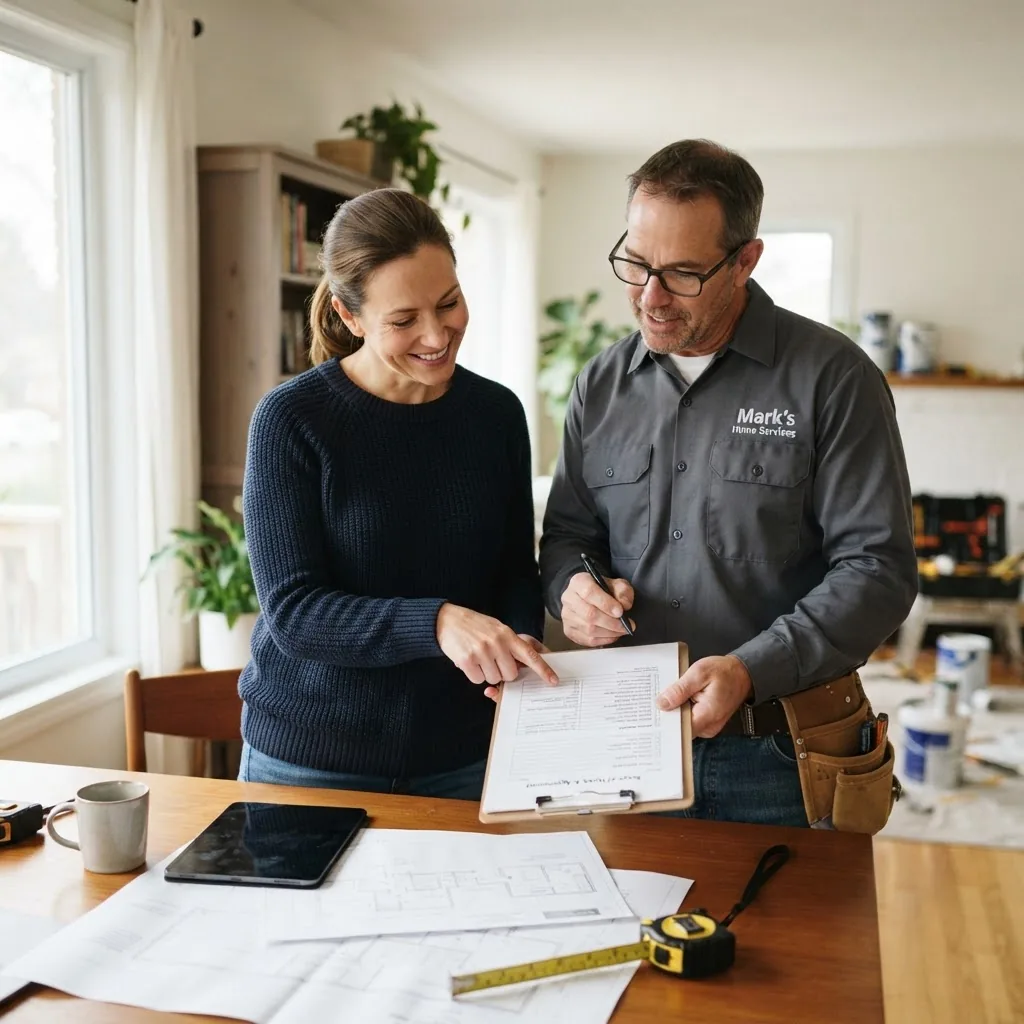
- Define the job clearly. List tasks, desired outcomes, and whether materials will be provided. Clear scope reduces surprise charges and makes quotes comparable.
- Find local candidates. Use online directories, community boards, referrals, and local search for “handyman local service” or “home handyman services.” Consider asking neighbors or building management for recommendations and checking listings with photos and prior work.
- Check online reviews and reputation. Read multiple reviews to spot patterns—on-time arrivals, communication, cleanup, and follow-up. Look for recent reviews and how the provider responded to complaints.
- Ask targeted interview questions. Sample questions:
- What experience do you have with this specific task?
- Do you carry insurance and can you provide a certificate?
- Will you provide a written estimate and a work agreement?
- Who will be on site and do you subcontract?
- Verify licensing and insurance. Confirm liability insurance and, where required, trade licensing. Ask to see insurance certificates and business registration to reduce liability risk.
- Request a written estimate and timeframe. Ask for itemized pricing, expected hours, materials cost, payment schedule, and warranty. Compare at least two quotes to spot outliers.
- Confirm guarantees and a final checklist. Agree on a punch-list for acceptance, cleanup responsibilities, and follow-up warranties for the work performed.
- Book and communicate expectations. Set arrival window, access instructions, and any health/safety preferences, and get confirmation of insurance and IDs.
- For broader home services, coordinate related vendors. If you need decluttering alongside repairs, combine with apartment clean out service options or look for providers who handle both repair and cleanup to streamline scheduling.
- Keep records. Save estimates, agreements, invoices, and photos of pre- and post-work conditions for warranty claims.
Transition: With hiring steps clear, next is a breakdown of common handyman services homeowners request.
What common handyman services are offered for homes?
Answer: Common handyman services include plumbing repairs, minor electrical, carpentry, painting, appliance installation, fixture replacement, and small remodeling tasks, typically for jobs under a few hundred to a few thousand dollars.
Term: Home maintenance services near me — local providers offering routine upkeep and small repairs for residences; this phrase is commonly used in search to find proximate handymen.
- Plumbing repairs: Fixing leaks, replacing faucets, unclogging drains, installing toilet seats, or replacing shutoff valves. Usually quick, but always check for water damage and warranties.
- Electrical fixes: Replacing switches, outlets, light fixtures, ceiling fan installation, and troubleshooting minor electrical issues that don’t involve panel upgrades or new circuits.
- Carpentry jobs: Building or installing shelves, repairing trim and molding, fixing cabinet doors, and small framing tasks.
- Painting services: Touch-ups, trim painting, door refinishing, and small room repaints; often charged by project size or hourly rate.
- Appliance installation: Hooking up dishwashers, disposals, washing machines, and basic gas or electric range connections (verify local gas permit rules).
- Fixtures and hardware: Installing door hardware, window locks, curtain rods, towel bars, and similar items.
- Drywall and plaster repair: Patching holes, skim-coating, and texture matching for small cosmetic repairs.
- Exterior maintenance: Gutter cleaning and repairs (if within safe ladder range), fence repairs, and gate latch replacement.
- Assembly and mounting: Furniture assembly, TV mounting, and hanging art or mirrors with proper anchors.
- Basement and specialty tasks: Small basement repairs combined with cleaning and organization—consider providers who coordinate with basement cleaning services near me for full basement maintenance.
Transition: Knowing service types helps when estimating costs—next, detailed pricing models and typical price ranges are explained.
How do handyman service costs and pricing models work?
Answer: Handymen bill by hourly rates, flat-fee projects, or service-call charges; costs vary by trade, region, complexity, and materials—expect hourly rates from modest local averages to premium city pricing and flat fees for defined small jobs.
Term: Hourly rate — the fee charged per hour of labor; a common pricing model for variable-scope handyman work.
Pricing models explained:
- Hourly rates: Charged per technician; commonly used for undefined scopes. According to a 2024 industry report, average hourly rates ranged broadly by region—this model is transparent for variable tasks.
- Flat fees: Agreed for discrete tasks (e.g., replace a faucet) and useful to cap cost risk.
- Service call or trip charge: A base fee for travel and inspection, often credited toward the final invoice if work proceeds.
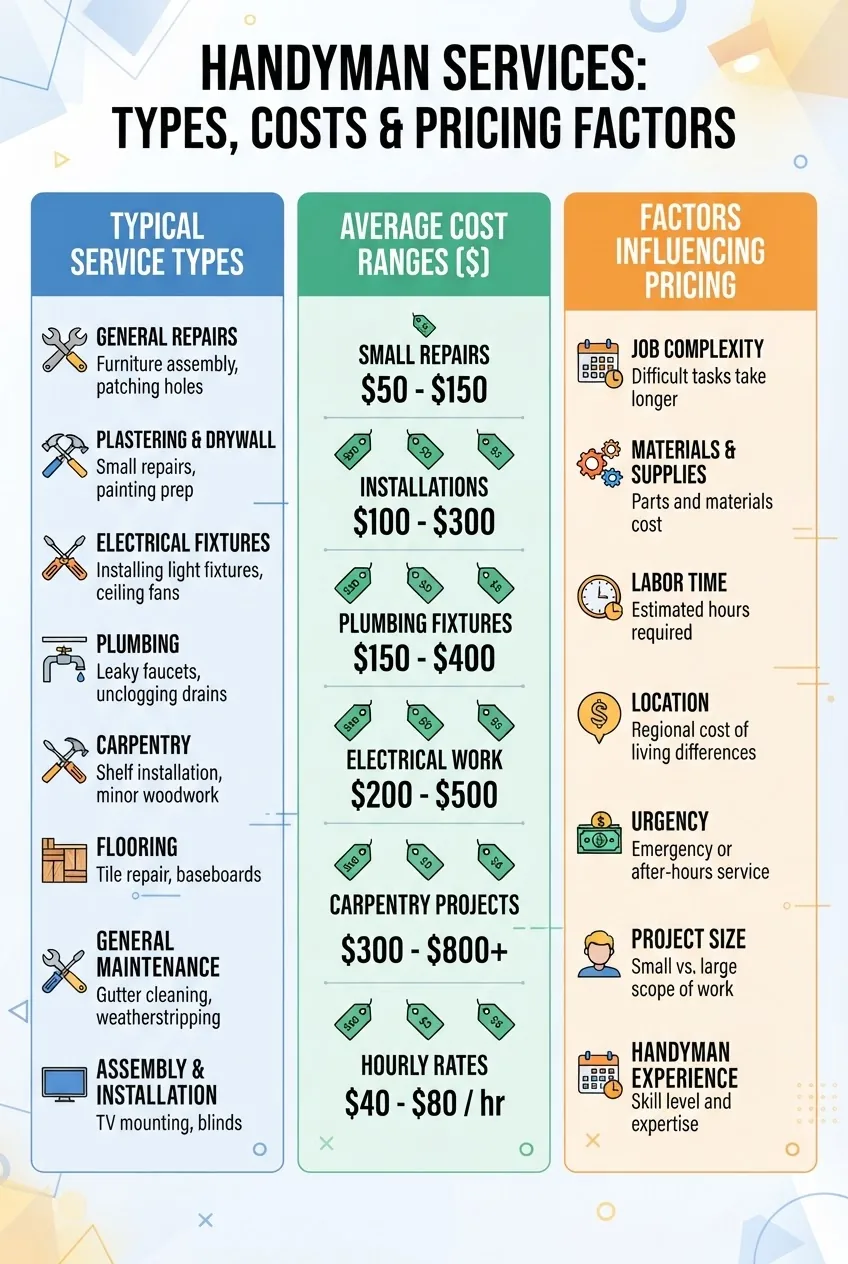
Below is a comparison table of typical tasks with common cost ranges (national averages are approximate and vary widely by metro area and complexity).
| Service | Typical cost range | Common pricing model |
|---|---|---|
| Faucet replacement | $100–$350 (parts & labor) | Flat fee or hourly |
| Drywall patch (small) | $75–$250 | Flat fee |
| Light fixture or switch replacement | $80–$220 | Hourly or flat |
| Door or trim repair | $120–$450 | Hourly or project |
| Appliance hookup | $80–$300 | Flat fee |
| Hourly labor (general) | $50–$120 per hour | Hourly |
Cost drivers include regional labor rates, materials quality, permit requirements, job complexity, time of year, and emergency or after-hours service. According to a 2023 contractor cost survey, urban metro areas reported average hourly rates roughly 20–40% higher than national suburban averages.
Comparing cleaning-related projects: estimate interplay with cleaning costs for move-related work by consulting the apartment move out cleaning cost guide when planning combined labor and cleaning budgets.
When requesting quotes online for handyman jobs, use similar practices as with cleaners: provide lists, photos, dimensions, and expected outcomes to get accurate estimates—see tips from cleaning quotes online to apply to handyman estimates.
Transition: Costs and provider type both affect value—next compares hiring a handyman company versus an independent handyman.
How do handyman companies compare to independent handymen?
Answer: Handyman companies usually offer broader scheduling, employee backup, formal guarantees, and administrative support; independent handymen can be less expensive and more flexible but may offer limited backup and fewer formal warranties.
Quick comparison table and brief analysis:
| Feature | Handyman company | Independent handyman |
|---|---|---|
| Pricing | Often higher due to overhead | Typically lower hourly labor |
| Scheduling | More capacity, faster response | Limited slots, personal availability |
| Insurance & guarantees | Often formal policies and warranties | May carry insurance; warranties vary |
| Reliability | Backup personnel and customer service | Depend on individual reputation |
Analysis: Choose a company when you need scheduling reliability, multi-technician jobs, or stronger guarantees. Choose an independent handyman for single-tech skills, lower rates, or long-term relationship with a skilled tradesperson. Always verify insurance and ask for references regardless of type.
Transition: After choosing provider type, you’ll need to find reliable local services—here’s how to locate trustworthy “home maintenance services near me.”
How can I find reliable “home maintenance services near me”?
Answer: Find reliable local handymen by combining referrals, local search, review verification, background checks, licensing and insurance validation, and a short verification checklist before booking.
Search and verification checklist:
- Ask neighbors and local property managers: Personal referrals often reveal punctuality and cleanup habits.
- Use local directories and search: Search for “handyman local service” and review portfolios and real-photo evidence of work.
- Read multiple reviews: Compare platforms; pay attention to recent reviews and resolution of complaints.
- Verify identity and insurance: Ask for insurance certificates and business registration; call the insurer if unsure.
- Request references: Speak with recent customers about project outcomes and any warranty claims.
- Background or criminal checks: For in-home work, ask if the company conducts employee background checks.
Local cleaning and maintenance cross-checks: combine handyman work with cleaning services when needed—compare options with local guides like Cincinnati home cleaning services for complementary services in regional contexts.
When evaluating listings, also compare cleaning provider guidance at cleaning services near me to apply equivalent vetting rigour for handymen.
Transition: Once you’ve found a reliable provider, managing and scheduling jobs efficiently saves time and prevents confusion.
How should I schedule and manage handyman jobs?
Answer: Schedule handyman jobs by prioritizing urgent tasks, grouping related work into single visits, confirming written estimates and access instructions, and using clear communication and a punch-list to manage expectations.
- Prioritize tasks — handle safety and water/energy issues first (e.g., leaks), then cosmetic fixes.
- Bundle similar tasks — combine small repairs in the same visit to reduce trip charges.
- Set clear availability windows — agree on arrival windows and allow for realistic travel time.
- Confirm access and keys — leave instructions for lockboxes or schedule while home.
- Establish communication protocol — preferred contact method, progress updates, and change request handling.
- Use a written punch-list — list expected outcomes, acceptance criteria, and a final inspection checklist.
- Plan for materials — decide who supplies parts; get approval for upgraded materials and costing before purchase.
- Document completion — take photos and confirm sign-off and receipt of any warranties or care instructions.
Transition: Verify warranties and insurance before work begins, as these affect recourse for poor work or damage.
What warranty, guarantees, and security should I consider when hiring handyman services?
Answer: Prioritize providers who offer written service warranties, carry liability insurance and workers’ compensation, provide itemized contracts, and agree to post-work remedies; document all guarantees in writing for protection.
Term: Service warranty — a written promise that repair work will be fixed at no additional labor cost within a specified time if the initial service fails due to workmanship.
Key points to confirm:
- Written warranty details: Duration, coverage limits, exclusion list, and claim process.
- Insurance certificates: General liability and workers’ compensation proof to cover damage and on-site injuries.
- Contract and scope: Itemized description of tasks, materials, total cost, and payment schedule.
- Dispute resolution: Specify remediation steps and timelines if work does not meet agreed standards.
For broader context on professional service warranty standards in other service sectors, compare how disinfection and specialized commercial services structure guarantees—see commercial disinfection services costs and providers for contrast on warranties, protocols, and provider vetting.
External resources for policy and consumer protection:
- government contractor licensing pages offer state and federal licensing guidance for contractors and when permits are required.
- home improvement consumer protection organizations provide best-practice checklists and complaint procedures for hiring home service providers.
- industry cost reports and marketplace surveys give current average pricing and demand trends for home services.
Transition: If you’re weighing whether to DIY or hire a pro, the next section spells out pros, cons, and decision criteria.
Should I DIY or hire a professional handyman?
Answer: DIY smaller, safe, low-skill tasks where you have tools and time; hire a professional for safety-sensitive, code-related, or technically complex tasks where correct execution and insurance matter.
Pros of DIY:
- Lower labor cost if you have time and basic skills.
- Immediate control over scheduling and materials.
- Satisfaction from completed projects.
Cons of DIY:
- Risk of mistakes that increase total costs or violate codes.
- Potential safety hazards (electrical, gas, structural).
- No professional warranty or insurance coverage.
Pros of hiring a professional:
- Faster, safer completion with professional-grade tools and experience.
- Insurance covers on-site injuries and accidental damage.
- Often includes a workmanship warranty.
Cons of hiring:
- Higher direct cost than DIY labor.
- Requires vetting and trust-building.
If you need combined cleaning and repair—such as after a move—refer to the cleaner for house cleaning hiring guide to coordinate cleaning pros alongside handyman work.
Transition: Below are concise answers to common homeowner questions on handyman services.
What do homeowners commonly ask about handyman services?
Answer: Homeowners commonly ask about service scope, cost, time to complete tasks, insurance, guarantees, and how to handle unsatisfactory repairs—this FAQ addresses those points concisely.
Transition: Use the Q&A below for focused, quick answers and save this guide for reference during hiring and budgeting.
Conclusion
Handyman services offer a cost-effective, flexible route for most small-to-medium residential repairs—select providers by clear scope, validated credentials, written quotes, and documented warranties. Bundle jobs when practical, verify insurance, and prefer professionals for safety- or code-sensitive work. Ready to hire? Use this checklist and request itemized quotes to make informed choices.
Call to action: Gather photos and a task list, request two written quotes, and book a vetted local handyman to get started.