By the end of this guide you will be able to find, vet and compare local cleaning providers and get accurate quotes you can trust. Plan 2–6 hours of focused work (spread over a few days) and basic research skills — no industry experience required.
Understanding Cleaning Services Near Me: What to Expect
Start by understanding the scope and options you’ll encounter when searching for cleaning services near me. Residential cleaning falls into predictable categories and knowing the differences helps you request accurate quotes and avoid scope creep during the job.
- Know the common service types — Standard cleaning: surface dusting, vacuuming, bathrooms, kitchen; Deep cleaning: oven, baseboards, behind appliances, often 50–150% longer than standard; Maid service/recurring service: scheduled weekly/biweekly maintenance; Housekeeping/housekeeper: ongoing, often broader duties including laundry and bed-making.
- Expect different provider models — Independent cleaners (individuals) vs cleaning companies (teams/agencies). Companies usually provide insurance and backup staff; individuals can be cheaper but require stronger vetting.
- Understand what’s usually excluded — Carpet steam cleaning, window washing outside, heavy hoarding, major appliance repair and pest control. Ask providers for a written scope that lists inclusions and exclusions.
- Health, safety and documentation — Ask whether the provider is bonded and insured, and whether technicians have background checks. For commercial-grade or higher-risk jobs you can contrast residential scope with a commercial disinfection services guide to see the difference in methods and liability.
- How pricing is communicated — You’ll see flat-rate packages, hourly billing, and customized quotes based on square footage and tasks. Clarify whether quotes include supplies, travel time, taxes, and gratuity.
Transition: now that you know what to expect, the next section walks you through where to find houses to clean and the platforms that make the search efficient.
How to Find Houses to Clean: Strategies and Tools

Finding houses to clean can mean two things: you’re a homeowner looking for a provider, or a cleaner looking for clients. Below are hands-on strategies for both angles with concrete places to look and how to use them.
- Search local directories and marketplaces — Use Google local pack, Yelp, Nextdoor and Facebook Marketplace; filter by “4+ stars” and most recent reviews. Record three candidate companies or cleaners, note rates, and the number of recent reviews (aim for >20 recent reviews for meaningful data).
- Use cleaning-specific platforms — Apps like Handy, TaskRabbit, Thumbtack or local cleaning platforms match cleaners to homes. These platforms give quick quotes but always verify the independent provider’s background check and insurance details before booking.
- Check community boards and classifieds — Craigslist, local church or neighborhood boards, and community Facebook groups often have individual housekeepers advertising weekly slots. When contacting, ask for references, two client phone numbers, and proof of insurance if they claim it.
- Ask neighbors and building managers — Word of mouth remains one of the best ways to find reliable cleaners. Ask for the cleaner’s name, frequency, hourly rate, and whether they bring their own supplies.
- Contact local agencies and franchises — Larger local cleaning companies will have formal quotes, background-checked staff, and written guarantees. These are better for recurring or larger homes.
- Leverage real-estate and property networks — Property managers and realtors regularly hire cleaners for staging or move-ins. If you want recurring or commercial-style volume, ask property managers for referrals or post your availability on landlord/vendor lists.
- For cleaners: optimize listings and pricing — If you’re offering services, create a clear profile with photos, defined services (standard, deep, move-out), and set your base hourly rate or package prices. Typical starting hourly rates for independent cleaners in 2024 range $25–$45 depending on market; confirm local norms before setting rates.
- Use targeted ads or neighborhood flyers (for providers) — A focused flyer with a first-time discount (10–20%) and clear contact details performs well. Track response by assigning a promo code per distribution channel to know where clients come from.
- Handle inquiries with a qualification script — Ask: home size (sq ft), number of bathrooms/kitchens, last deep clean date, photos or video, and desired date. This information reduces estimate errors by 20–40% compared to on-site-only quoting, according to a 2024 industry report by a national cleaning trade organization.
- Document and follow up — Always send a brief written confirmation with scope, date/time, cancellation policy and payment method. This reduces no-shows and miscommunications.
If you need specialized help like clearing an entire apartment, see our resource on apartment clean out services. If you’re deciding whether to hire an individual or a business, review our guide on how to hire a cleaner for house cleaning. For job-seekers looking to work as a cleaner, check requirements in cleaning jobs near me requirements.
Transition: after you’ve identified candidates, the next section explains how to choose the best one using concrete selection criteria.
Criteria for Choosing the Best House Cleaning Service
Use this step-by-step vetting checklist to separate reliable providers from risky choices. Think of it like choosing a mechanic or babysitter — you’re checking competence, references, and safeguards.
- Verify identity and basic credentials
- Ask for full company name, contact phone number, and physical address (not a P.O. box).
- Confirm business registration if they claim to be a company. Independents should provide at least two client references and government ID.
- Confirm insurance and bonding status
- Request proof of general liability insurance and a bonding certificate if available. Bonding covers theft by employees; insurance covers property damage and injury.
- Note minimum acceptable policies: $1 million general liability is a common standard for small companies; smaller independents often have less — weigh risk accordingly.
- For verification, check industry standards at ISSA and check complaint histories at BBB.
- Assess reviews and reputation
- Look for volume, recency and response behavior. A provider with many recent, detailed reviews is more reliable than one with isolated five-star entries.
- Ask how the company responds to negative reviews; a professional response shows complaint-resolution capability.
- Use public review sites plus direct references. For consumer rights and complaint procedures see consumer protection guidance.
- Compare guarantees and service-level agreements
- Does the company offer re-cleaning guarantees (e.g., re-clean within 48 hours at no charge)? Get guarantees in writing.
- Ask about substitution policies — if your usual cleaner is sick, will the company send equally trained staff?
- Examine the quote for transparency
- Ensure the quote lists tasks, time estimate, total price (or hourly rate) and whether supplies are included.
- A vague quote like “general cleaning” is a red flag; request a task-by-task list instead.
- Check training and equipment
- Ask whether staff are trained on safe chemical use and cross-contamination avoidance. For specialized jobs like mold remediation or disinfection, verify certifications.
- Confirm whether the cleaner brings their own equipment or uses your supplies; this affects pricing and responsibility for broken items.
- Consider communication and reliability
- Test response speed: a professional should reply to inquiries within 24 hours. Ask about arrival windows — 30–60 minute arrival windows are common for busy companies.
- Ask for a dedicated account manager for recurring service accounts to simplify scheduling and complaints.
- Evaluate value, not only price
- Match scope to cost: a low hourly rate that skips oven cleaning or baseboards is not cheaper if you need those tasks.
- Factor in travel fees, minimum visit charges and supplies; request a breakdown to compare like-for-like.
- Specialty services and niche requirements
- If you need basement cleaning or heavy-duty work, check for experience in niche areas — see basement cleaning services.
- Finalize a trial run
- Book a one-time or first-time deep clean as a trial. Use this to measure attention to detail, timeliness and how well the company documents missed items.
- Set objective success criteria: e.g., “kitchen counters, stove, microwave interior, bathroom tile, and baseboards” completed to satisfaction; allow a re-clean if items are missed.
Transition: once you know who meets your criteria, the next practical step is getting accurate quotes you can compare side-by-side.
Common niche example: for specialized clean-outs or larger move-outs, compare with our apartment move out cleaning costs resource to understand additional tasks and pricing.
How to Get and Compare Quotes for Cleaning Services Near Me
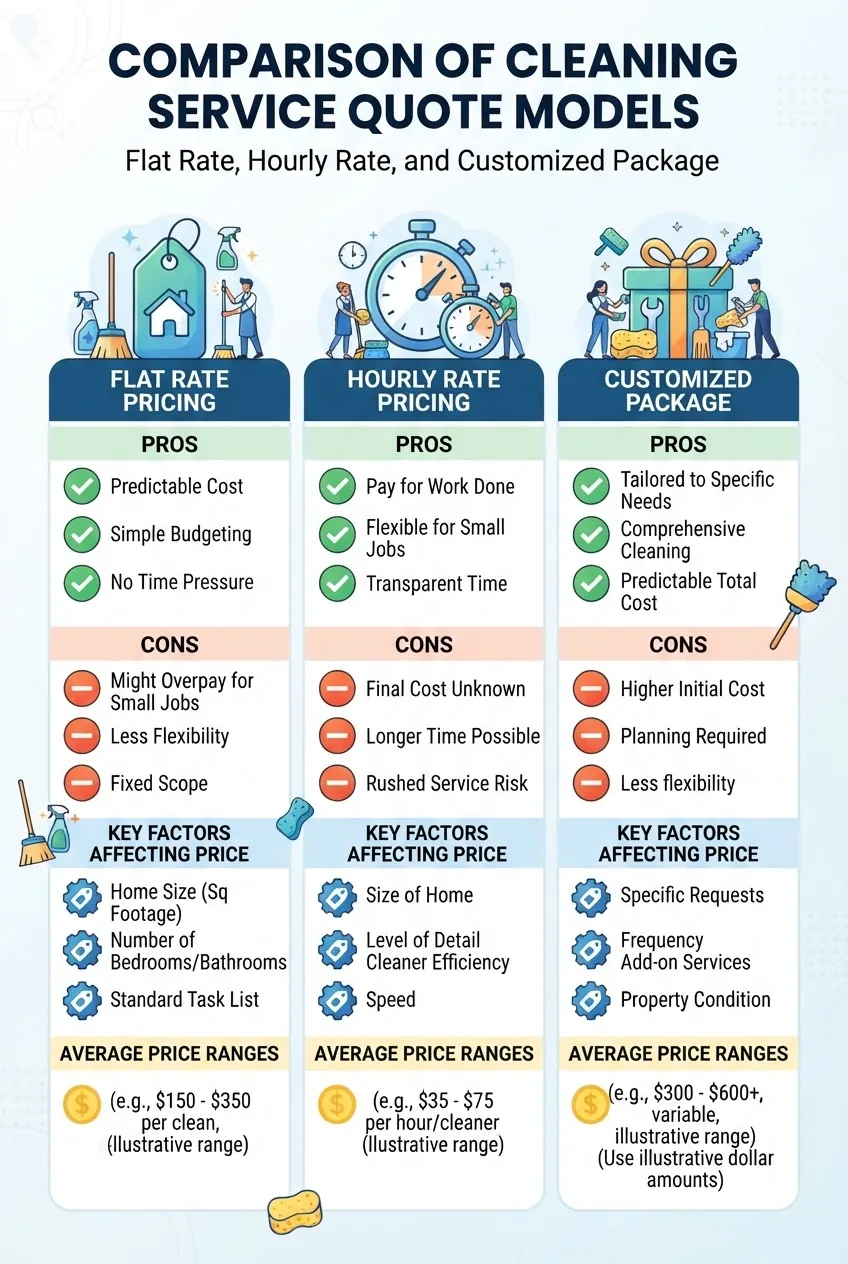
Getting accurate quotes is the single most important action to avoid surprises. Below is a practical comparison table followed by a step-by-step approach to collect and reconcile estimates.
| Quote Model | How it’s calculated | Pros | Cons |
|---|---|---|---|
| Flat rate / Package | Set price for defined tasks (e.g., 3BR/2BA standard clean). | Easy comparison, predictable cost. | May not cover unexpected tasks; vendors define scope differently. |
| Hourly rate | Charged by the hour, multiplied by number of cleaners. | Flexible for variable homes; fair if scope uncertain. | Cost varies with speed and efficiency; harder to predict final total. |
| Customized package | Estimate built from on-site assessment or detailed photos/video. | Most accurate; tailored to specific needs. | Takes more time to prepare; price may be higher for one-off tasks. |
- Gather consistent information — Provide each prospective provider the same data: square footage, number of bedrooms/bathrooms, photos of kitchens and bathrooms, list of desired tasks, and access instructions. This ensures apples-to-apples quotes.
- Request detailed, written quotes — Ask for: total price, price per task or hourly rate, number of cleaners, estimated hours, included supplies, travel fees, taxes, cancellation policy, and guarantee terms. Keep quotes for later comparison.
- Compare on three axes: scope, cost, and risk — Create a simple spreadsheet with columns for scope items, total cost, insurance/bonding, guarantee, and recent review score. Favor a slightly higher price with full insurance and a re-clean guarantee over a cheap uninsured provider.
- Understand flat vs hourly trade-offs — Flat rates are predictable for typical homes. Hourly works for variable conditions. If given hourly, ask for a time estimate and a cost cap (e.g., not to exceed X hours without written approval).
- Watch for common hidden charges — Supplies, travel time, minimum-service fees, disposal fees for bulky trash, and early-morning or late-night scheduling premiums. Ask providers to mark any extras explicitly.
- Negotiate a trial and a price lock — For recurring service, ask to lock the first three visits at the quoted price and commit to a 3–6 month trial. This gives both parties a runway to adjust frequency and scope.
- Verify estimate accuracy online — If using online quote tools, double-check by phone. For guidance on accurate online quoting see cleaning quotes online and compare with local examples like cleaning companies in Oklahoma City or urban guides such as cleaning service NYC costs.
- Use a scoring system — Score each quote 1–10 on transparency, coverage (tasks included), insurance, and price. Weight transparency and insurance higher (e.g., 35% each) and price lower (30%) — this helps avoid choosing purely on cost.
- Ask about discounts and bundling — Many companies offer first-time discounts (10–20%), recurring-service discounts, or bundled add-ons (e.g., deep-clean upgrade at a reduced rate). Factor these into 3-month cost projections.
- Confirm scheduling and payment terms — Get the earliest available date for the trial clean, clarify cancellation windows (24–48 hours typical), and note acceptable payment methods (card, ACH, cash). Document any deposit requirement.
Transition: comparing quotes thoroughly prevents surprises. The next section helps you evaluate reviews and ratings to validate the companies on your shortlist.
Understanding Reviews and Ratings for Cleaning Services Near Me
Reviews are a primary trust signal but require context. Use a systematic approach to interpret what reviews reveal about a cleaning provider’s reliability and quality.
Five review interpretation tips
- Look at review recency and frequency — dozens of old reviews are less meaningful than a steady stream of current ones.
- Read for specifics, not stars — reviews that mention specific tasks (e.g., “left oven interior spotless” or “missed baseboards”) reveal real performance signals.
- Notice the company response pattern — timely, courteous responses to complaints indicate good customer service.
- Be wary of overly generic five-star reviews with no detail; they may be solicited or fake.
- Cross-check review platforms — Yelp, Google, Nextdoor and the BBB can show different pictures; use at least two sources plus direct references.
Red flags to watch for: frequent negative comments about punctuality, undisclosed upcharges, missing items after service, or no visible resolution to complaints. If you see repeated incidents of the same failure, consider it a strong signal to remove the provider from your shortlist.
Transition: the ideas above help you choose a provider in your area; next is a practical local example showing how decisions play out in a specific market.
Local Spotlight: House Cleaning Charlotte as an Example
Charlotte is a useful case study because it combines suburban and urban neighborhoods with varied home sizes, which mirrors many national markets. Below is a step-by-step account of how a homeowner in Charlotte selected a recurring cleaner.
- Define needs and schedule — The homeowner wanted biweekly maintenance for a 1,700 sq ft townhouse, focusing on kitchen, bathrooms, and dusting. They allowed a 3-hour window per visit.
- Shortlist three providers — Two local companies and one independent cleaner recommended on Nextdoor. The homeowner prioritized providers with background checks and insurance.
- Gather and compare quotes — The companies offered flat rates of $110–$150 per visit; the independent quoted $28/hour with a 3-hour minimum. After scoring for insurance and guarantees, the homeowner compared total monthly spend across options.
- Run a paid trial — They booked a one-time deep clean with the top-scoring company to validate workmanship. The company provided a 48-hour re-clean guarantee in writing.
- Evaluate outcomes and set recurring terms — After the trial, the homeowner confirmed weekly versus biweekly needs; biweekly proved sufficient. They scheduled payment by card, set a 48-hour cancellation policy, and saved 10% on recurring billing.
This homeowner’s approach reflects national best practices: shortlist, written quotes, trial, and documented guarantees. For complementary city examples, compare local options like home cleaning in Cincinnati.
Transition: whether you’re in Charlotte or another city, maintaining a clean room between professional visits saves time and protects your investment.
Tips for Maintaining Your Clean Room Between Professional Cleanings
Short, repeatable tasks keep a cleaned space presentable and reduce the frequency of deep cleans. Follow these practical steps.
- Daily 10-minute tidy — Put away surfaces, wipe high-traffic countertops, and do a quick vacuum of visible crumbs. Set a 10-minute timer each evening.
- Weekly 30-minute rotation — Rotate focus areas: week 1 sinks and bathrooms (15 minutes each), week 2 dusting and bookshelf tidy, week 3 bed linen change and vacuum, week 4 appliance wipe-down.
- Spot cleaning rules — Tackle spills within 5 minutes using a microfiber cloth and appropriate cleaner to avoid stains setting in.
- Supply kit — Maintain a small kit: microfiber cloths (6), all-purpose cleaner (32 oz), disinfectant wipes, handheld vacuum. Replenish monthly.
- Declutter habit — Use a “one-in, one-out” rule for small items (e.g., incoming mail / outgoing mail basket) to avoid buildup.
If you need combined cleaning and organization help, consider cleaning and organizing services near me to tackle larger projects.
Transition: the final practical section answers the most common operational questions about hiring and scheduling.
Frequently Asked Questions About Cleaning Services Near Me
Below are concise answers to frequent concerns — use them to make clear requests and avoid scope confusion when booking service.
Step-by-step action plan (numbered)
- List required tasks — Create a one-page scope: rooms, specific tasks (e.g., “clean inside microwave”), and frequency. Use this for all quote requests.
- Collect three comparable quotes — Provide identical information to each provider and request written quotes within 48 hours.
- Score and select — Score quotes on transparency, insurance, guarantee and price; pick the highest-scoring provider, not the cheapest.
- Book a paid trial — Schedule a trial clean, confirm arrival window and payment method, and document any special instructions.
- Inspect and document — Walk through immediately after the clean with a checklist; photograph missed items and request re-clean within the guarantee window.
- Schedule recurring service — If satisfied, set recurring dates, payment authorization, and a standing cancellation notice (24–48 hours).
Common mistakes and how to avoid them
I once hired the cheapest cleaner because of price alone; they missed the oven and charged extra for grout. From that experience I always require a written task list and a re-clean guarantee before I book. I also now insist on seeing insurance and two references for new providers.
Checklist before you finalize a cleaner
- Written quote with task list, price and guarantees
- Proof of insurance and bonding (or signed waiver for independent cleaners)
- At least five recent reviews or two personal references
- Clear cancellation and re-clean policies
- Trial clean completed and inspected
- Recurring schedule and payment method confirmed
When to call in a professional instead
Call a professional for biohazard cleaning, mold remediation, large hoarding jobs, or when insurance documentation is required for landlords or property managers. Also use specialty providers for carpet or upholstery steam cleaning, exterior window washing, or significant water damage.
Final summary: Follow the practical steps here — list tasks, get three written quotes, verify insurance and reviews, run a paid trial, and use a simple scoring system to choose. That method minimizes surprises and protects your home. Ready to find your cleaner? Start by drafting your one-page scope now, then request three quotes within 48 hours.