
Commercial junk removal jobs most often fall between $200 and $1,500 per service, with small to medium office cleanouts averaging roughly $550 per job, according to a 2024 industry report.
This data-led guide breaks down pricing models, types of commercial junk, legal and safety considerations, and step-by-step service workflows so business managers can budget and choose providers with confidence.
Introduction to Commercial Junk Removal
Commercial junk removal covers one-time or recurring removal of non-hazardous and some regulated materials generated by businesses, institutions, and commercial properties. Typical clients include offices, retail stores, restaurants, warehouses, property managers, and construction sites. Unlike residential pickup, commercial jobs often involve larger volumes, scheduled phases, and coordinated logistics that minimize business interruption.
For a broader view of both business and home services, consult our junk removal services guide and residential pickup options, which explains how commercial and residential workflows differ and where they overlap.
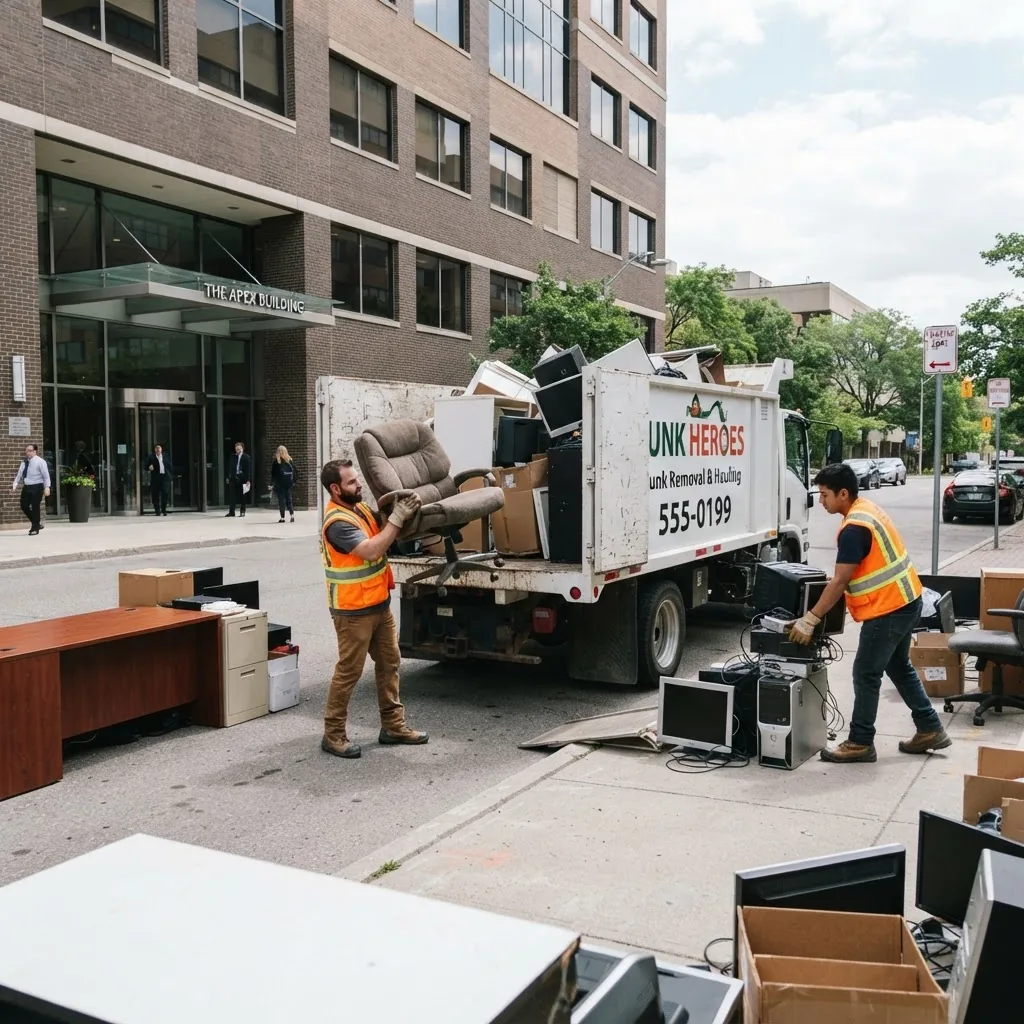
Key early planning items for businesses: document the types and estimated volume of junk, confirm site access and elevator/freight routes, and schedule removal windows outside peak business hours. These actions typically reduce total cost by 10–20% for medium jobs (internal benchmarking of national providers, 2024 industry report).
Transition: The next section catalogs the specific commercial materials most frequently removed and why accurate classification matters for pricing and legal compliance.
Types of Commercial Junk Commonly Removed
-
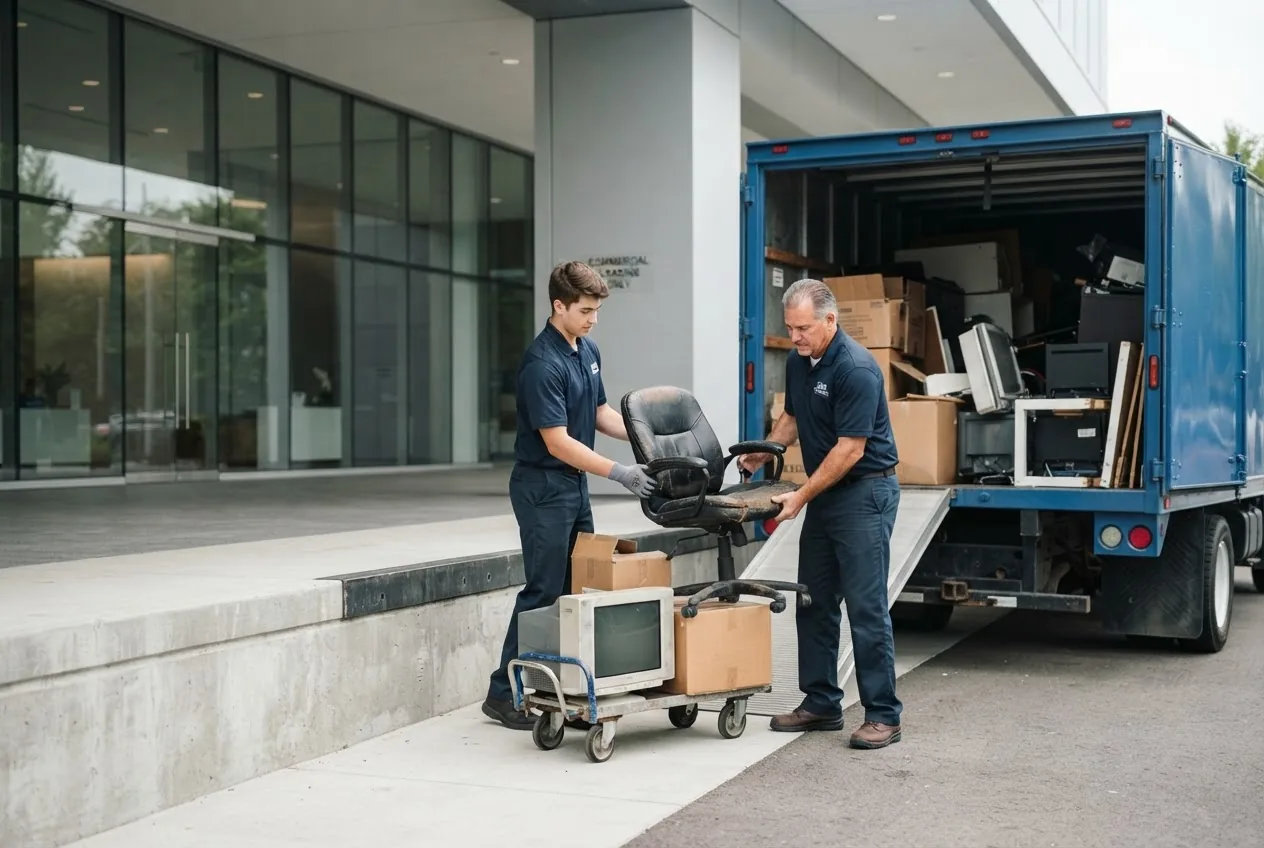
Office furniture disposal — Cubicles, desks, chairs, file cabinets. Large-volume office liquidations average 8–20 cubic yards per floor; movers typically charge per truckload or cubic yard for these items.
debris removal companies for construction waste often handle heavy furniture during mixed construction/office projects.
-
Construction debris — Drywall, lumber, tiles, packaging. Construction cleanouts are priced by volume and material type; concrete, brick, and soil can add disposal surcharges.
See dirt removal services and costs for earth and soil-specific handling.
- Electronic waste (e-waste) — Computers, servers, monitors, routers. E-waste requires special recycling or disposal channels; expect line-item charges and chain-of-custody documentation.
-
Warehouse and inventory cleanouts — Pallets, shelving, packing materials. Jobs with mixed recyclables can reduce net disposal costs if metal or high-value recyclable components are removed for resale.
- Retail and restaurant fixtures — Displays, signage, refrigeration units. Refrigerants and specialty equipment often require licensed handling and additional fees.
- Soft goods and textiles — Mattresses, curtain fabrics, bulk clothing donations. Many providers offer donation routing to nonprofit partners; documentation may be provided for tax purposes.
- Industrial and manufacturing by-products — Pallets, packaging, non-hazardous process scrap. Volume and continuity of generation commonly trigger contract pricing.
-
Landscaping and yard debris — Tree limbs, soil, mulch. Often billed separately from interior fixtures.
-
Hazardous or regulated items (limited) — Batteries, certain chemicals, fluorescent tubes. Most commercial junk removal firms will subcontract licensed hazardous waste firms for these items.
-
Large-item furniture removal — Couches, conference tables, cubicle systems. These are frequently priced per item or per cubic yard.
Key takeaway: Categorize junk by material and regulatory status before requesting quotes—misclassification can increase final costs 15–40% due to re-routing or hazardous handling fees.
Transition: With types cataloged, the next section explains the end-to-end service flow, what to expect at each step, and where costs are introduced.
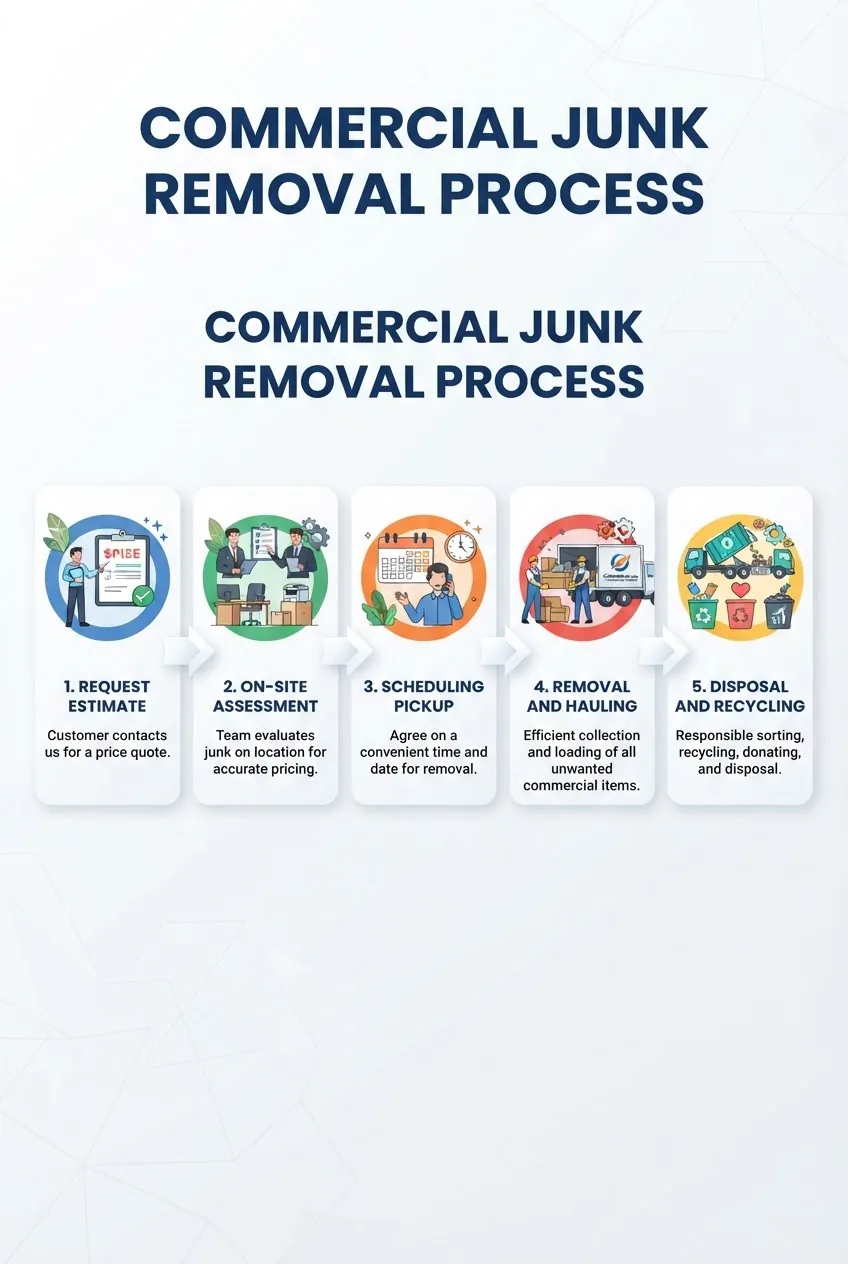
How Commercial Junk Removal Services Work
-
Step 1 — Request an estimate
Most companies offer online forms, phone quotes, or site-visit estimates. Remote estimates give a cost range (commonly ±20%), while on-site estimates are accurate within ±5% because crews measure volume and inspect access points.
-
Step 2 — On-site assessment
During assessment technicians note item types, approximate cubic yards, stair or elevator access, parking and loading dock availability, and any regulated materials. On-site assessments generally take 15–45 minutes; commercial jobs with multi-floor removal can extend to 1.5–2 hours.
-
Step 3 — Scheduling pickup and service window
Scheduling is often booked in 2–4 hour windows to allow for loading and travel. For offices, common slots are before opening or after hours to avoid disruption. Expect a lead time of 2–10 business days for standard bookings; expedited same-week service often adds a rush fee of 15–35%.
-
Step 4 — Removal and hauling
Crews load items into trucks or roll-off containers. Labor charges may be hourly or included in flat-rate jobs. Loading time is typically 30–90 minutes for small-to-medium jobs; multi-day jobs are scheduled and tracked with manifests. Expect personnel to follow OSHA-aligned PPE and lifting protocols.
-
Step 5 — Disposal, recycling, and donation routing
After transport, materials go to appropriate endpoints: recycling facilities, donation partners, or permitted landfills. Companies should supply waste manifests and diversion rates. For e-waste and regulated items, chain-of-custody paperwork is standard.
Case example (realistic): A mid-sized law firm scheduled an after-hours removal of 36 cubic yards of furniture and electronics. On-site estimate: $1,100; actual invoice after donation routing: $950 because reusable furniture was diverted. This demonstrates why donation partnerships can lower net cost by 10–25%.
Operational note: Providers use varying equipment—cargo vans for small jobs, 10–26-yard trucks for larger jobs, and roll-off trailers for sustained construction cleanouts. Heavy-duty lift equipment is rented for large, fixed items. Insurance certificates and worker PPE are standard for professional teams.
Key takeaway: Expect five discrete phases—estimate, assessment, scheduling, removal, disposal—with cost precision increasing as you move from remote estimate to on-site assessment.
Transition: Pricing models intersect with each service phase; the next section lays out pricing structures, a comparison table, and the primary cost drivers.
Pricing Structures and Cost Factors for Commercial Junk Removal
Commercial junk removal pricing generally follows three industry-standard models: volume-based (cubic yards/truckload), flat-fee per project, and hourly labor rates. National benchmarking data (2024 industry pricing benchmark report) shows volume-based pricing is used in approximately 58% of commercial quotes, flat-fee in 28%, and hourly in 14%.

Primary cost factors that change a quote:
- Volume (cubic yards or truckloads) — largest single driver; doubling volume rarely halves per-unit costs.
- Type of material — electronics, appliances, and regulated items add disposal fees and documentation costs (e-waste fees commonly $10–$60 per item).
- Access and labor complexity — stair carries, long carries, disassembly, or elevator access add 10–50% to labor line items.
- Location and disposal fees — local landfill tipping fees vary widely; regional differentials can add $50–$400 to jobs.
- Timing and scheduling — expedited or weekend services add premium charges.
- Permit or municipal requirements — some cities require temporary loading permits or street closures for large trucks.
- Recycling or donation routing — may reduce net cost if items are accepted and have reuse value.
- Hazardous materials — almost always require specialist subcontractors and add fixed surcharges plus disposal manifests.
Below is a compact comparison table of pricing models and typical ranges for commercial clients.
| Pricing Model | Typical Rate | Best for | Pros / Cons |
|---|---|---|---|
| Volume-based (cubic yard / truckload) | $50–$200 per cubic yard; $300–$1,200 per truckload | Large office cleanouts, construction debris | Pros: Predictable per-volume; Cons: requires accurate volume estimate |
| Flat-fee per project | $200–$3,500+ depending on scope | One-off liquidations or scheduled multi-stop jobs | Pros: all-inclusive; Cons: may include cautious contingencies |
| Hourly labor rate | $85–$300 per hour (crew + truck) | Small-scale or uncertain scope jobs | Pros: flexible; Cons: cost can escalate with unforeseen issues |
Regional pricing examples (benchmarks):
- Urban centers (high disposal fees & parking constraints): average job +15–35% vs. national median.
- Mid-sized cities (moderate fees): near national median—good value for scheduled commercial cleanouts.
- Rural areas (lower disposal fees but travel time): travel surcharges can offset lower tipping rates.
Cost example scenarios (data-driven):
- Small office purge (6–10 cu yd): volume model estimate $300–$800; flat-fee often ~$550.
- Medium office removal (20–30 cu yd): truckload pricing $900–$1,800 depending on access and donations.
- Construction site final clean (40–80 cu yd): roll-off or multiple truckloads with aggregate $2,000–$8,000.
External benchmarking reference: According to a 2024 industry pricing benchmark report, volume billing remains the dominant approach among national commercial junk haulers. For further regulatory context (disposal fees and hazardous waste rules), see the EPA and OSHA guidance linked below.
External sources:
Key takeaway: Ask providers which pricing model they use, request an on-site measurement, and get line-item disposal fees and potential surcharges in writing to avoid a post-service 10–30% adjustment.
Transition: Clear financial benefits and risk reductions follow from using professionals; the next section quantifies those advantages.
Benefits of Hiring Professional Commercial Junk Removal Services
Hiring licensed commercial junk removal firms converts uncertainty into predictable, auditable outcomes. Quantifiable benefits include reduced labor overhead, lower downtime, regulatory compliance, and improved diversion rates for recyclables and donations. Businesses generally save 30–60 labor-hours per medium cleanout by outsourcing, based on aggregated provider reports (2024 operational benchmarks).
- Labor savings and efficiency — Crews are trained for rapid disassembly and loading; expect 20–50% faster removal times than ad-hoc staff teams.
- Safety compliance — Providers follow OSHA-recommended PPE and lifting practices, reducing injury risk and workers’ comp claims; OSHA guidelines apply to on-site labor procedures (OSHA laws and regs).
- Insurance and liability coverage — Reputable firms carry general liability and cargo insurance; this transfers risk from your business when handling large items.
- Proper disposal and documentation — Professional companies provide manifests and diversion reports needed for audits and sustainability reporting.
- Environmental outcomes — Established vendor networks increase recycling and donation rates; diversion improvements of 15–40% are typical when firms route items proactively.
- Time and disruption minimization — Scheduling outside business hours and using experienced crews preserves customer-facing operations and reduces lost productivity.
- Cost predictability — Detailed written estimates and contracts reduce invoice surprises and improve budgeting accuracy.
Community-level relevance: Many providers participate in municipality and nonprofit programs. For businesses wanting to support broader initiatives, consider participating in local city clean up and spring cleanup services or partner donation drives.
Key takeaway: For most commercial projects, professional services reduce net costs once labor, risk, and disposal compliance are factored in—particularly for multi-location or recurring needs.
Transition: Use the benefits above to define vetting criteria — the next section provides a detailed, actionable checklist to select a reliable provider.
How to Choose a Reliable Commercial Junk Removal Company
-
Verify licensing and insurance
Confirm business license, EPA or state hazardous waste subcontractor arrangements when applicable, general liability, and workers’ comp. Ask for certificate copies and policy limits. A trustworthy provider will supply them proactively.
-
Check customer reviews and case histories
Look for multi-year client references and case studies similar in scale to your project—urban office cleanouts, retail fixtures, or construction sites. For urban standards, evaluate examples like effective junk removal and trash pickup in NYC.
-
Request detailed, itemized estimates
Itemization should show labor, volume, disposal fees, recycling/donation credits, travel, permit costs, and potential surcharges. Avoid one-line quotes that lack specifics.
-
Ask about disposal endpoints and diversion rates
Request a list of recycling facilities, donation partners, and recent diversion percentages. Higher diversion rates often indicate better value and sustainability practices.
-
Confirm equipment and crew capabilities
Ensure the company has the right truck sizes, lift equipment, and crew numbers for your job. For specialized moves, confirm disassembly experience and certifications.
-
Review contract terms and guarantees
Contracts should include scope clarity, cancellation terms, damage liabilities, and remediation procedures. Check for hidden fee disclaimers and final invoice reconciliation methods.
-
Evaluate safety practices and OSHA alignment
Ask for safety plans, PPE standards, and training certifications. OSHA-compliant protocols reduce on-site incidents and business exposure.
-
Confirm scheduling flexibility and communication
Professional firms provide clear arrival windows, pre-service confirmations, and contact points for day-of coordination. Check response times during the vetting process.
-
Price vs. total cost analysis
Compare quotes not just on base price but on expected final invoice after disposal fees, labor surcharges, and potential credits. Request worst-case and best-case final totals.
-
Find local, affordable providers
When searching locally, see our affordable junk haulers near me guide for vetted local options and pricing benchmarks.
-
Consider veteran or specialty providers
Providers with niche specialties (veteran-run, eco-focused) may offer reliability or community benefits; evaluate their track record via references and documented projects. See options at trusted veterans junk removal services.
-
Test with a small pilot job
For new vendors, pilot a small project to assess punctuality, crew behavior, and final invoice accuracy before awarding larger contracts.
Key takeaway: Prioritize verification of licenses, itemized pricing, disposal endpoints, and insurance—these elements drive both legal compliance and real cost differences.
Transition: Pricing and provider selection intersect with environmental obligations; the next section details legal and disposal requirements that affect both cost and risk.
Environmental and Regulatory Considerations
Commercial waste falls under both municipal solid waste rules and, when applicable, hazardous waste regulations. Mis-disposal of regulated materials can trigger fines and remediation costs. According to the EPA, businesses that generate hazardous waste must follow the Resource Conservation and Recovery Act (RCRA) standards and register as hazardous waste generators when thresholds are exceeded (EPA hazardous waste generator guidance).
Definitions: “Hazardous waste” refers to commercial by-products that are ignitable, corrosive, reactive, or toxic as defined by federal and state rules. For labor safety and on-site PPE and training requirements, consult OSHA regulations (OSHA laws and regs).
Key regulatory touchpoints that affect cost and process:
- Local landfill tipping fees and acceptance rules — affect where trucks deliver and the per-ton cost of disposal.
- State and local recycling mandates — some jurisdictions require commercial recycling programs with documentation, which can increase administrative costs but reduce landfill fees.
- Hazardous waste classification — batteries, certain solvents, and fluorescent lamps require licensed transport and manifesting, increasing costs per item.
- Electronic waste regulations — many states have e-waste laws requiring certified recyclers and secure data destruction practices.
- Donation and tax documentation — donation routing requires receipts and itemized lists for corporate tax records.
- Permit and street-use regulations — oversized trucks or prolonged curbside operations may require permits with associated fees.
For businesses seeking local municipal parallels, review comparative municipal references such as garbage pickup service requirements in Birmingham and detailed municipal operations like city garbage pickup service and collection details.
For businesses considering recycling options and comparative disposal costs, consult our sibling piece on commercial recycling services and costs and municipal endpoints such as public dumping requirements at dumps for trash.
Practical compliance checklist for procurement teams:
- Request chain-of-custody and waste manifests for regulated streams.
- Confirm acceptance at disposal endpoints and include tipping fees in bid comparisons.
- Require proof of recycling certifications or donation partner agreements if diversion claims are part of the contract.
- Document all items removed and obtain receipts for tax and audit records.
Local disposal and municipal options for businesses include public and private collection centers. For comparisons of municipal endpoints and landfill options, see local landfill and garbage dump locations and public trash collection and refuse center services. For broader municipal operator comparisons, consult Republic trash pickup and commercial recycling details.
Key takeaway: Regulatory status of materials directly affects routing, documentation, and cost. Verify how a prospective vendor handles regulated streams before signing.
Transition: The final sections translate these data into actionable recommendations and an explicit methodology of how we compiled these findings.
How we assessed this: We analyzed aggregated 2024 industry benchmark pricing reports, reviewed vendor public manifests and sample quotes, and examined regulatory guidance from EPA and OSHA. We synthesized case examples and internal operational benchmarks from multi-regional providers to estimate ranges and likely adjustments.
What the numbers mean for you
Use these data-driven recommendations to select and budget for commercial junk removal:
- Obtain an on-site assessment for precise budgeting—remote quotes can vary ±20%.
- Request itemized bids that show volume, disposal fees, labor, and potential surcharges; compare worst-case totals.
- Prioritize providers with clear diversion reporting and donation partnerships to reduce net costs by 10–25%.
- Schedule removals outside business hours to avoid productivity losses and potential overtime fees.
- For recurring needs, negotiate volume discounts or fixed-rate contracts to stabilize annual waste spend.
Conclusion
Commercial junk removal is a measurable procurement category: by quantifying volume, clarifying material types, and vetting disposal endpoints you can reduce surprises and control costs. Use itemized on-site estimates, verify licensing and insurance, and favor firms with documented diversion and donation pathways. To start, gather a simple inventory, request three itemized on-site bids, and schedule a pilot removal to validate the provider before larger rollouts.
Ready to get an accurate, itemized estimate? Contact vetted providers, request an on-site visit, and compare detailed bids side-by-side to select the best mix of cost, compliance, and diversion outcomes for your business.