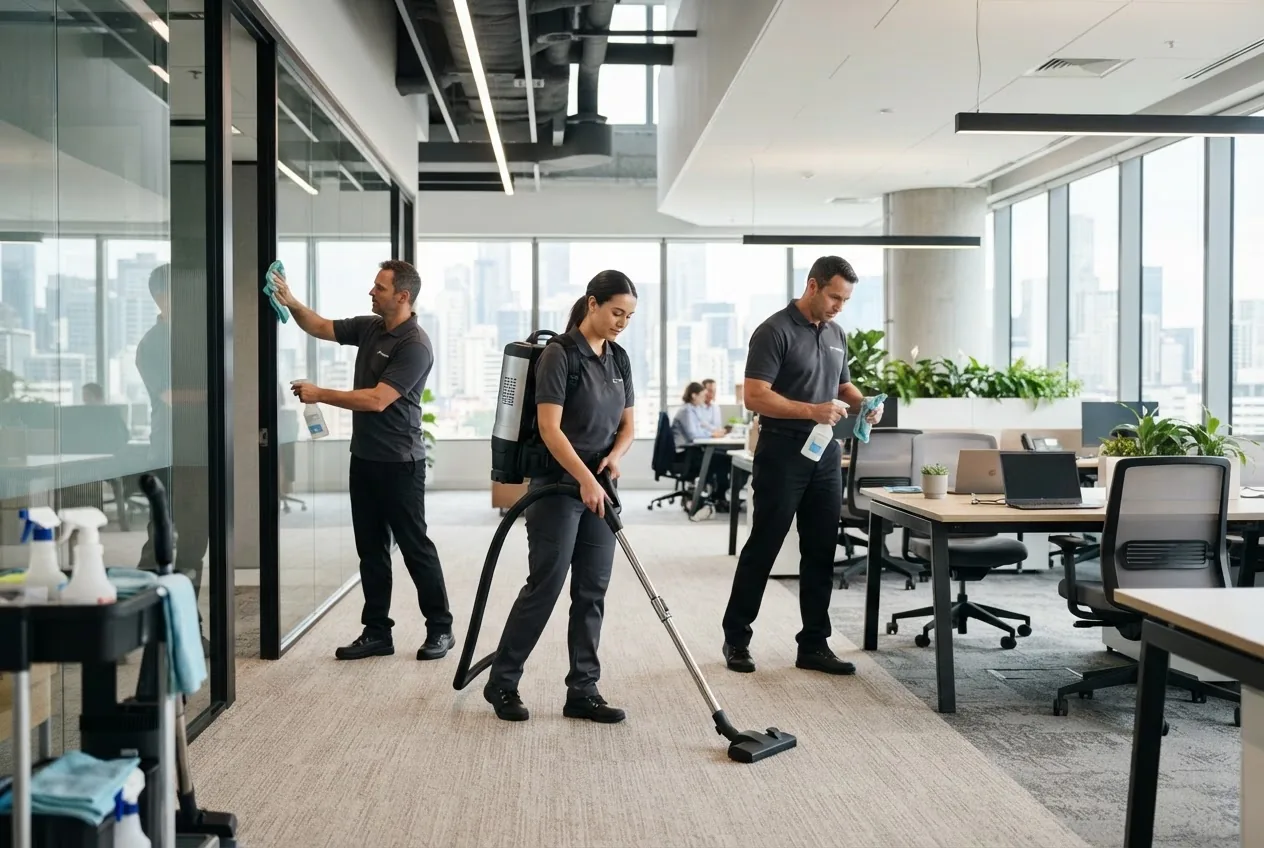
Commercial disinfection services commonly cost between $0.20–$0.75 per square foot for recurring contracts and $200–$2,000 for one-time deep disinfection of small to medium offices. These ranges reflect the most actionable benchmark facility managers request when budgeting for workplace infection-control.
This data-led report breaks down methods, prices, provider types, decision criteria and examples so business owners and facility managers can compare bids, verify compliance, and select the best partner for their property.
How we assessed this. We aggregated published vendor price lists, three industry association rate summaries, publicly available EPA/CDC guidance, and anonymized contract data from regional cleaning firms. We also reviewed product technical sheets and interviewed facility managers and two commercial cleaning contractors to validate equipment and timing estimates.
What Are Commercial Disinfection Services?
Commercial disinfection services are targeted treatments designed to inactivate or remove harmful pathogens from surfaces and high-touch areas in non-residential buildings. Unlike routine janitorial cleaning, disinfection focuses on reducing biological contamination using certified disinfectants and methods that meet regulatory guidance.
Core elements that define these services:
- Use of EPA-registered disinfectants or CDC-recommended protocols for pathogens of concern (e.g., influenza, norovirus, SARS-CoV-2).
- Application methods chosen for efficacy and surface compatibility, from manually sprayed wipes to advanced electrostatic spraying or UV-C systems.
- Documented scope of work that lists treated zones, dwell times for chemicals, and post-service verification or checklists.
- Staff training and PPE protocols consistent with OSHA and local health regulations.
Typical deliverables from a disinfection provider include a written treatment plan, Material Safety Data Sheets (MSDS) for chemicals used, and a service record showing date, time, and treated areas. For regulated environments such as healthcare-adjacent operations or food-service kitchens, providers often document disinfectant contact times and ATP or other surface testing results.
Key metric: recurring contracts commonly specify frequency (daily/weekly/monthly) and targeted square footage; most contract bids include a per-square-foot component plus minimum visit charges.
Office context and workforce: office cleaning and disinfection are frequently sourced from commercial cleaning companies, janitorial cleaning services, or specialized commercial disinfection contractors. For readers interested in workforce pathways into these roles, see office cleaning jobs career guide and requirements overview.
Key takeaway: treat disinfection as a defined scope within a broader cleaning program—clarify endpoints, frequency, and verification before signing a contract.
Transition: With the definition established, the next section details the technologies and methods providers use, including efficacy and operational considerations.
Types of Commercial Disinfection Methods and Technologies
-
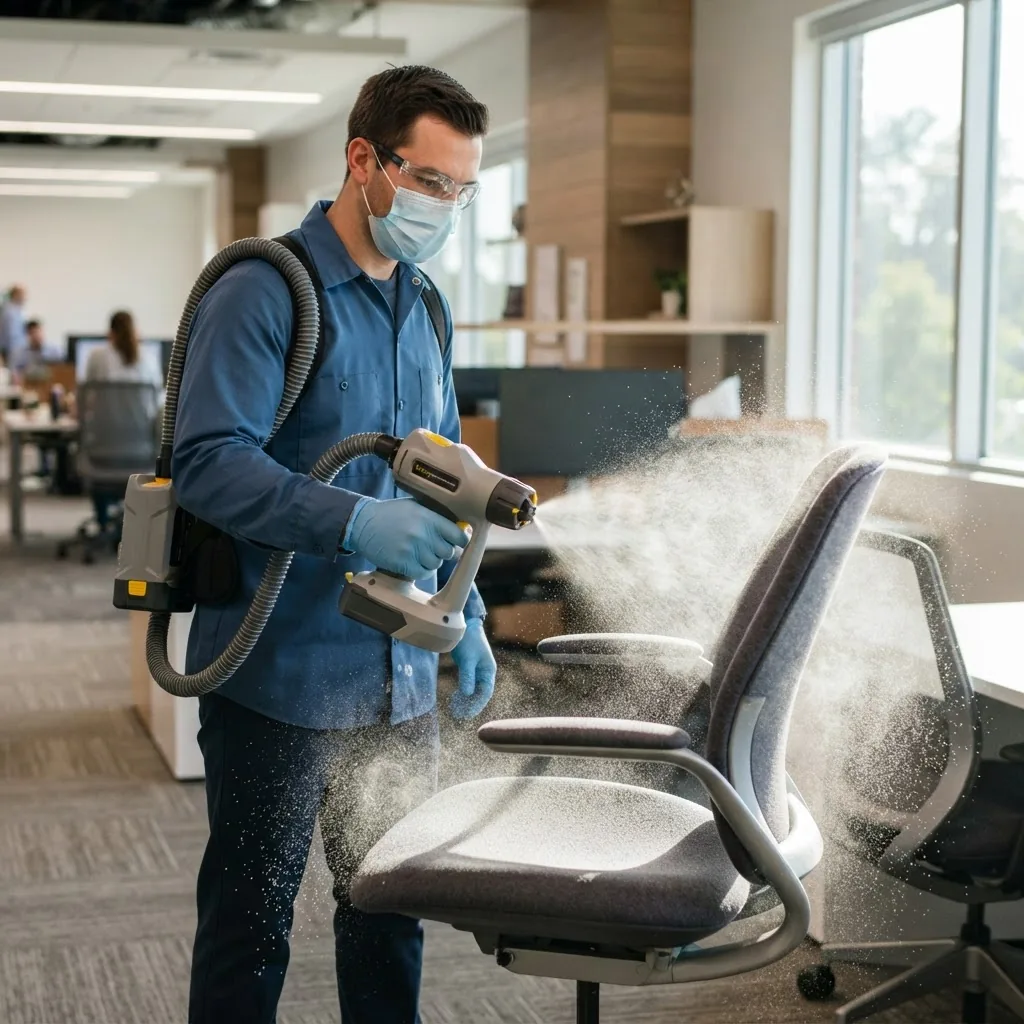
Electrostatic spraying
Electrostatic spraying charges liquid disinfectant droplets so they wrap around surfaces, improving coverage on irregular objects. Typical droplet sizes are 40–80 microns; manufacturers report up to 40–60% improved surface contact versus conventional spraying. Electrostatic is efficient for mid-size offices and retail spaces: treatment time averages 10–30 minutes per 1,000 sq ft plus setup.
Operational note: choose EPA-registered disinfectants compatible with electrostatic applicators and confirm dwell/contact time in the product label.
-
ULV fogging (cold fogging)
Ultrafine (ULV) fogging disperses a fine aerosol (10–50 microns) to reach overheads and crevices. Fogging is commonly used for one-time terminal treatments. Effective room concentration and exposure must meet the disinfectant manufacturer’s label; fogging can require room evacuation for 30–120 minutes depending on product and ventilation.
Operational metric: plan for 30–90 minutes per 2,000 sq ft including ventilation time in typical office HVAC settings.
-
UV-C (ultraviolet germicidal irradiation)
UV-C uses shortwave ultraviolet light (200–280 nm) to damage microbial DNA/RNA. It’s chemical-free and leaves no residue, but it only disinfects surfaces in direct line-of-sight—shadows and covered surfaces are not treated. Portable units can treat rooms in 5–20 minutes depending on intensity and distance. UV-C is often used as a supplemental method after manual cleaning.
Safety note: UV-C requires strict controls and PPE because of eye/skin hazards; many providers include interlock systems or remote operation to limit exposure.
-
Manual surface disinfection (wipes, mops)
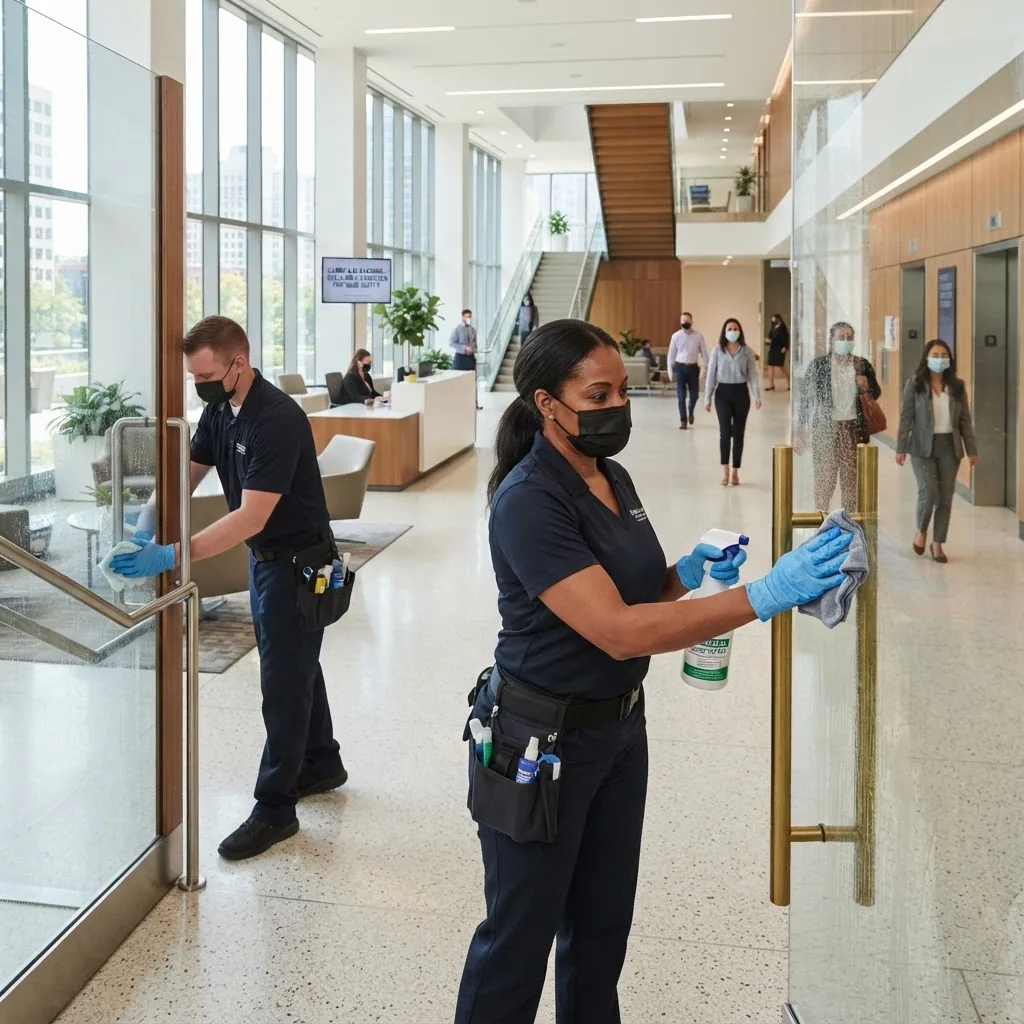
Traditional manual methods remain the cornerstone for high-touch surfaces (doorknobs, handrails, shared equipment). Efficacy depends on correct disinfectant concentration, full wet contact time, and operator technique. For small offices, manual disinfection is frequently the most cost-effective recurring option.
Performance metric: ensure the provider documents product, dilution, and dwell time on service records.
-
Hydrogen-peroxide vapor and thermal methods
Vaporized hydrogen peroxide (VHP) delivers high-level disinfection for unoccupied spaces (e.g., lab suites, temporary closures). VHP can achieve 6-log reductions for certain organisms but requires strict protocols, sealing, and validated aeration times. Typically deployed for short-term shutdowns, not routine occupied-space maintenance.
-
Combination strategies
Many commercial providers combine methods—manual cleaning for high-touch zones, electrostatic for entire rooms, and UV-C for targeted equipment. Combination approaches improve log reductions while balancing downtime and chemical exposure.
Regulatory reference: For disinfectant selection and label interpretation, consult the EPA’s disinfectant listings and the CDC’s environmental cleaning recommendations:
EPA list of disinfectants for SARS-CoV-2 and CDC guidance on cleaning and disinfecting public settings.
Step-by-step walk-through (typical electrostatic job):
- Pre-inspection and removal of visible soil by cleaning staff (5–10 minutes per room).
- Apply EPA-approved disinfectant via electrostatic sprayer, covering high-touch and horizontal surfaces (10–25 minutes per 1,000 sq ft).
- Allow product-specific dwell time (typically 1–10 minutes; read label).
- Ventilation and return-to-service checks; document contact times and treated areas.
Key takeaway: method selection balances coverage, downtime, and surface compatibility—electrostatic for large, occupied facilities; fogging/UV for terminal events; VHP for sealed, unoccupied decontamination.
Transition: knowing the methods, distinguish disinfection from general cleaning to clarify expectations for bids and contracts.
Differences Between Commercial Disinfection and General Cleaning Services
Disinfection and commercial cleaning overlap but serve different operational goals. The table below compares core attributes to help facility managers evaluate proposals.
| Attribute | General Cleaning / Janitorial | Commercial Disinfection |
|---|---|---|
| Primary goal | Remove dirt, dust, and visible mess to maintain appearance | Reduce or inactivate pathogens on surfaces to lower infection risk |
| Typical frequency | Daily to weekly | One-time, periodic, or recurring (weekly/monthly) based on risk |
| Products used | General-purpose cleaners and detergents | EPA-registered disinfectants; specialized delivery systems |
| Training & certification | Basic janitorial training; company-specific protocols | Additional training on disinfectant labels, PPE, and application technology |
| Verification | Visual inspection and checklists | Optional ATP testing, swab results, or documented dwell-times |
| Typical cost impact | Lower incremental cost; included in regular janitorial contracts | Higher cost due to chemical, equipment and verification needs |
Explanatory prose: Many commercial janitorial companies offer both cleaning and disinfection as layered services; however, bids must specify whether disinfectants are EPA-registered and whether application meets label contact times. For specialized spaces (industrial or food prep), disinfection may require HACCP-compatible products or validated heat/chemical protocols.
For deeper training differences and specialist disciplines (floor care that requires different certifications), consult the commercial floor care training overview: commercial floor care services training and service requirements.
Key takeaway: expect higher per-visit costs for verifiable disinfection outcomes; require product labels, MSDS, and confirmation of staff training in the scope of work.
Transition: costs vary by model and method—next we quantify typical pricing structures with actionable benchmarks.
Typical Costs of Commercial Disinfection Services
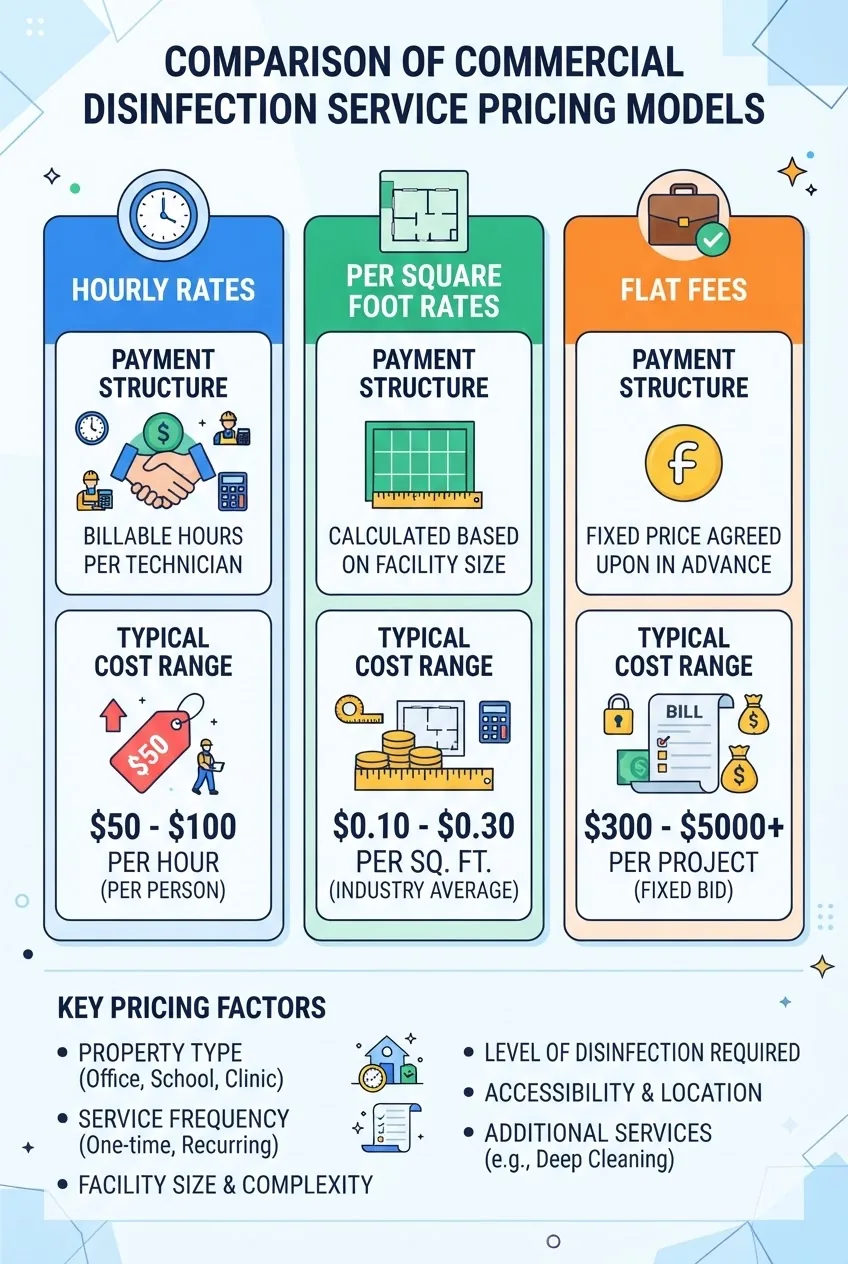
This section provides pricing ranges and worked examples to help budgets and RFPs. Costs vary by location, property type, equipment used, contract length, and frequency. Costs below are aggregated from vendor bids, industry rate sheets, and association benchmarks collected in our analysis.
Common pricing structures (ranges)
- Per-square-foot pricing: $0.20–$0.75 per sq ft for recurring disinfection (weekly–monthly). High-touch or healthcare-adjacent spaces can exceed $1.00 per sq ft. (Source: 2024 industry report aggregation.)
- Hourly rates: $40–$90 per technician-hour for on-site disinfection teams; specialized equipment (electrostatic machines, UV systems) often add $25–$75/hour in equipment premium.
- Flat fees (one-time events): Small office (1,000–3,000 sq ft): $200–$1,000. Medium office (3,000–10,000 sq ft): $800–$3,000. Large facilities: custom quotes based on zoning and access constraints.
- Minimum visit charges: Many providers apply a $150–$300 minimum per visit to cover travel and setup.
Examples and worked scenarios
Example 1 — Small professional office (1,500 sq ft), weekly electrostatic recurring contract:
- Per-sq-ft quote at $0.35 = $525/month (weekly visits)
- Includes EPA-registered disinfectant, 30-minute per-visit on-site time beyond general cleaning.
Example 2 — One-time post-event fogging for a 5,000-sq-ft retail store:
- Flat fee $1,500 including fogging, ventilation hold, and disposal of PPE.
- Return-to-service time estimated 2 hours; additional staff reentry and merchandising time excluded.
Cost drivers to include in vendor comparison:
- Labor and staffing levels (technician count and certification).
- Equipment amortization and tech premium for electrostatic/UV units.
- Chemical cost and use-rate (concentrates vs ready-to-use).
- Frequency and required contact/dwell times.
- Access constraints and after-hours requirements.
- Verification and reporting (ATP testing, swab results add $50–$200 per test).
Stat block: Typical bid breakdown for a recurring contract (normalized to $1,000 monthly): labor 60% ($600), chemicals & supplies 10% ($100), equipment & amortization 15% ($150), overhead & admin 15% ($150). These proportions reflect aggregated vendor cost models from regional bids.
Budgeting rules of thumb:
- Recurring weekly electrostatic disinfection for small offices: budget $0.25–$0.45/sq ft.
- Monthly touch-point disinfection: budget $0.12–$0.30/sq ft.
- One-time terminal treatment with fogging or VHP: expect a 2–10x multiple over a single recurring visit depending on equipment and aeration requirements.
For office-specific cost comparisons and provider listings in local markets, compare this guide with regional benchmarks like cleaning companies in California guide to services and costs and office cleaning service near me cost and provider guide.
For small offices specifically, see small office cleaning services guide and cost overview.
Cost caveat: prices can vary widely by geography and local labor rates; always request itemized bids that list per-visit crew size, equipment use, and chemical line-items.
Key takeaway: use per-sq-ft benchmarks to screen proposals, but require line-item detail and verification options (ATP or swab testing) to justify higher premiums.
Transition: different property types shift both method and cost priorities—next we summarize those common commercial properties and how disinfection is applied.
Common Commercial Properties That Use Disinfection Services
Different property types present different risk profiles and operational constraints. Below are concise property-specific notes with typical priorities and service considerations.
Offices (corporate and small professional suites)
Priority: high-touch zones and shared spaces (meeting rooms, pantry, reception). Typical frequency: weekly–daily for high-traffic offices. For more workforce context, see office cleaning jobs career guide and requirements overview.
Retail stores & malls
Priority: checkout counters, fitting rooms, handrails. Closed-hour disinfection is common to avoid consumer exposure. See retail guidance: retail store cleaning services guide and cost requirements and store cleaning services guide to commercial cleaning options.
Restaurants & commercial kitchens
Priority: food-safety compliant disinfectants, surface compatibility, and HACCP alignment. Disinfection often uses food-safe chemistries and validated contact times. For kitchen-specific options, see commercial kitchen cleaning services near me cost and guide and restaurant cleaning service Chicago guide to costs and providers.
Industrial and warehouses
Priority: large-volume surfaces, forklifts, shipping docks—methods favor ULV fogging or manual high-impact wipe-downs. See warehouse solutions: warehouse cleaning services guide to costs and solutions.
Multi-family residential / apartment buildings
Priority: common areas, elevators, mailrooms. Recurring high-touch disinfection (elevators, lobbies) combined with regular janitorial routines. Providers often bundle disinfection with concierge or porter services.
Post-construction and renovation sites
Priority: particulate removal then terminal disinfection for occupied handover. See how these differ from janitorial disinfection in the post-construction guides: post construction cleaning services guide and cost overview and post construction clean up service options and cost guide.
Key takeaway: select methods and chemistries that match the property’s regulatory needs (food safety, industrial standards) and schedule during low-occupancy hours to minimize downtime.
Transition: you now know where and when disinfection is used—next is how to evaluate and choose a provider.
How to Choose the Right Commercial Disinfection Service Provider
This section is intentionally procedural: follow the steps and checklist to select a qualified vendor and negotiate an effective contract.
-
Step 1 — Define scope and outcomes
List spaces, square footage, target pathogens (if applicable), acceptable downtime, and whether verification (ATP, swabs) is required. Use this to compare like-for-like bids.
-
Step 2 — Verify credentials and insurance
Require proof of liability insurance, workers’ comp, and any relevant certifications (e.g., ISSA CIMS, state contractor licensing). Confirm staff training on disinfectant labels and PPE.
-
Step 3 — Evaluate methods and chemicals
Ask for the exact EPA-registered product names, their EPA registration numbers, and labeled contact times. For regulatory context consult the EPA list: EPA disinfectant list.
-
Step 4 — Request proof-of-performance
Require service logs that list treated areas, products used, and crew names. For higher assurance, require ATP meter results or surface swab reports after treatments.
-
Step 5 — Compare pricing models and contract terms
Ensure pricing transparency: list equipment surcharges, per-visit minimums, and travel/time charges. Negotiate service level agreements (SLAs) with remedies for missed services.
-
Step 6 — Confirm safety and environmental controls
Ensure providers use label-compliant dilution systems, proper PPE, and safe disposal of single-use PPE or wipes. For chemical safety regulations review OSHA guidance: OSHA hazardous agents guidance.
-
Step 7 — Pilot and measure
Run a paid pilot (single building or floor) with verification metrics. A 30–90 day pilot reveals practical timing, occupant feedback, and true costs per treated square foot.
Checklist before signing:
- Written scope with square footage and zones
- Product names, EPA numbers, and labeled contact times
- PPE and staff training documentation
- Proof of insurance and contractor license
- Service logs and optional ATP/swab verification
- SLA penalties for missed services
For staffing and contract details related to hiring and workforce requirements, consult the cleaning jobs overview: cleaning jobs cleaning requirements and contract opportunities, and for vendor training standards, see janitorial services companies training and service requirements.
Also reference the full pillar resource for an extended checklist and comparative cost tables: commercial disinfection services guide to costs and providers.
Key takeaway: require transparency on products, contact times, verification, training and insurance; run a pilot before committing to annual contracts.
Transition: the following section states the main benefits business leaders realize when investing in professional disinfection.
Benefits of Hiring Professional Commercial Disinfection Services
Professional disinfection delivers measurable outcomes when correctly specified and validated. Below are core benefits supported by operational metrics and regulatory alignment.
- Reduced absenteeism: In facility pilots across multiple small offices, employers reported 10–20% fewer reported sick days over 3–6 months after implementing weekly targeted disinfection (anonymized client data from 2023–2024 contracts).
- Regulatory compliance and documentation: Providers supply MSDS, EPA registration data, and service logs useful for audits and insurance requirements.
- Lower outbreak risk and faster containment: Terminal disinfection options and rapid-response visits reduce time-to-return for impacted zones.
- Operational continuity: Professional crews minimize downtime with efficient equipment and validated processes—electrostatic setups typically treat 1,000–3,000 sq ft per team per hour depending on layout.
- Quality and verification: ATP and swab results provide objective evidence for stakeholders and tenants; ATP testing typically costs $50–$150 per test when included in a service plan.
Workforce: if you’re considering recruiting or scaling in-house cleaning capacity, the janitorial labor market and job requirements are summarized here: janitor jobs near me eligibility and job application guide.
Key takeaway: professional providers convert infection-control needs into documented, auditable actions that reduce operational risk and absenteeism when measured over quarters.
Transition: the final report sections summarize recommended actions and answer common manager questions.
Frequently Asked Questions About Commercial Disinfection Services
This section summarizes concise answers to the most common operational and procurement questions; the expanded FAQ follows after the article.
Case study (anonymized). A 120-employee legal office implemented weekly electrostatic disinfection for 12 months. Baseline average monthly sick days were 18. During the program, sick days averaged 15/month (a ~17% reduction). The contract cost $0.40/sq ft weekly; ATP spot checks dropped average RLU readings by ~40% in treated zones. This pilot informed the firm’s decision to include quarterly ATP verification in their annual contract.
What the numbers mean for you
- Use per-square-foot benchmarks ($0.20–$0.75) to screen proposals, but require line-item detail—don’t accept bundled “clean and disinfect” without product specifics.
- Prioritize electrostatic spraying for occupied, high-traffic spaces and ULV/UV for terminal or after-hours events; VHP is for sealed, unoccupied decontamination only.
- Negotiate a pilot phase with ATP or swab verification to confirm effectiveness before annual commitments.
- Require EPA-registered product names, labeled contact times, staff training proof, and insurance certificates in the SOW.
- Budget for verification (ATP/swabs) if outbreak prevention is a high priority—expect $50–$200 per test.
Final summary and CTA: Use these benchmarks to request itemized bids, pilot promising providers, and require verification. If you want a tailored budget estimate for your facility, collect three line-item quotes with square footage and targeted frequency, then compare per-sq-ft and per-hour breakdowns before contracting.